Wei Meng, Xie Qingyun, Zhu Jun, Wang Tao, Zhang Fan, Cheng Yue, Guo Dongyang, Wang Ying, Mo Liweng, Wang Shuai
Department of Nephrology and Rheumatology, Chengdu Military General Hospital. No. 270, Rongdu Avenue, Jinniu District, Chengdu, Sichuan, 610083, P.R. China.
Department of Orthopaedics, Chengdu Military General Hospital. No. 270, Rongdu Avenue, Jinniu District, Chengdu, Sichuan, 610083, P.R. China
Biosci Rep. 2016 May 6;36(3). doi: 10.1042/BSR20160068. Print 2016 Jun.
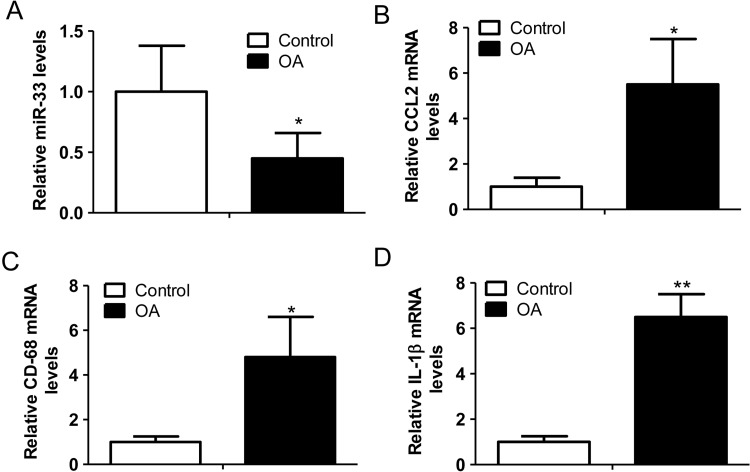
CCL2-mediated macrophage infiltration in articular tissues plays a pivotal role in the development of the osteoarthritis (OA). miRNAs regulate the onset and progression of diseases via controlling the expression of a series of genes. How the CCL2 gene was regulated by miRNAs was still not fully elucidated. In the present study, we demonstrated that the binding sites of miR-33 in the 3'UTR of CCL2 gene were conserved in human, mouse and rat species. By performing gain- or loss-of-function studies, we verified that miR-33 suppressed CCL2 expression in the mRNA and protein levels. We also found that miR-33 suppressed the CCL2 levels in the supernatant of cultured primary mouse chondrocytes. With reporter gene assay, we demonstrated that miR-33 targeted at AAUGCA in the 3'UTR of CCL2 gene. In transwell migration assays, we demonstrated that the conditional medium (CM) from miR-33 deficient chondrocytes potentiated the monocyte chemotaxis in a CCL2 dependent manner. Finally, we demonstrated that the level of miR-33 was decreased, whereas the CCL2 level was increased in the articular cartilage from the OA patients compared with the control group. In summary, we identified miR-33 as a novel suppressor of CCL2 in chondrocytes. The miR-33/CCL2 axis in chondrocytes regulates monocyte chemotaxis, providing a potential mechanism of macrophage infiltration in OA.
CCL2介导的巨噬细胞浸润在关节组织中对骨关节炎(OA)的发展起着关键作用。微小RNA(miRNA)通过控制一系列基因的表达来调节疾病的发生和发展。miRNA如何调控CCL2基因仍未完全阐明。在本研究中,我们证明了CCL2基因3'非翻译区(UTR)中miR-33的结合位点在人、小鼠和大鼠物种中是保守的。通过进行功能获得或功能缺失研究,我们证实miR-33在mRNA和蛋白质水平上抑制CCL2的表达。我们还发现miR-33抑制原代小鼠软骨细胞培养上清液中的CCL2水平。通过报告基因检测,我们证明miR-33靶向CCL2基因3'UTR中的AAUGCA。在Transwell迁移实验中,我们证明来自miR-33缺陷软骨细胞的条件培养基(CM)以CCL2依赖的方式增强单核细胞趋化性。最后,我们证明与对照组相比,OA患者关节软骨中miR-33水平降低,而CCL2水平升高。总之,我们确定miR-33是软骨细胞中CCL2的新型抑制剂。软骨细胞中的miR-33/CCL2轴调节单核细胞趋化性,为OA中巨噬细胞浸润提供了潜在机制。