Donaldson Robin, Sun Yuan, Liang De-Yong, Zheng Ming, Sahbaie Peyman, Dill David L, Peltz Gary, Buck Kari J, Clark J David
Department of Computer Science, Stanford University, Stanford, CA, USA.
Anesthesiology Service, Veterans Affairs Palo Alto Health Care System, 3801 Miranda Ave., Anesthesiology, 112A, Palo Alto, CA, 94304, USA.
BMC Genomics. 2016 Apr 29;17:313. doi: 10.1186/s12864-016-2634-1.
Opioids are a mainstay for the treatment of chronic pain. Unfortunately, therapy-limiting maladaptations such as loss of treatment effect (tolerance), and paradoxical opioid-induced hyperalgesia (OIH) can occur. The objective of this study was to identify genes responsible for opioid tolerance and OIH.
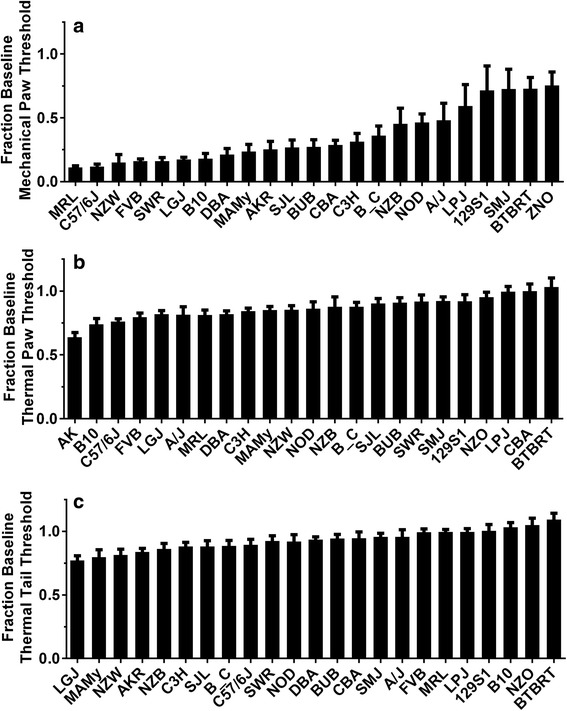
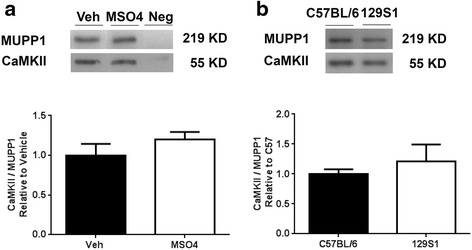
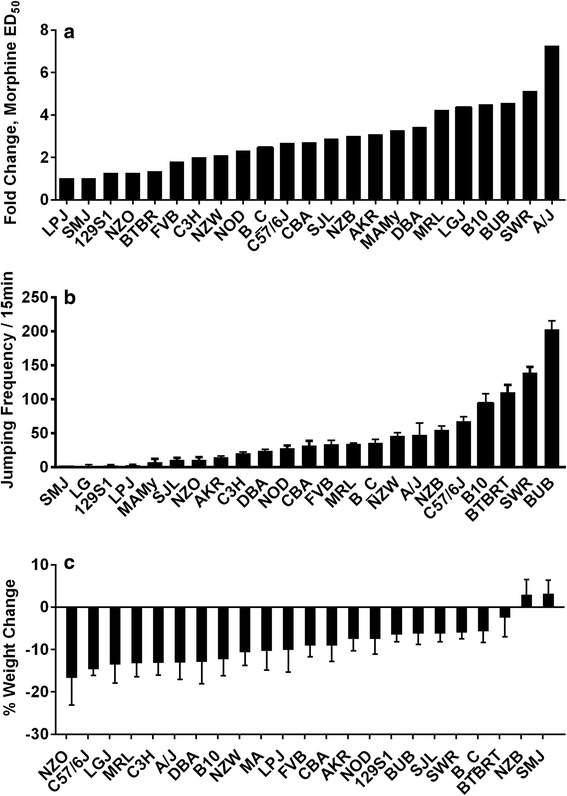
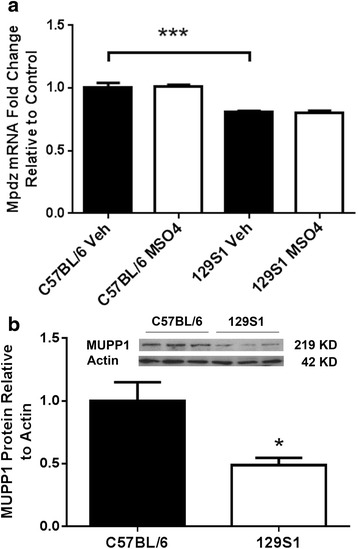
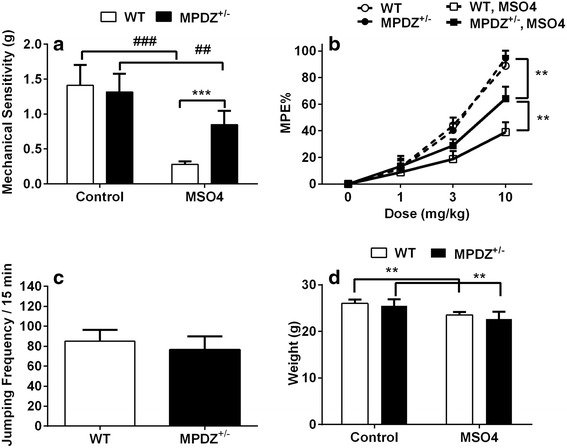
These studies used a well-established model of ascending morphine administration to induce tolerance, OIH and other opioid maladaptations in 23 strains of inbred mice. Genome-wide computational genetic mapping was then applied to the data in combination with a false discovery rate filter. Transgenic mice, gene expression experiments and immunoprecipitation assays were used to confirm the functional roles of the most strongly linked gene. The behavioral data processed using computational genetic mapping and false discovery rate filtering provided several strongly linked biologically plausible gene associations. The strongest of these was the highly polymorphic Mpdz gene coding for the post-synaptic scaffolding protein Mpdz/MUPP1. Heterozygous Mpdz +/- mice displayed reduced opioid tolerance and OIH. Mpdz gene expression and Mpdz/MUPP1 protein levels were lower in the spinal cords of low-adapting 129S1/Svlm mice than in high-adapting C57BL/6 mice. Morphine did not alter Mpdz expression levels. In addition, association of Mpdz/MUPP1 with its known binding partner CaMKII did not differ between these high- and low-adapting strains.
The degrees of maladaptive changes in response to repeated administration of morphine vary greatly across inbred strains of mice. Variants of the multiple PDZ domain gene Mpdz may contribute to the observed inter-strain variability in tolerance and OIH by virtue of changes in the level of their expression.
阿片类药物是治疗慢性疼痛的主要手段。不幸的是,可能会出现治疗效果丧失(耐受性)和矛盾的阿片类药物诱导的痛觉过敏(OIH)等限制治疗的适应性变化。本研究的目的是确定导致阿片类药物耐受性和OIH的基因。
这些研究使用了一种成熟的递增吗啡给药模型,以在23个近交系小鼠品系中诱导耐受性、OIH和其他阿片类药物适应性变化。然后将全基因组计算遗传图谱与错误发现率过滤器相结合应用于数据。使用转基因小鼠、基因表达实验和免疫沉淀试验来确认最紧密相关基因的功能作用。使用计算遗传图谱和错误发现率过滤处理的行为数据提供了几个紧密相关的生物学上合理的基因关联。其中最强的是编码突触后支架蛋白Mpdz/MUPP1的高度多态性Mpdz基因。杂合子Mpdz +/-小鼠表现出较低的阿片类药物耐受性和OIH。低适应性的129S1/Svlm小鼠脊髓中的Mpdz基因表达和Mpdz/MUPP1蛋白水平低于高适应性的C57BL/6小鼠。吗啡不会改变Mpdz的表达水平。此外,在这些高适应性和低适应性品系之间,Mpdz/MUPP1与其已知结合伴侣CaMKII的关联没有差异。
不同近交系小鼠对重复给予吗啡的适应性变化程度差异很大。多个PDZ结构域基因Mpdz的变体可能因其表达水平的变化而导致观察到的耐受性和OIH的品系间变异性。