Du Jian, Shen Ning, He Hai-Shan, Fu Xiao-Lan, Wang Jing-Zhong, Mao Chong-Zhou
Department of General Surgery, Suining Municipal Hospital of Traditional Chinese Medicine, Suining, 629000, Sichuan, China.
World J Surg Oncol. 2016 Apr 29;14:130. doi: 10.1186/s12957-016-0882-9.
A study was conducted to investigate the clinicopathological features and survival outcomes of gastrointestinal stromal tumors (GISTs) that are synchronous with other gastrointestinal cancers.
Clinical and pathological data of 286 patients with primary GIST from a single institution from January 2009 to December 2014 were reviewed.
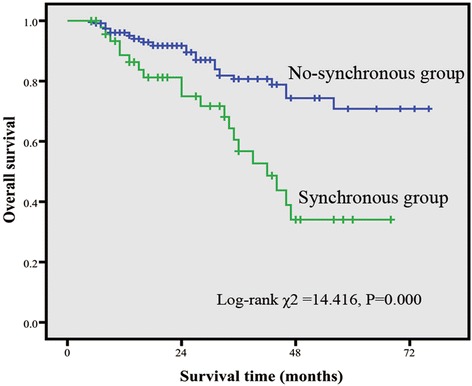
The entire study population comprised 286 patients with GISTs. Of these patients, 167 (58.4%) were males and 119 (41.6%) were females. The median age was 58 years old (in the range 29-86 years). A total of 47 patients were diagnosed with GISTs synchronous with other digestive tract malignancies (synchronous group), whereas 239 patients were diagnosed with non-synchronous disease (non-synchronous group). The concomitant digestive tumors in 27, 12, 7, and 1 patients were diagnosed as gastric carcinoma, esophageal carcinoma, colorectal carcinoma, and pancreatic adenocarcinoma, respectively. Compared with the synchronous group, the non-synchronous group exhibited a higher percentage of increased mitotic count (P = 0.011). The difference in tumor diameter between the two groups was statistically significant (P < 0.001). Patients in the non-synchronous group exhibited larger tumor size than the patients in the synchronous group (5.9 ± 3.5 cm vs. 1.6 ± 0.4 cm, P < 0.001). The majority of GIST lesions in the synchronous group were located in the stomach (P = 0.020). Lower risk stratifications and worse ECOG performance statuses were observed in the synchronous group (P < 0.001) than in the non-synchronous group. The 5-year overall survival rate was significantly higher in patients with no synchronous digestive tract malignancies than in patients with synchronous disease (70.8 vs. 34.1%, P < 0.001).
Patients with GIST synchronous with other gastrointestinal cancers show worse prognosis than those with non-synchronous tumors. Clinicians should pay more attention to this subgroup.
开展了一项研究以调查与其他胃肠道癌症同时发生的胃肠道间质瘤(GIST)的临床病理特征和生存结果。
回顾了2009年1月至2014年12月来自单一机构的286例原发性GIST患者的临床和病理数据。
整个研究人群包括286例GIST患者。其中,男性167例(58.4%),女性119例(41.6%)。中位年龄为58岁(范围29 - 86岁)。共有47例患者被诊断为与其他消化道恶性肿瘤同时发生的GIST(同步组),而239例患者被诊断为非同步疾病(非同步组)。27例、12例、7例和1例患者同时发生的消化肿瘤分别被诊断为胃癌、食管癌、结直肠癌和胰腺腺癌。与同步组相比,非同步组有丝分裂计数增加的百分比更高(P = 0.011)。两组肿瘤直径差异有统计学意义(P < 0.001)。非同步组患者的肿瘤大小大于同步组患者(5.9 ± 3.5 cm对1.6 ± 0.4 cm,P < 0.001)。同步组中大多数GIST病变位于胃(P = 0.020)。与非同步组相比,同步组观察到更低的风险分层和更差的美国东部肿瘤协作组(ECOG)表现状态(P < 0.001)。无同步消化道恶性肿瘤患者的5年总生存率显著高于有同步疾病的患者(70.8%对34.1%,P < 0.001)。
与其他胃肠道癌症同时发生GIST的患者预后比非同步肿瘤患者更差。临床医生应更多关注这一亚组。