Joshi Parag H, Khokhar Arif A, Massaro Joseph M, Lirette Seth T, Griswold Michael E, Martin Seth S, Blaha Michael J, Kulkarni Krishnaji R, Correa Adolfo, D'Agostino Ralph B, Jones Steven R, Toth Peter P
Johns Hopkins Ciccarone Center for the Prevention of Heart Disease, Baltimore, MD Division of Cardiology, University of Texas Southwestern Medical Center, Dallas, TX
Royal Brompton and Harefield NHS Trust, London, UK.
J Am Heart Assoc. 2016 Apr 29;5(5):e002765. doi: 10.1161/JAHA.115.002765.
Remnant lipoproteins (RLPs), the triglyceride-enriched precursors to low-density lipoprotein, are an emerging risk factor for coronary heart disease (CHD). We sought to determine the association of RLP cholesterol (RLP-C) levels with incident CHD in 2 diverse, prospective, longitudinal observational US cohorts.
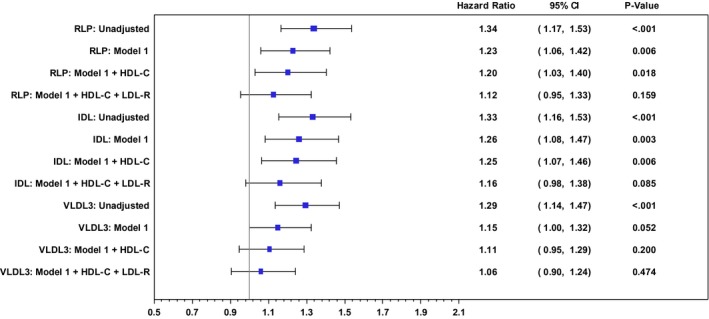
We analyzed cholesterol levels from serum lipoprotein samples separated via density gradient ultracentrifugation in 4114 US black participants (mean age 53.8 years, 64% women) from the Jackson Heart Study and a random sample of 818 predominantly white participants (mean age 57.3 years, 52% women) from the Framingham Offspring Cohort Study. Multivariable-adjusted hazard ratios (HRs) for RLP-C (the sum of very low-density lipoprotein3 cholesterol and intermediate-density lipoprotein cholesterol) were derived to estimate associations with incident CHD events consisting of myocardial infarction, CHD death, and revascularizations for each cohort separately and as a combined population. There were 146 CHD events in the combined population. After adjustments for age, sex, body mass index, smoking, blood pressure, diabetes, and lipid-lowering therapy for the combined population, RLP-C (HR 1.23 per 1-SD increase, 95% CI 1.06-1.42, P<0.01) and intermediate-density lipoprotein cholesterol (HR 1.26 per 1-SD increase, 95% CI 1.08-1.47, P<0.01) predicted CHD during an 8-year follow-up. Associations were attenuated by high-density lipoprotein cholesterol and ultimately lost significance with inclusion of real low-density lipoprotein cholesterol, which excludes Lp(a) and IDL cholesterol fractions. Similar associations were seen in multivariable analyses within each cohort.
RLP-C levels are predictive of incident CHD in this diverse group of primary prevention subjects. Interventions aimed at reducing RLP-C to prevent CHD warrant further intensive investigation.
URL: http://www.ClinicalTrials.gov. Unique identifier: NCT00415415.
残余脂蛋白(RLP)是富含甘油三酯的低密度脂蛋白前体,是冠心病(CHD)的一个新出现的危险因素。我们试图在美国两个不同的前瞻性纵向观察队列中确定RLP胆固醇(RLP-C)水平与CHD发病之间的关联。
我们分析了来自杰克逊心脏研究的4114名美国黑人参与者(平均年龄53.8岁,64%为女性)和弗雷明汉后代队列研究的818名主要为白人的参与者(平均年龄57.3岁,52%为女性)血清脂蛋白样本经密度梯度超速离心分离后的胆固醇水平。得出RLP-C(极低密度脂蛋白3胆固醇和中间密度脂蛋白胆固醇之和)的多变量调整风险比(HR),以分别估计每个队列以及合并人群中与包括心肌梗死、CHD死亡和血运重建在内的CHD发病事件的关联。合并人群中有146例CHD事件。在对合并人群的年龄、性别、体重指数、吸烟、血压、糖尿病和降脂治疗进行调整后,RLP-C(每增加1个标准差,HR为1.23,95%CI为1.06-1.42,P<0.01)和中间密度脂蛋白胆固醇(每增加1个标准差,HR为1.26,95%CI为1.08-1.47,P<0.01)在8年随访期间可预测CHD。高密度脂蛋白胆固醇减弱了这种关联,最终在纳入真正的低密度脂蛋白胆固醇(排除Lp(a)和IDL胆固醇组分)后失去显著性。在每个队列的多变量分析中也观察到类似的关联。
在这一多样化的一级预防人群中,RLP-C水平可预测CHD发病。旨在降低RLP-C以预防CHD的干预措施值得进一步深入研究。