Hoffman Amy J, Brintnall Ruth Ann, Given Barbara A, von Eye Alexander, Jones Lee W, Brown Jean K
Author Affiliations: College of Nursing, Michigan State University, East Lansing (Drs Hoffman and Given); Kirkhof College of Nursing, Grand Valley State University, Grand Rapids, Michigan (Dr Brintnall); and Psychology Department, Michigan State University, East Lansing (Dr von Eye); and Department of Medicine, Memorial Sloan Kettering Cancer Center, New York (Dr Jones); and School of Nursing, University at Buffalo, the State University of New York (Dr Brown).
Cancer Nurs. 2017 Jan/Feb;40(1):1-12. doi: 10.1097/NCC.0000000000000378.
Fatigue remains a prevalent and debilitating symptom in persons with non-small cell lung cancer (NSCLC). Exercise has been shown to be effective in reducing fatigue, yet interventions are limited for postsurgical NSCLC patients. To date, while surgery is offered as a standard curative treatment for NSCLC, no formal guidelines exist for postsurgical rehabilitation.
This study focuses on the design and testing of a postsurgical intervention for NSCLC patients to promote perceived self-efficacy for fatigue self-management targeting cancer-related fatigue (CRF) severity and its associated fatigability through exercise.
A 2-arm randomized controlled trial was used to examine the impact of a 6-week rehabilitative CRF self-management exercise intervention on 37 NSCLC participants compared with 35 control group participants receiving usual care from diagnosis to 6 weeks' postsurgical hospital discharge.
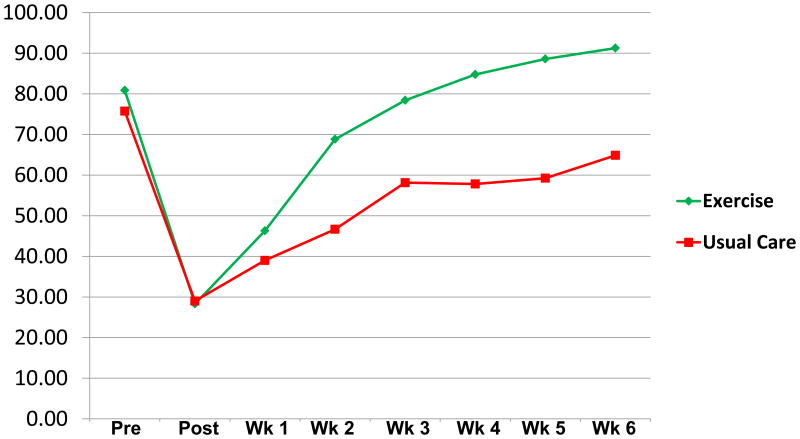
We exceeded goals for recruitment (66%), retention (97%), adherence (93%), and acceptability. Our 6-week exercise intervention demonstrated preliminary efficacy in significantly reducing CRF severity and fatigability as compared with usual care, with mean CRF levels restored to levels lower than presurgery. Likewise, the exercise group's functional performance (physical and mental health scores) exceeded usual care. Furthermore, no adverse events were reported; participants had a mean age of 67 years and a mean of 8 comorbid conditions.
An exercise intervention for postsurgical NSCLC patients is feasible, safe, and highly acceptable showing positive changes in CRF self-management.
To advance practice, testing of the effectiveness of this health-promoting self-management exercise intervention in a larger-scale randomized controlled trial is needed.
疲劳仍是非小细胞肺癌(NSCLC)患者中普遍存在且使人衰弱的症状。运动已被证明对减轻疲劳有效,但针对NSCLC术后患者的干预措施有限。迄今为止,虽然手术是NSCLC的标准治愈性治疗方法,但尚无术后康复的正式指南。
本研究聚焦于为NSCLC患者设计和测试一种术后干预措施,以通过运动提高对疲劳自我管理的感知自我效能,目标是癌症相关疲劳(CRF)的严重程度及其相关的易疲劳性。
采用双臂随机对照试验,研究为期6周的CRF自我管理康复运动干预对37名NSCLC参与者的影响,并与35名从诊断到术后6周出院接受常规护理的对照组参与者进行比较。
我们在招募(66%)、留存(97%)、依从性(93%)和可接受性方面均超出目标。与常规护理相比,我们为期6周的运动干预在显著降低CRF严重程度和易疲劳性方面显示出初步疗效,CRF平均水平恢复到低于术前的水平。同样,运动组的功能表现(身心健康评分)也超过了常规护理。此外,未报告不良事件;参与者的平均年龄为67岁,平均有8种合并症。
对NSCLC术后患者进行运动干预是可行、安全且高度可接受的,在CRF自我管理方面显示出积极变化。
为了推进实践,需要在更大规模的随机对照试验中测试这种促进健康的自我管理运动干预的有效性。