Wang Baojun, Gong Huijie, Zhang Xu, Li Hongzhao, Ma Xin, Song Erlin, Gao Jiangping, Dong Jun
Department of Urology, Chinese PLA General Hospital/Chinese PLA Medical Academy, Beijing, P. R. China.
PLoS One. 2016 May 2;11(5):e0154578. doi: 10.1371/journal.pone.0154578. eCollection 2016.
To evaluate the presentation, management, pathology, and functional and oncological outcomes of patients undergoing retroperitoneoscopic treatment of bilateral synchronous sporadic RCC at our institution.
We retrospectively evaluated the records of 60 patients with bilateral synchronous sporadic RCC who underwent retroperitoneoscopic treatment at the General Hospital of People's Liberation Army from 2008 to 2014. The estimated glomerular filtration rate was calculated and compared among different surgical procedures. The overall survival and recurrence free survival were assessed based on information from recent follow-up.
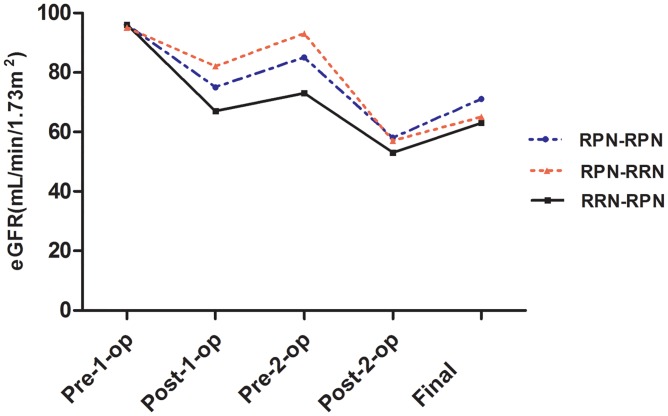
Fifty-six patients underwent bilateral retroperitoneoscopic surgeries in staged procedures, and four patients underwent bilateral retroperitoneoscopic surgeries in simultaneous procedures. Among the former group of patients, 34 underwent bilateral partial nephrectomy, 12 underwent radical nephrectomy followed by partial nephrectomy, and 10 underwent partial nephrectomy followed by radical nephrectomy. Bilateral partial nephrectomy can better preserve renal function (p = 0.040) and the sequence of partial nephrectomy and radical nephrectomy did not affect functional outcomes (p = 0.790). One patient undergoing simultaneous procedures developed acute renal failure and required temporary hemodialysis. At 3 and 5 years, overall survival rates were 93.0% and 89.4%, and recurrence free survival rates were 90.5% and 81.6%. High nuclear grade (p = 0.014) was related to disease recurrence.
Staged bilateral partial nephrectomy was efficient in preserving renal function. The survival of patients with bilateral synchronous sporadic renal tumors was similar to that of patients with unilateral nonmetastatic tumors. Nuclear grade was an independent prognostic factor of disease recurrence.
评估在我院接受后腹腔镜治疗双侧同步散发性肾细胞癌(RCC)患者的临床表现、治疗方法、病理情况以及功能和肿瘤学结局。
我们回顾性评估了2008年至2014年期间在解放军总医院接受后腹腔镜治疗的60例双侧同步散发性RCC患者的记录。计算并比较不同手术方式下的估计肾小球滤过率。根据近期随访信息评估总生存率和无复发生存率。
56例患者分期接受双侧后腹腔镜手术,4例患者同期接受双侧后腹腔镜手术。在前一组患者中,34例行双侧部分肾切除术,12例行根治性肾切除术后行部分肾切除术,10例行部分肾切除术后行根治性肾切除术。双侧部分肾切除术能更好地保留肾功能(p = 0.040),部分肾切除术和根治性肾切除术的顺序不影响功能结局(p = 0.790)。1例同期手术患者发生急性肾衰竭,需要临时血液透析。3年和5年时,总生存率分别为93.0%和89.4%,无复发生存率分别为90.5%和81.6%。高核分级(p = 0.014)与疾病复发相关。
分期双侧部分肾切除术在保留肾功能方面有效。双侧同步散发性肾肿瘤患者的生存率与单侧非转移性肿瘤患者相似。核分级是疾病复发的独立预后因素。