Ballhorn Daniel J, Schädler Martin, Elias Jacob D, Millar Jess A, Kautz Stefanie
Department of Biology, Portland State University, Portland, Oregon, 97201, United States of America.
Helmholtz-Centre for Environmental Research, Dept. Community Ecology, 06120, Halle, Germany.
PLoS One. 2016 May 2;11(5):e0154116. doi: 10.1371/journal.pone.0154116. eCollection 2016.
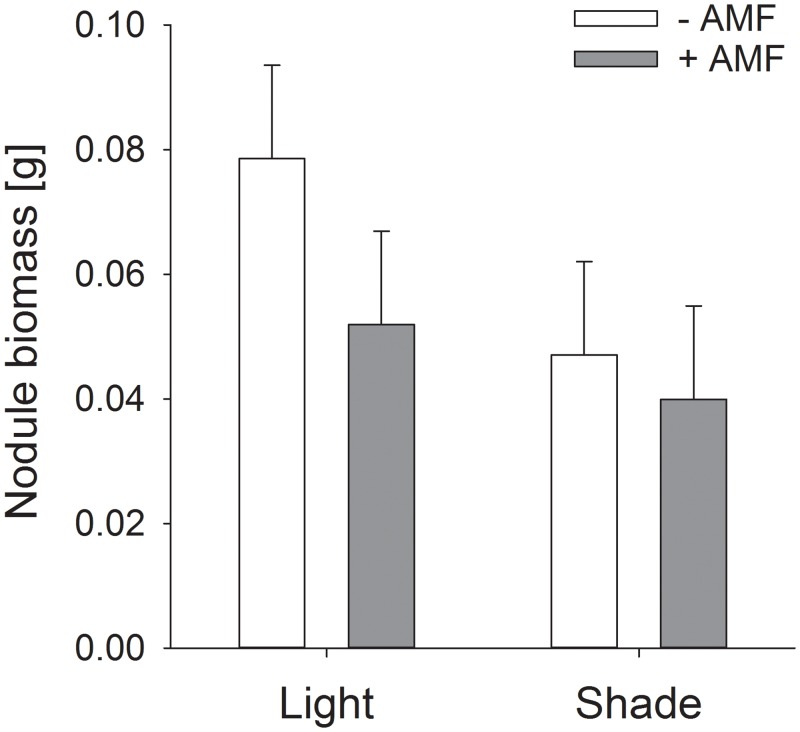
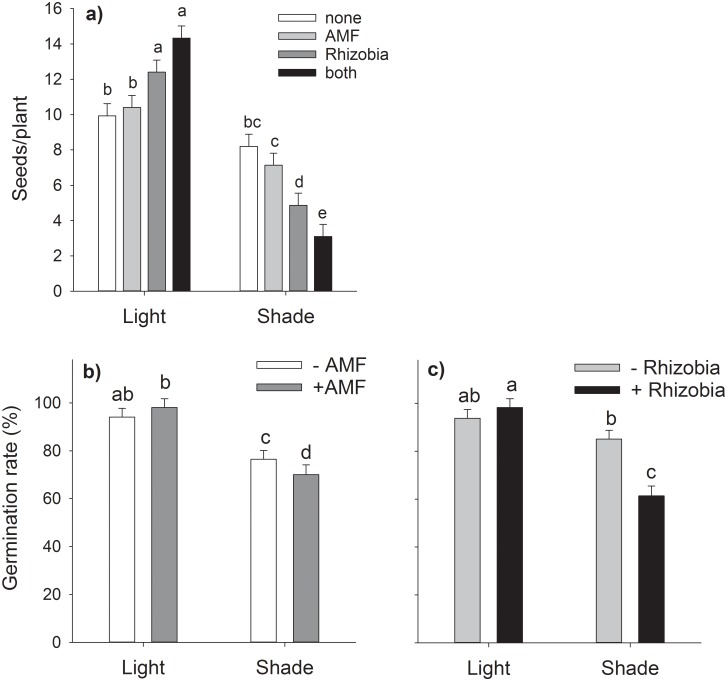
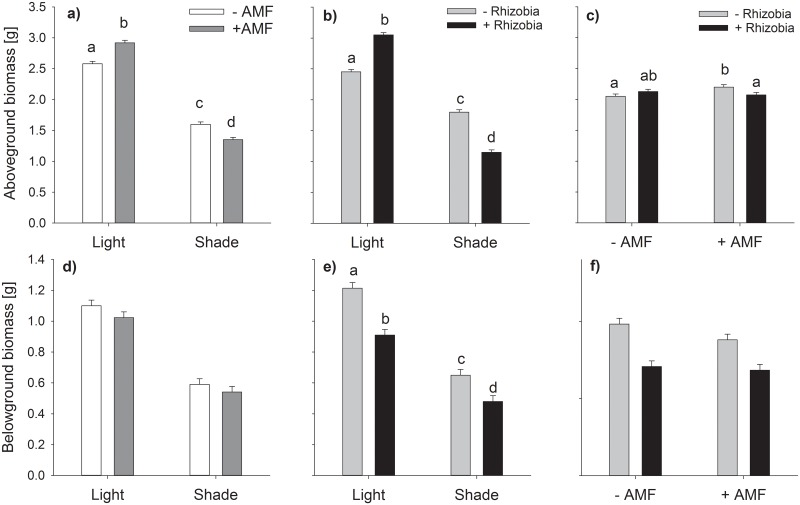
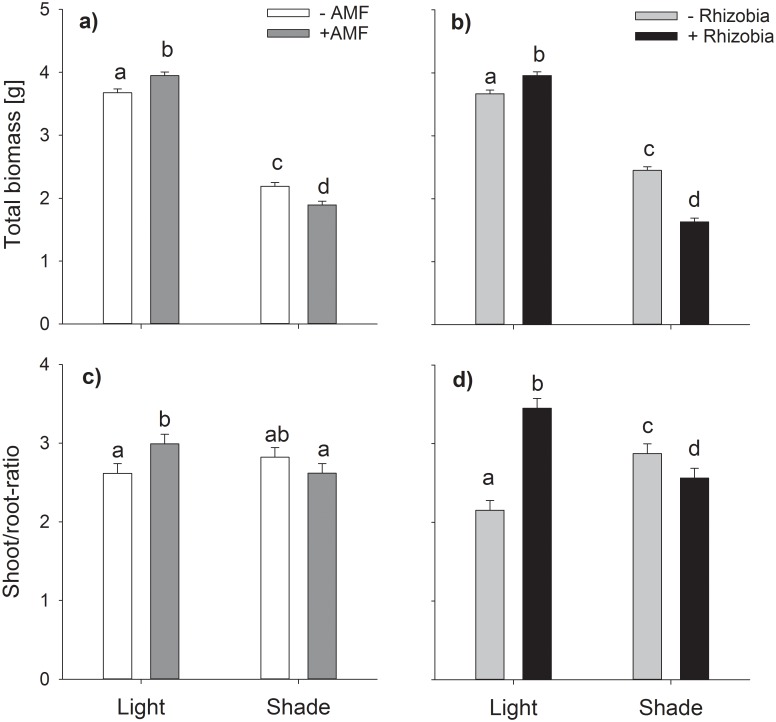
Plant associations with root microbes represent some of the most important symbioses on earth. While often critically promoting plant fitness, nitrogen-fixing rhizobia and arbuscular mycorrhizal fungi (AMF) also demand significant carbohydrate allocation in exchange for key nutrients. Though plants may often compensate for carbon loss, constraints may arise under light limitation when plants cannot extensively increase photosynthesis. Under such conditions, costs for maintaining symbioses may outweigh benefits, turning mutualist microbes into parasites, resulting in reduced plant growth and reproduction. In natural systems plants commonly grow with different symbionts simultaneously which again may interact with each other. This might add complexity to the responses of such multipartite relationships. We experimented with lima bean (Phaseolus lunatus), which efficiently forms associations with both types of root symbionts. We applied full light and low-light to each of four treatments of microbial inoculation. After an incubation period of 14 weeks, we quantified vegetative aboveground and belowground biomass and number and viability of seeds to determine effects of combined inoculant and light treatment on plant fitness. Under light-limited conditions, vegetative and reproductive traits were inhibited in AMF and rhizobia inoculated lima bean plants relative to controls (un-colonized plants). Strikingly, reductions in seed production were most critical in combined treatments with rhizobia x AMF. Our findings suggest microbial root symbionts create additive costs resulting in decreased plant fitness under light-limited conditions.
植物与根部微生物的共生关系是地球上一些最重要的共生现象。固氮根瘤菌和丛枝菌根真菌(AMF)虽然通常对促进植物健康至关重要,但它们也需要植物分配大量碳水化合物以换取关键养分。尽管植物通常可以弥补碳损失,但在光照受限的情况下,当植物无法大幅提高光合作用时,就可能会出现限制因素。在这种情况下,维持共生关系的成本可能会超过收益,使互利共生的微生物变成寄生虫,导致植物生长和繁殖减少。在自然系统中,植物通常同时与不同的共生体生长在一起,这些共生体之间也可能相互作用。这可能会增加这种多部分关系的响应复杂性。我们以利马豆(菜豆)进行实验,它能有效地与这两种根部共生体形成共生关系。我们对四种微生物接种处理分别施加全光照和低光照。经过14周的培养期后,我们对地上和地下的营养生物量以及种子数量和活力进行了量化,以确定接种剂和光照处理组合对植物健康的影响。在光照受限的条件下,接种了AMF和根瘤菌的利马豆植株的营养和生殖性状相对于对照组(未定殖植株)受到了抑制。令人惊讶的是,在根瘤菌×AMF的组合处理中,种子产量的降低最为严重。我们的研究结果表明,根部微生物共生体会产生累加成本,导致在光照受限条件下植物健康状况下降。