Tan Hor-Yue, Wang Ning, Li Sha, Hong Ming, Wang Xuanbin, Feng Yibin
School of Chinese Medicine, Li Ka Shing Faculty of Medicine, The University of Hong Kong, Pokfulam, Hong Kong.
Laboratory of Chinese Herbal Pharmacology, Renmin Hospital, Hubei 442000, China; Hubei Key Laboratory of Wudang Local Chinese Medicine Research, Hubei University of Medicine, Hubei 442000, China.
Oxid Med Cell Longev. 2016;2016:2795090. doi: 10.1155/2016/2795090. Epub 2016 Apr 6.
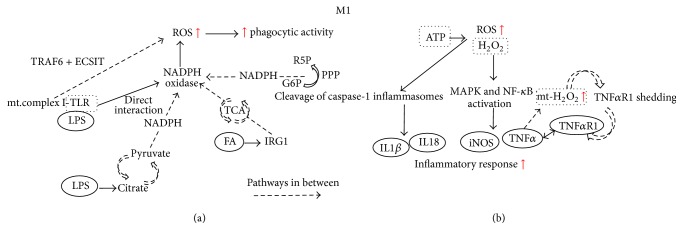
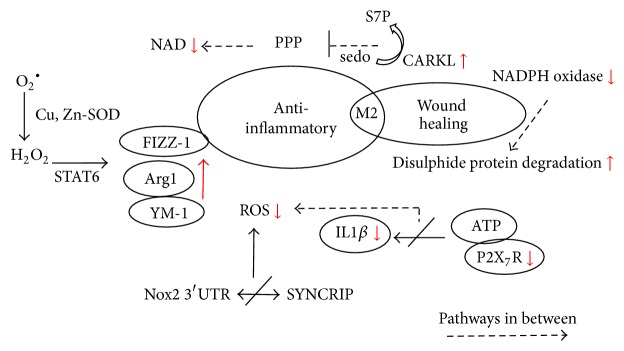
High heterogeneity of macrophage is associated with its functions in polarization to different functional phenotypes depending on environmental cues. Macrophages remain in balanced state in healthy subject and thus macrophage polarization may be crucial in determining the tissue fate. The two distinct populations, classically M1 and alternatively M2 activated, representing the opposing ends of the full activation spectrum, have been extensively studied for their associations with several disease progressions. Accumulating evidences have postulated that the redox signalling has implication in macrophage polarization and the key roles of M1 and M2 macrophages in tissue environment have provided the clue for the reasons of ROS abundance in certain phenotype. M1 macrophages majorly clearing the pathogens and ROS may be crucial for the regulation of M1 phenotype, whereas M2 macrophages resolve inflammation which favours oxidative metabolism. Therefore how ROS play its role in maintaining the homeostatic functions of macrophage and in particular macrophage polarization will be reviewed here. We also review the biology of macrophage polarization and the disturbance of M1/M2 balance in human diseases. The potential therapeutic opportunities targeting ROS will also be discussed, hoping to provide insights for development of target-specific delivery system or immunomodulatory antioxidant for the treatment of ROS-related diseases.
巨噬细胞的高度异质性与其根据环境线索向不同功能表型极化的功能相关。在健康个体中,巨噬细胞处于平衡状态,因此巨噬细胞极化可能对决定组织命运至关重要。经典激活的M1和替代激活的M2这两种不同的细胞群代表了完全激活谱的两端,它们与多种疾病进展的关联已得到广泛研究。越来越多的证据表明,氧化还原信号传导与巨噬细胞极化有关,并且M1和M2巨噬细胞在组织环境中的关键作用为某些表型中活性氧(ROS)丰度的原因提供了线索。主要清除病原体的M1巨噬细胞和ROS可能对M1表型的调节至关重要,而M2巨噬细胞可解决有利于氧化代谢的炎症。因此,本文将综述ROS如何在维持巨噬细胞的稳态功能,特别是巨噬细胞极化中发挥作用。我们还将综述巨噬细胞极化的生物学以及人类疾病中M1/M2平衡的紊乱。还将讨论针对ROS的潜在治疗机会,希望为开发用于治疗ROS相关疾病的靶向特异性递送系统或免疫调节抗氧化剂提供见解。