Dallol Ashraf, Buhmeida Abdelbaset, Al-Ahwal Mahmoud Shaheen, Al-Maghrabi Jaudah, Bajouh Osama, Al-Khayyat Shadi, Alam Rania, Abusanad Atlal, Turki Rola, Elaimi Aisha, Alhadrami Hani A, Abuzenadah Mohammed, Banni Huda, Al-Qahtani Mohammed H, Abuzenadah Adel M
KACST Technology Innovation Center in Personalized Medicine, King Abdulaziz University, P.O. Box 80216, Jeddah, 21589, Kingdom of Saudi Arabia.
Center of Excellence in Genomic Medicine Research, King Abdulaziz University, Jeddah, Kingdom of Saudi Arabia.
J Transl Med. 2016 May 4;14(1):118. doi: 10.1186/s12967-016-0878-9.
Colorectal cancer (CRC) is a heterogeneous disease with different molecular characteristics associated with many variables such as the sites from which the tumors originate or the presence or absence of chromosomal instability. Identification of such variables, particularly mutational hotspots, often carries a significant diagnostic and/or prognostic value that could ultimately affect the therapeutic outcome.
High-throughput mutational analysis of 99 CRC formalin-fixed and paraffin-embedded (FFPE) cases was performed using the Cancer Hotspots Panel (CHP) v2 on the Ion Torrent™ platform. Correlation with survival and other Clinicopathological parameters was performed using Fisher's exact test and Kaplan-Meier curve analysis.
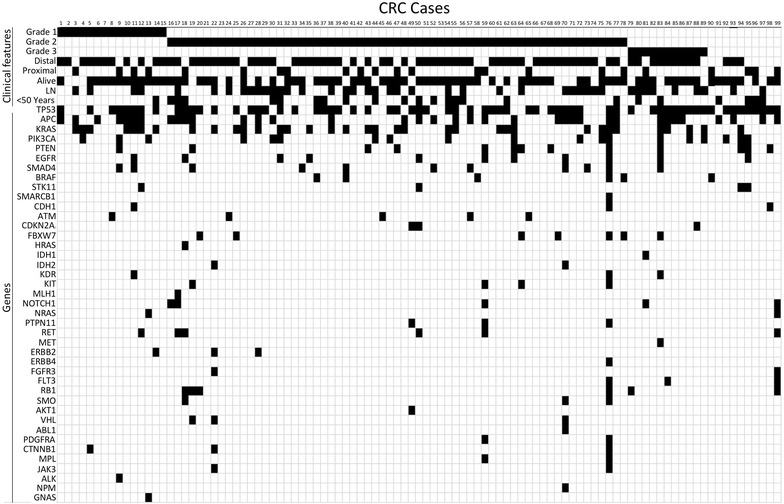
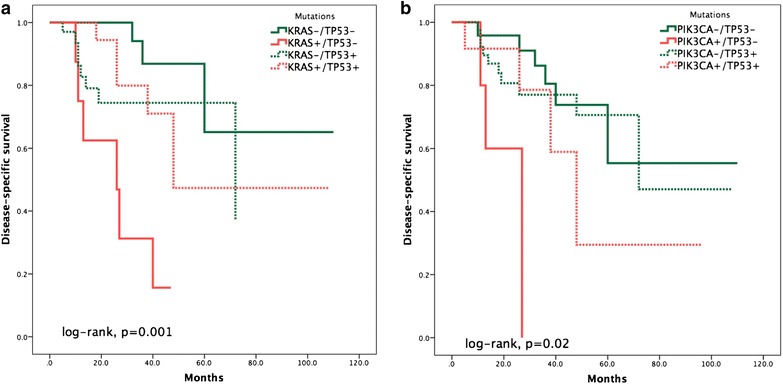
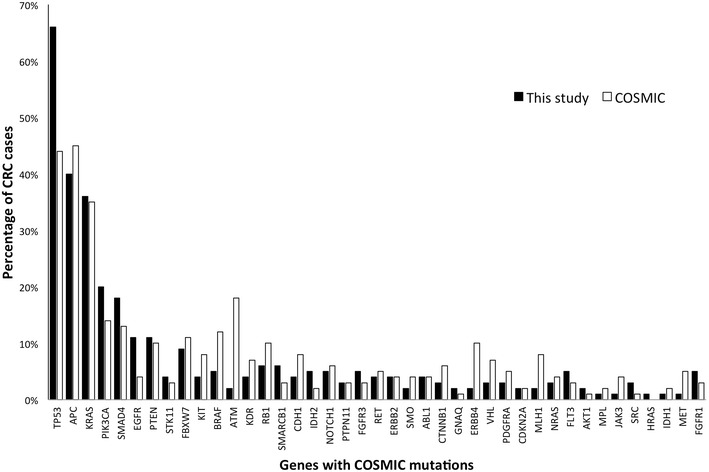
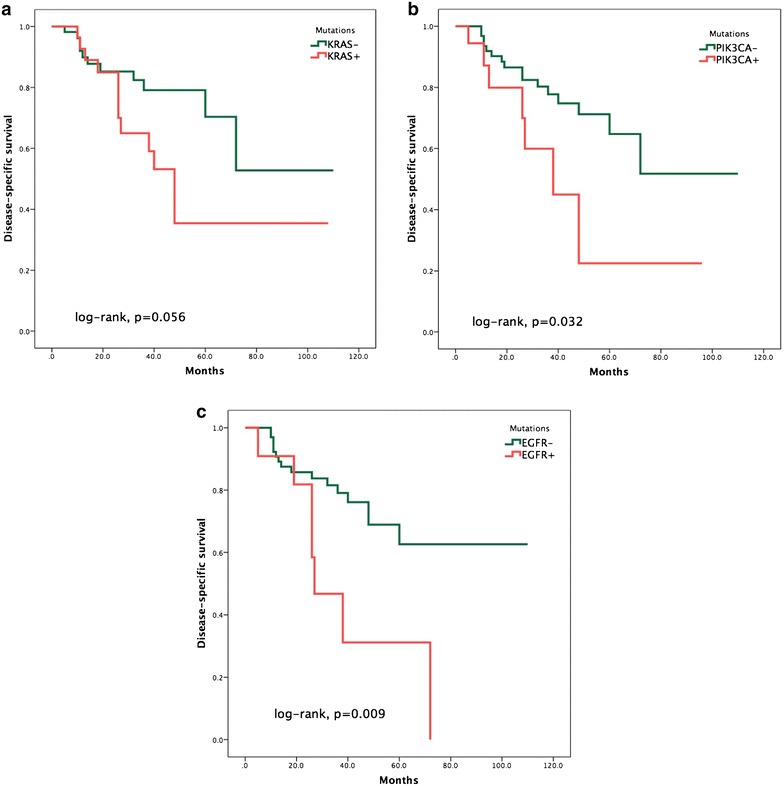
Targeted sequencing lead to the identification of frequent mutations in TP53 (65 %), APC (36 %), KRAS (35 %), PIK3CA (19 %), PTEN (13 %), EGFR (11 %), SMAD4 (11 %), and FBXW7 (7 %). Other genes harbored mutations at lower frequency. EGFR mutations were relatively frequent and significantly associated with young age of onset (p = 0.028). Additionally, EGFR or PIK3CA mutations were a marker for poor disease-specific survival in our cohort (p = 0.009 and p = 0.032, respectively). Interestingly, KRAS or PIK3CA mutations were significantly associated with poor disease-specific survival in cases with wild-type TP53 (p = 0.001 and p = 0.02, respectively).
Frequent EGFR mutations in this cohort as well as the differential prognostic potential of KRAS and PIK3CA in the presence or absence of detectable TP53 mutations may serve as novel prognostic tools for CRC in patients from the Kingdom of Saudi Arabia. Such findings could help in the clinical decision-making regarding therapeutic intervention for individual patients and provide better diagnosis or prognosis in this locality.
结直肠癌(CRC)是一种异质性疾病,具有不同的分子特征,与许多变量相关,如肿瘤起源部位或染色体不稳定性的有无。识别这些变量,尤其是突变热点,通常具有重要的诊断和/或预后价值,最终可能影响治疗结果。
使用Ion Torrent™平台上的癌症热点面板(CHP)v2对99例CRC福尔马林固定石蜡包埋(FFPE)病例进行高通量突变分析。使用Fisher精确检验和Kaplan-Meier曲线分析与生存及其他临床病理参数进行相关性分析。
靶向测序导致识别出TP53(65%)、APC(36%)、KRAS(35%)、PIK3CA(19%)、PTEN(13%)、EGFR(11%)、SMAD4(11%)和FBXW7(7%)中的频繁突变。其他基因的突变频率较低。EGFR突变相对频繁,且与发病年龄较轻显著相关(p = 0.028)。此外,在我们的队列中,EGFR或PIK3CA突变是疾病特异性生存不良的标志物(分别为p = 0.009和p = 0.032)。有趣的是,在TP53野生型病例中,KRAS或PIK3CA突变与疾病特异性生存不良显著相关(分别为p = 0.001和p = 0.02)。
该队列中频繁的EGFR突变以及KRAS和PIK3CA在可检测到或未检测到TP53突变时的不同预后潜力,可能作为沙特阿拉伯王国CRC患者的新型预后工具。这些发现有助于针对个体患者的治疗干预进行临床决策,并在该地区提供更好的诊断或预后。