Xavier Andre Machado, Anunciato Aparecida Kataryna Olimpio, Rosenstock Tatiana Rosado, Glezer Isaias
Department of Biochemistry, Escola Paulista de Medicina, Universidade Federal de São Paulo , São Paulo , Brazil.
Department of Physiological Science, Santa Casa de São Paulo Medical School , São Paulo , Brazil.
Front Endocrinol (Lausanne). 2016 Apr 19;7:31. doi: 10.3389/fendo.2016.00031. eCollection 2016.
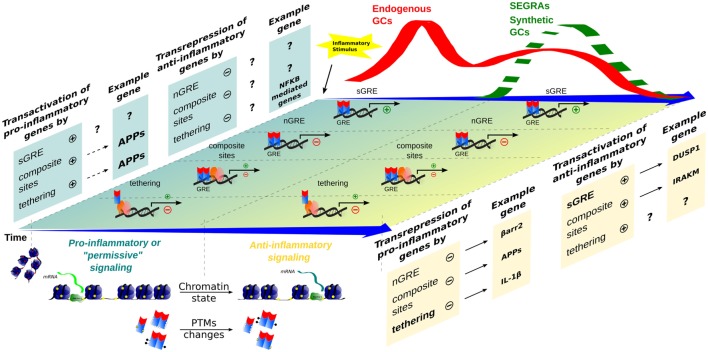
Glucocorticoids (GCs) are potent anti-inflammatory compounds that have been extensively used in clinical practice for several decades. GC's effects on inflammation are generally mediated through GC receptors (GRs). Signal transduction through these nuclear receptors leads to dramatic changes in gene expression programs in different cell types, typically due to GR binding to DNA or to transcription modulators. During the last decade, the view of GCs as exclusive anti-inflammatory molecules has been challenged. GR negative interference in pro-inflammatory gene expression was a landmark in terms of molecular mechanisms that suppress immune activity. In fact, GR can induce varied inhibitory molecules, including a negative regulator of Toll-like receptors pathway, or subject key transcription factors, such as NF-κB and AP-1, to a repressor mechanism. In contrast, the expression of some acute-phase proteins and other players of innate immunity generally requires GR signaling. Consequently, GRs must operate context-dependent inhibitory, permissive, or stimulatory effects on host defense signaling triggered by pathogens or tissue damage. This review aims to disclose how contradictory or comparable effects on inflammatory gene expression can depend on pharmacological approach (including selective GC receptor modulators; SEGRMs), cell culture, animal treatment, or transgenic strategies used as models. Although the current view of GR-signaling integrated many advances in the field, some answers to important questions remain elusive.
糖皮质激素(GCs)是强效抗炎化合物,几十年来一直在临床实践中广泛使用。GCs对炎症的作用通常通过糖皮质激素受体(GRs)介导。通过这些核受体的信号转导会导致不同细胞类型中基因表达程序发生显著变化,这通常是由于GR与DNA或转录调节因子结合所致。在过去十年中,GCs作为唯一抗炎分子的观点受到了挑战。GR对促炎基因表达的负向干扰是抑制免疫活性分子机制方面的一个里程碑。事实上,GR可以诱导多种抑制分子,包括Toll样受体途径的负调节因子,或使关键转录因子如核因子κB(NF-κB)和激活蛋白-1(AP-1)受到抑制机制的作用。相反,一些急性期蛋白和先天免疫的其他参与者的表达通常需要GR信号传导。因此,GRs必须对病原体或组织损伤引发的宿主防御信号产生依赖于背景的抑制、允许或刺激作用。本综述旨在揭示对炎症基因表达的矛盾或可比效应如何取决于药理学方法(包括选择性糖皮质激素受体调节剂;SEGRMs)、细胞培养、动物治疗或用作模型的转基因策略。尽管目前对GR信号传导的观点整合了该领域的许多进展,但一些重要问题的答案仍然难以捉摸。