Isles Anthony R, Ingason Andrés, Lowther Chelsea, Walters James, Gawlick Micha, Stöber Gerald, Rees Elliott, Martin Joanna, Little Rosie B, Potter Harry, Georgieva Lyudmila, Pizzo Lucilla, Ozaki Norio, Aleksic Branko, Kushima Itaru, Ikeda Masashi, Iwata Nakao, Levinson Douglas F, Gejman Pablo V, Shi Jianxin, Sanders Alan R, Duan Jubao, Willis Joseph, Sisodiya Sanjay, Costain Gregory, Werge Thomas M, Degenhardt Franziska, Giegling Ina, Rujescu Dan, Hreidarsson Stefan J, Saemundsen Evald, Ahn Joo Wook, Ogilvie Caroline, Girirajan Santhosh D, Stefansson Hreinn, Stefansson Kari, O'Donovan Michael C, Owen Michael J, Bassett Anne, Kirov George
Cardiff University, MRC Centre for Neuropsychiatric Genetics and Genomics, Institute of Psychological Medicine and Clinical Neurosciences, Cardiff University, Cardiff, United Kingdom.
DeCode Genetics, Reykjavik, Iceland.
PLoS Genet. 2016 May 6;12(5):e1005993. doi: 10.1371/journal.pgen.1005993. eCollection 2016 May.
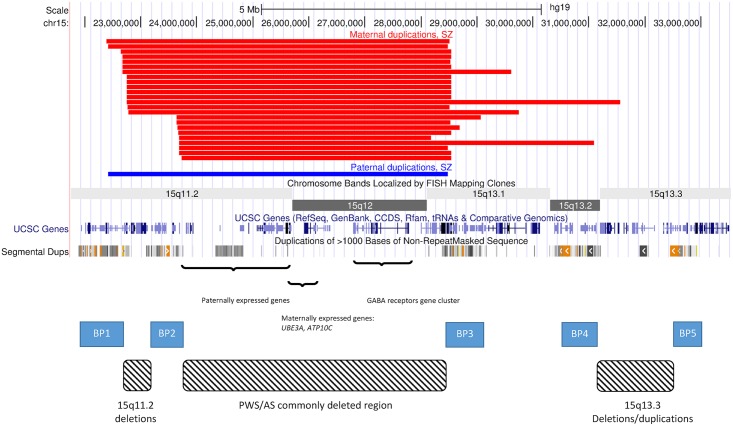
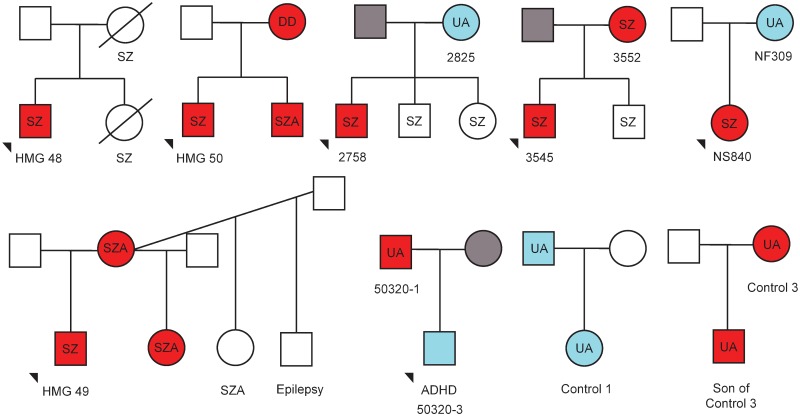
Duplications at 15q11.2-q13.3 overlapping the Prader-Willi/Angelman syndrome (PWS/AS) region have been associated with developmental delay (DD), autism spectrum disorder (ASD) and schizophrenia (SZ). Due to presence of imprinted genes within the region, the parental origin of these duplications may be key to the pathogenicity. Duplications of maternal origin are associated with disease, whereas the pathogenicity of paternal ones is unclear. To clarify the role of maternal and paternal duplications, we conducted the largest and most detailed study to date of parental origin of 15q11.2-q13.3 interstitial duplications in DD, ASD and SZ cohorts. We show, for the first time, that paternal duplications lead to an increased risk of developing DD/ASD/multiple congenital anomalies (MCA), but do not appear to increase risk for SZ. The importance of the epigenetic status of 15q11.2-q13.3 duplications was further underlined by analysis of a number of families, in which the duplication was paternally derived in the mother, who was unaffected, whereas her offspring, who inherited a maternally derived duplication, suffered from psychotic illness. Interestingly, the most consistent clinical characteristics of SZ patients with 15q11.2-q13.3 duplications were learning or developmental problems, found in 76% of carriers. Despite their lower pathogenicity, paternal duplications are less frequent in the general population with a general population prevalence of 0.0033% compared to 0.0069% for maternal duplications. This may be due to lower fecundity of male carriers and differential survival of embryos, something echoed in the findings that both types of duplications are de novo in just over 50% of cases. Isodicentric chromosome 15 (idic15) or interstitial triplications were not observed in SZ patients or in controls. Overall, this study refines the distinct roles of maternal and paternal interstitial duplications at 15q11.2-q13.3, underlining the critical importance of maternally expressed imprinted genes in the contribution of Copy Number Variants (CNVs) at this interval to the incidence of psychotic illness. This work will have tangible benefits for patients with 15q11.2-q13.3 duplications by aiding genetic counseling.
15q11.2 - q13.3区域的重复与普拉德 - 威利/安吉尔曼综合征(PWS/AS)区域重叠,与发育迟缓(DD)、自闭症谱系障碍(ASD)和精神分裂症(SZ)有关。由于该区域存在印记基因,这些重复的亲本来源可能是致病性的关键。母源重复与疾病相关,而父源重复的致病性尚不清楚。为了阐明母源和父源重复的作用,我们对DD、ASD和SZ队列中15q11.2 - q13.3间质性重复的亲本来源进行了迄今为止最大规模、最详细的研究。我们首次表明,父源重复会导致患DD/ASD/多种先天性异常(MCA)的风险增加,但似乎不会增加患SZ的风险。对一些家庭的分析进一步强调了15q11.2 - q13.3重复的表观遗传状态的重要性,在这些家庭中,重复是父源遗传给母亲,母亲未受影响,而她的后代继承了母源重复,患有精神病。有趣的是,15q11.2 - q13.3重复的SZ患者最一致的临床特征是学习或发育问题,在76%的携带者中发现。尽管父源重复的致病性较低,但在一般人群中其发生率较低,一般人群患病率为0.0033%,而母源重复为0.0069%。这可能是由于男性携带者的生育力较低和胚胎的差异存活,这在两种类型的重复在略超过50%的病例中都是新发的这一发现中得到了呼应。在SZ患者或对照中未观察到等臂染色体15(idic15)或间质性三联体。总体而言,本研究细化了15q11.2 - q13.3处母源和父源间质性重复的不同作用,强调了母源表达的印记基因在此区间拷贝数变异(CNV)对精神病发病率的贡献中的关键重要性。这项工作将通过辅助遗传咨询为患有15q11.2 - q13.3重复的患者带来切实益处。