Korwar Sudha, Morris Benjamin L, Parikh Hardik I, Coover Robert A, Doughty Tyler W, Love Ian M, Hilbert Brendan J, Royer William E, Kellogg Glen E, Grossman Steven R, Ellis Keith C
Department of Medicinal Chemistry, School of Pharmacy, The Institute for Structural Biology, Drug Discovery, and Development, and the Massey Cancer Center, Virginia Commonwealth University, Richmond, VA 23298, United States.
Division of Hematology, Oncology, & Palliative Care, Department of Human and Molecular Genetics, and the Massey Cancer Center, Virginia Commonwealth University, Richmond, VA 23298, United States.
Bioorg Med Chem. 2016 Jun 15;24(12):2707-15. doi: 10.1016/j.bmc.2016.04.037. Epub 2016 Apr 20.
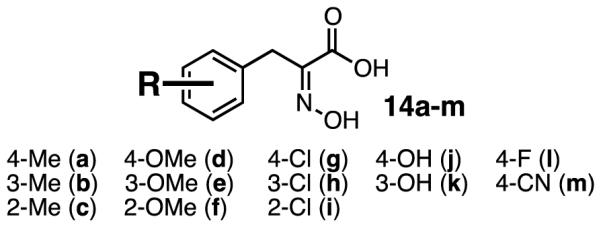
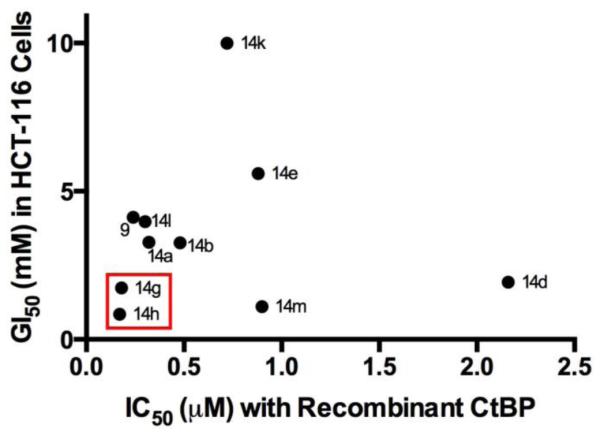
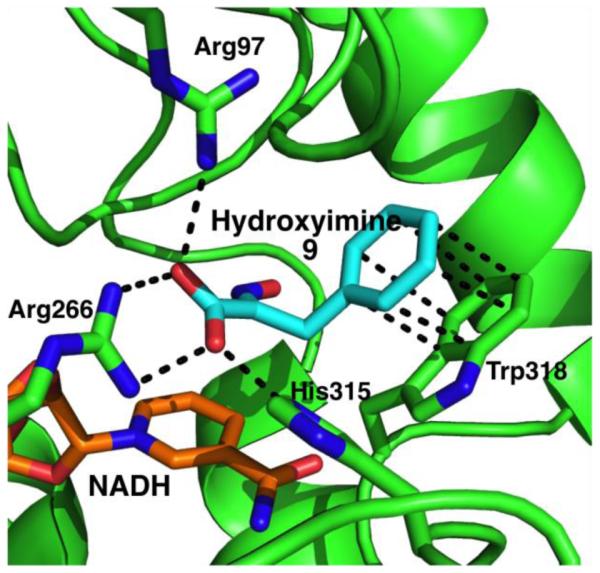
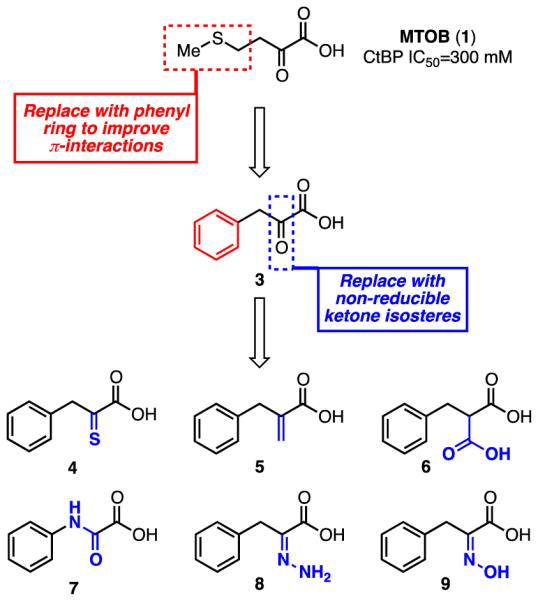
C-terminal Binding Protein (CtBP) is a transcriptional co-regulator that downregulates the expression of many tumor-suppressor genes. Utilizing a crystal structure of CtBP with its substrate 4-methylthio-2-oxobutyric acid (MTOB) and NAD(+) as a guide, we have designed, synthesized, and tested a series of small molecule inhibitors of CtBP. From our first round of compounds, we identified 2-(hydroxyimino)-3-phenylpropanoic acid as a potent CtBP inhibitor (IC50=0.24μM). A structure-activity relationship study of this compound further identified the 4-chloro- (IC50=0.18μM) and 3-chloro- (IC50=0.17μM) analogues as additional potent CtBP inhibitors. Evaluation of the hydroxyimine analogues in a short-term cell growth/viability assay showed that the 4-chloro- and 3-chloro-analogues are 2-fold and 4-fold more potent, respectively, than the MTOB control. A functional cellular assay using a CtBP-specific transcriptional readout revealed that the 4-chloro- and 3-chloro-hydroxyimine analogues were able to block CtBP transcriptional repression activity. This data suggests that substrate-competitive inhibition of CtBP dehydrogenase activity is a potential mechanism to reactivate tumor-suppressor gene expression as a therapeutic strategy for cancer.
C末端结合蛋白(CtBP)是一种转录共调节因子,可下调许多肿瘤抑制基因的表达。利用CtBP与底物4-甲基硫代-2-氧代丁酸(MTOB)和NAD(+)的晶体结构作为指导,我们设计、合成并测试了一系列CtBP的小分子抑制剂。从我们的第一轮化合物中,我们鉴定出2-(羟基亚氨基)-3-苯基丙酸为一种有效的CtBP抑制剂(IC50 = 0.24μM)。对该化合物的构效关系研究进一步确定4-氯-(IC50 = 0.18μM)和3-氯-(IC50 = 0.17μM)类似物为另外的有效CtBP抑制剂。在短期细胞生长/活力测定中对羟基亚胺类似物的评估表明,4-氯-和3-氯-类似物分别比MTOB对照强2倍和4倍。使用CtBP特异性转录读数的功能性细胞测定表明,4-氯-和3-氯-羟基亚胺类似物能够阻断CtBP转录抑制活性。该数据表明,CtBP脱氢酶活性的底物竞争性抑制是重新激活肿瘤抑制基因表达作为癌症治疗策略的潜在机制。