Bartlett Jacquelaine, Predazzi Irene M, Williams Scott M, Bush William S, Kim Yeunjung, Havas Stephen, Toth Peter P, Fazio Sergio, Miller Michael
Department of Genetics, Geisel School of Medicine, Dartmouth College, Hanover, NH.
Knight Cardiovascular Institute, Oregon Health & Science University, Portland, OR.
Circ Cardiovasc Qual Outcomes. 2016 May;9(3):206-212. doi: 10.1161/CIRCOUTCOMES.115.002436. Epub 2016 May 10.
Although the inverse association between high-density lipoprotein cholesterol (HDL-C) and risk of cardiovascular disease (CVD) has been long established, it remains unclear whether low HDL-C remains a CVD risk factor when levels of low-density lipoprotein cholesterol (LDL-C) and triglycerides (TG) are not elevated. This is a timely issue because recent studies have questioned whether HDL-C is truly an independent predictor of CVD.
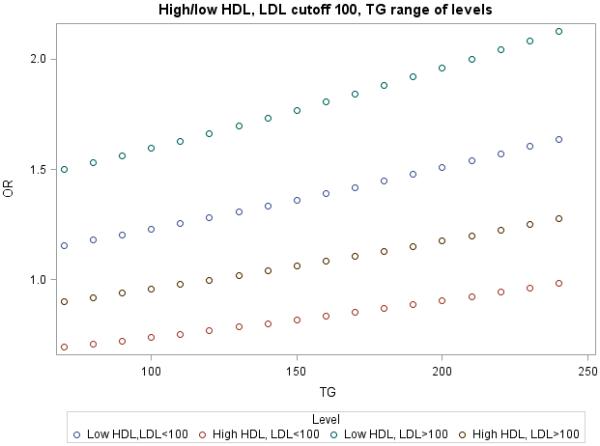
3590 men and women from the Framingham Heart Study offspring cohort without known CVD were followed between 1987 and 2011. Low HDL-C (<40 mg/dL in men and <50 mg/dL in women) was defined as isolated if TG and LDL-C were both low (<100 mg/dL). We also examined higher thresholds for TG (150 mg/dL) and LDL-C (130 mg/dL) and compared low versus high HDL-C phenotypes using logistic regression analysis to assess association with CVD. Compared with isolated low HDL-C, CVD risks were higher when low HDL-C was accompanied by LDL-C ≥100 mg/dL and TG <100 mg/dL (odds ratio 1.3 [1.0, 1.6]), TG ≥100 mg/dL and LDL-C <100 mg/dL (odds ratio 1.3 [1.1, 1.5]), or TG and LDL-C ≥100 mg/dL (odds ratio 1.6, [1.2, 2.2]), after adjustment for covariates. When low HDL-C was analyzed with higher thresholds for TG (≥150 mg/dL) and LDL-C (≥130 mg/dL), results were essentially the same. In contrast, compared with isolated low HDL-C, high HDL-C was associated with 20% to 40% lower CVD risk except when TG and LDL-C were elevated.
CVD risk as a function of HDL-C phenotypes is modulated by other components of the lipid panel.
尽管高密度脂蛋白胆固醇(HDL-C)与心血管疾病(CVD)风险之间的负相关关系早已确立,但当低密度脂蛋白胆固醇(LDL-C)和甘油三酯(TG)水平未升高时,低HDL-C是否仍是CVD风险因素仍不清楚。这是一个及时的问题,因为最近的研究对HDL-C是否真的是CVD的独立预测因子提出了质疑。
对弗雷明汉心脏研究后代队列中3590名无已知CVD的男性和女性在1987年至2011年期间进行了随访。如果TG和LDL-C均低(<100mg/dL),则将低HDL-C(男性<40mg/dL,女性<50mg/dL)定义为孤立性低HDL-C。我们还检查了TG(150mg/dL)和LDL-C(130mg/dL)的更高阈值,并使用逻辑回归分析比较低HDL-C与高HDL-C表型,以评估与CVD的关联。与孤立性低HDL-C相比,当低HDL-C伴有LDL-C≥100mg/dL且TG<100mg/dL(比值比1.3 [1.0, 1.6])、TG≥100mg/dL且LDL-C<100mg/dL(比值比1.3 [1.1, 1.5])或TG和LDL-C≥100mg/dL(比值比1.6, [1.2, 2.2])时,调整协变量后CVD风险更高。当以TG(≥150mg/dL)和LDL-C(≥130mg/dL)的更高阈值分析低HDL-C时,结果基本相同。相比之下,与孤立性低HDL-C相比,高HDL-C与CVD风险降低20%至40%相关,但TG和LDL-C升高时除外。
作为HDL-C表型函数的CVD风险受血脂谱其他成分的调节。