Ma Xiaomin, Guo Pengbo, Qiu Yumin, Mu Kun, Zhu Lihui, Zhao Wei, Li Tao, Han Lihui
Department of Immunology, Shandong University School of Medicine, Jinan 250012, China.
Department of Pathology, Shandong University School of Medicine, Jinan 250012, China.
Oncotarget. 2016 Jun 14;7(24):36185-36197. doi: 10.18632/oncotarget.9154.
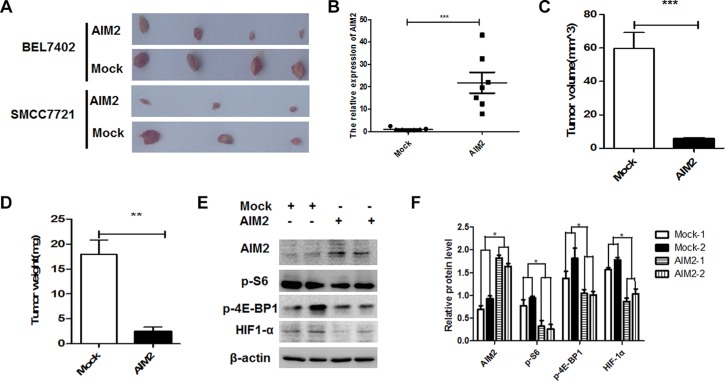
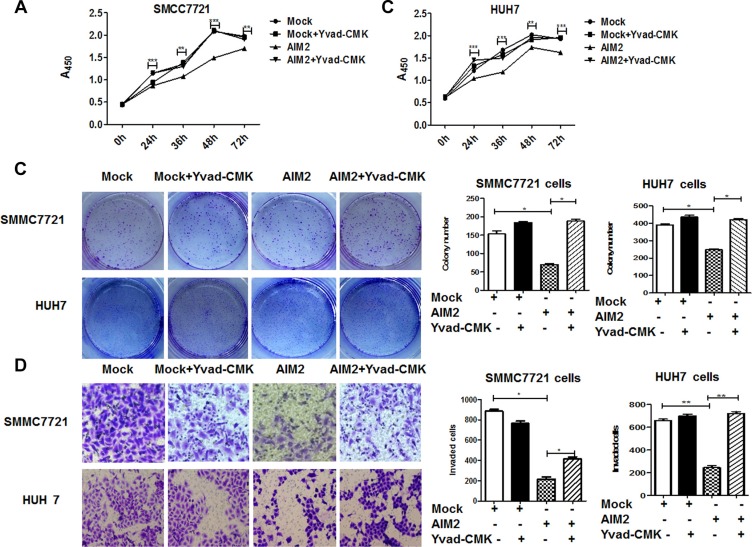
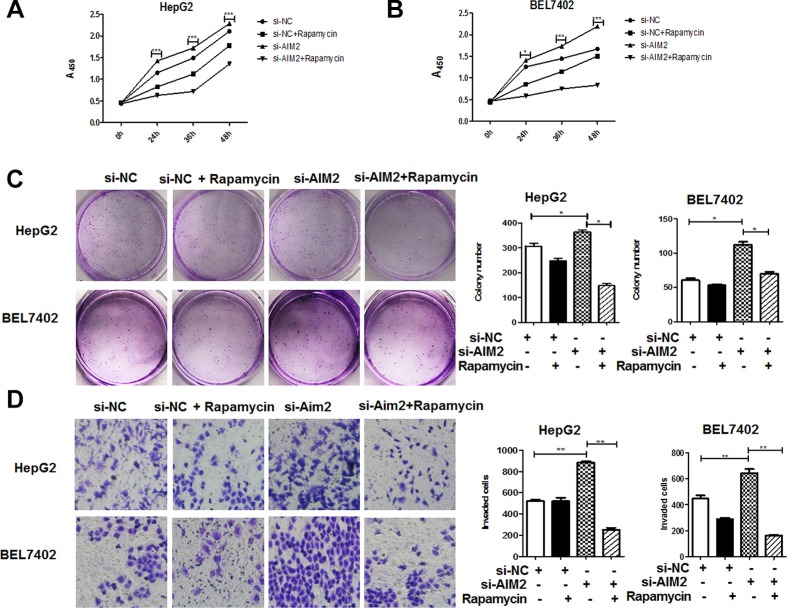
Absent in melanoma (AIM2) is a member of the interferon-inducible HIN-200 protein family and is recently recognized to play an important dual role in both innate immunity and tumor pathology. However, the role of AIM2 in the development of hepatocellular carcinoma (HCC) remains to be clarified. Here we showed that AIM2 expression was significantly decreased in liver cancer tissues, and loss of its expression was significantly correlated with more advanced tumor progression. Exogenous overexpression of AIM2 in HCC cells suppressed mammalian target of rapamycin (mTOR)-S6K1 pathway and further inhibited proliferation, colony formation and invasion of HCC cells. On the contrary, block of AIM2 in HCC cells induced (mTOR)-S6K1 pathway activation and thus promoted HCC progression. Treatment with mTOR pathway inhibitor rapamycin further verified its contribution to HCC progression in AIM2 absent HCC cells. Thus, these data suggested that AIM2 played a critical role as a tumor suppressor and might serve as a potential therapeutic target for future development of AIM2-based gene therapy for human liver cancer. This study also paves a new avenue to treat AIM2-deficient cancer by suppression of mTOR.
黑色素瘤缺失蛋白2(AIM2)是干扰素诱导的HIN-200蛋白家族的成员,最近被认为在先天免疫和肿瘤病理学中都发挥着重要的双重作用。然而,AIM2在肝细胞癌(HCC)发生发展中的作用仍有待阐明。在此我们表明,AIM2在肝癌组织中的表达显著降低,其表达缺失与更晚期的肿瘤进展显著相关。在肝癌细胞中外源性过表达AIM2可抑制雷帕霉素靶蛋白(mTOR)-S6K1通路,并进一步抑制肝癌细胞的增殖、集落形成和侵袭。相反,在肝癌细胞中阻断AIM2会诱导(mTOR)-S6K1通路激活,从而促进肝癌进展。用mTOR通路抑制剂雷帕霉素处理进一步证实了其在缺乏AIM2的肝癌细胞中对肝癌进展的作用。因此,这些数据表明AIM2作为一种肿瘤抑制因子发挥着关键作用,并且可能成为未来基于AIM2的人类肝癌基因治疗潜在的治疗靶点。本研究也为通过抑制mTOR治疗AIM2缺陷型癌症开辟了一条新途径。