Yamane Itsuro, Yamazaki Hisanori, Ishizeki Sayoko, Watanabe Yugo, Okumura Hanako, Okubo Mitsuharu, Kure Katsumasa, Hayakawa Yuiko, Furukawa Makoto, Ooi Munetaka, Mizukami Yoshihiro, Ito Mitsugu
Bacterial and Parasitic Disease Research Division, National Institute of Animal Health, Tsukuba, Ibaraki 305-0856, Japan.
J Vet Med Sci. 2016 Oct 1;78(9):1385-1389. doi: 10.1292/jvms.15-0723. Epub 2016 May 12.
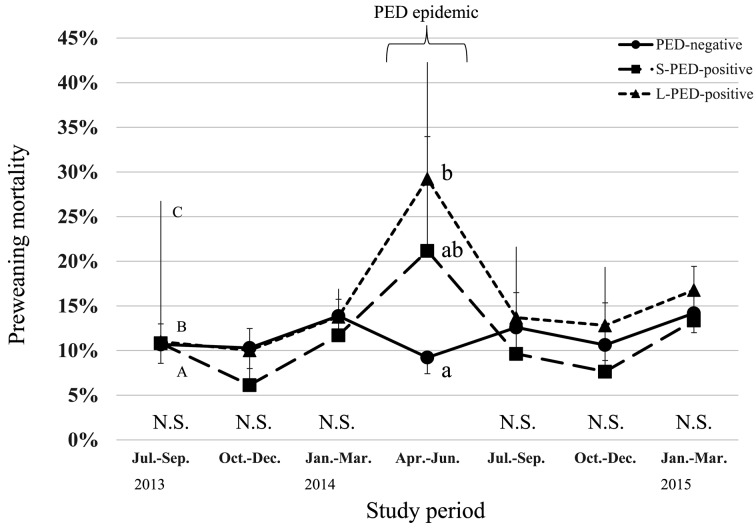
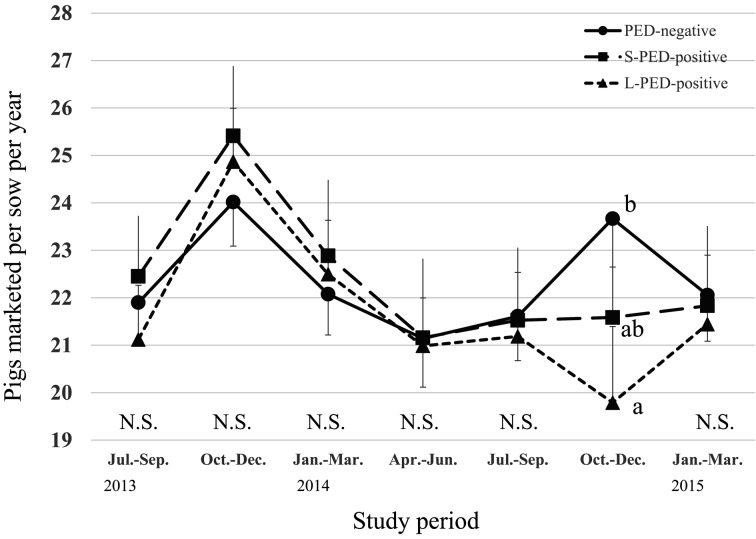
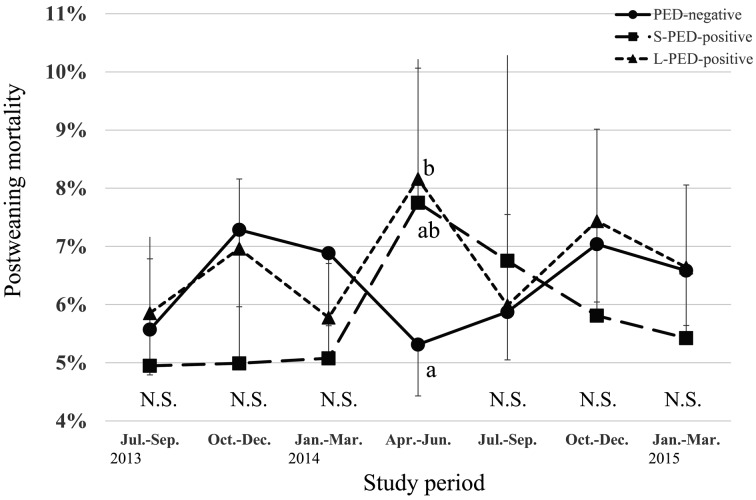
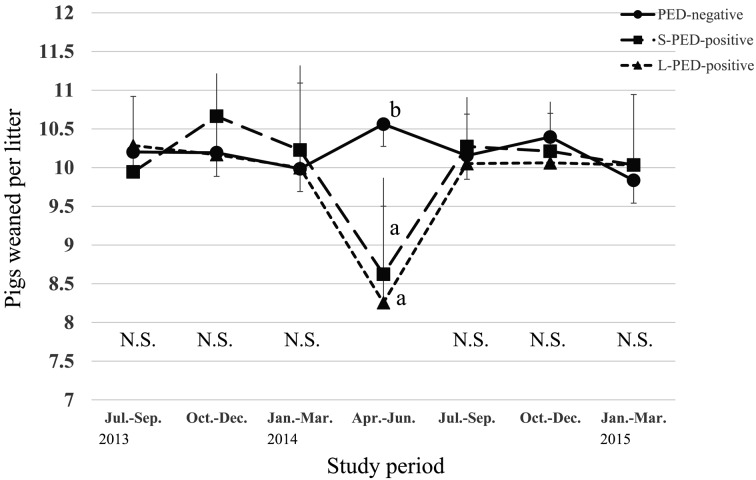
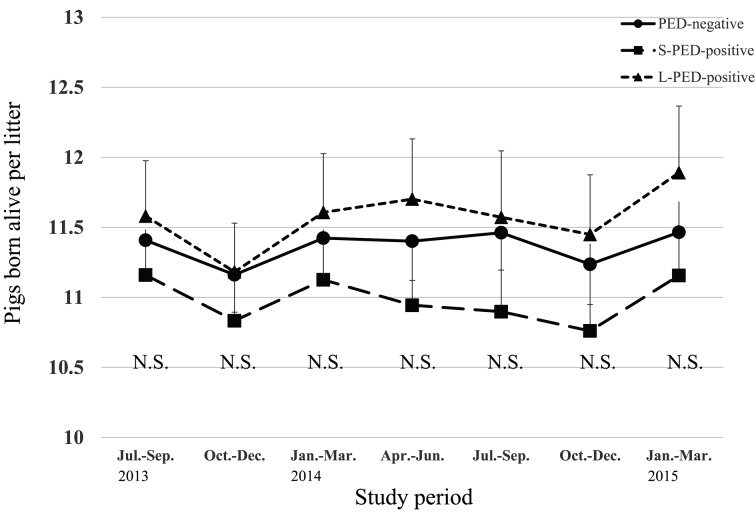
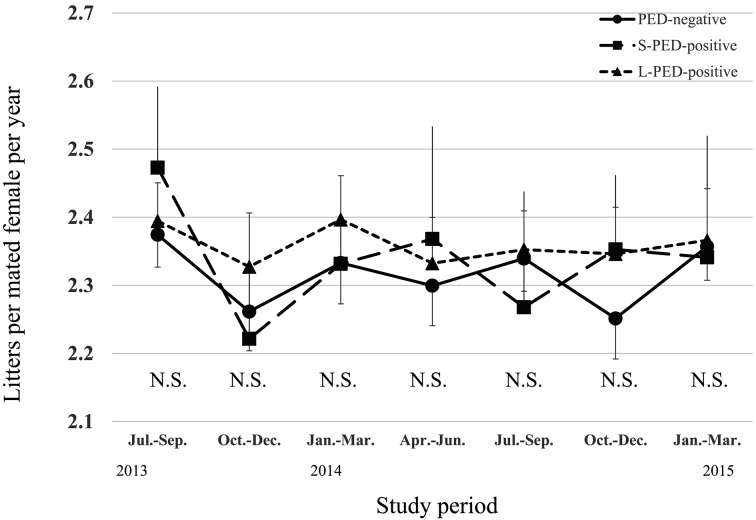
The objective was to investigate porcine epidemic diarrhea (PED) outbreak that occurred in 2014 in Japan and its effects on herd-level productivity using a data recording system (PigINFO). The study herds were selected from farrow-to-finish herds (n=99) that entered in the PigINFO system between July 2013 and March 2015. From 1 April to 30 June 2014 (PED epidemic), any herds with clinical signs of PED and feces positive for porcine epidemic diarrhea virus (PEDV) on polymerase chain reaction analysis and/or immunohistochemical staining were defined as PED-positive (n=38). They were further classified into those with long PED periods (L-PED-positive; n=28) and those with short PED periods (S-PED-positive; n=10). Herds with no clinical signs of PED were classified as PED-negative (n=61). Herd-level production data, including preweaning mortality (%; PRWM), postweaning mortality (%; POWM), pigs weaned per litter (PWL), pigs born alive per litter, litters per mated female per year and pigs marketed per sow (MP), were calculated every 3 months during study period. During the PED epidemic, L-PED-positive herds had significantly higher PRWM and POWM than PED-negative herds, and L-PED-positive and S-PED-positive herds had significantly lower PWL. During October-December 2014, L-PED-positive herds had significantly fewer MP than PED-negative herds. The PED outbreak increased mortality and consequently reduced the numbers of marketed pigs. The rapid control of an outbreak is important for reducing the financial losses arising from PED infections.
目的是利用数据记录系统(PigINFO)调查2014年在日本发生的猪流行性腹泻(PED)疫情及其对猪群生产性能的影响。研究猪群选自2013年7月至2015年3月期间录入PigINFO系统的全进全出猪群(n = 99)。在2014年4月1日至6月30日(PED疫情期间),任何出现PED临床症状且经聚合酶链反应分析和/或免疫组织化学染色检测猪流行性腹泻病毒(PEDV)粪便呈阳性的猪群被定义为PED阳性(n = 38)。它们进一步分为PED持续时间长的猪群(L-PED阳性;n = 28)和PED持续时间短的猪群(S-PED阳性;n = 10)。没有PED临床症状的猪群被分类为PED阴性(n = 61)。在研究期间,每3个月计算一次猪群水平的生产数据,包括断奶前死亡率(%;PRWM)、断奶后死亡率(%;POWM)、每窝断奶仔猪数(PWL)、每窝活产仔猪数、每年每头经产母猪产仔数和每头母猪出栏猪数(MP)。在PED疫情期间,L-PED阳性猪群的PRWM和POWM显著高于PED阴性猪群,L-PED阳性和S-PED阳性猪群的PWL显著较低。在2014年10月至12月期间,L-PED阳性猪群的MP显著少于PED阴性猪群。PED疫情增加了死亡率,从而减少了出栏猪的数量。迅速控制疫情对于减少PED感染造成的经济损失很重要。