Vitner Einat B, Farfel-Becker Tamar, Ferreira Natalia Santos, Leshkowitz Dena, Sharma Piyush, Lang Karl S, Futerman Anthony H
Department of Biomolecular Sciences, Weizmann Institute of Science, Rehovot, 76100, Israel.
Present address: Department of Infectious Diseases, Israel Institute for Biological Research, Ness-Ziona, 74100, Israel.
J Neuroinflammation. 2016 May 12;13(1):104. doi: 10.1186/s12974-016-0570-2.
Neuroinflammation is a key phenomenon in the pathogenesis of many neurodegenerative diseases. Understanding the mechanisms by which brain inflammation is engaged and delineating the key players in the immune response and their contribution to brain pathology is of great importance for the identification of novel therapeutic targets for these devastating diseases. Gaucher disease, the most common lysosomal storage disease, is caused by mutations in the GBA1 gene and is a significant risk factor for Parkinson's disease; in some forms of Gaucher disease, neuroinflammation is observed.
An unbiased gene profile analysis was performed on a severely affected brain area of a neurological form of a Gaucher disease mouse at a pre-symptomatic stage; the mouse used for this study, the Gba (flox/flox); nestin-Cre mouse, was engineered such that GBA1 deficiency is restricted to cells of neuronal lineage, i.e., neurons and macroglia.
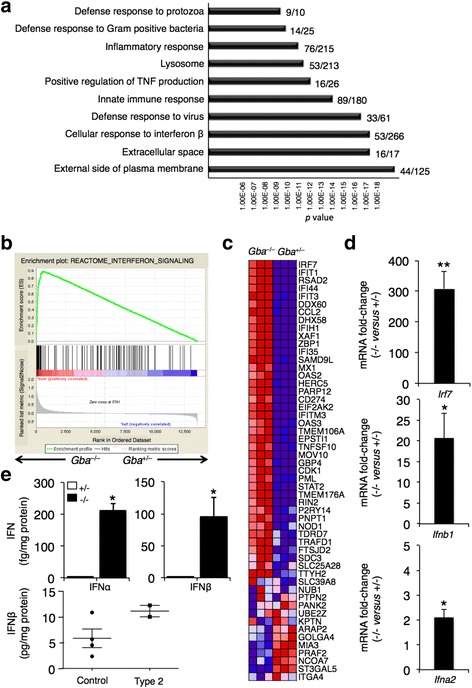
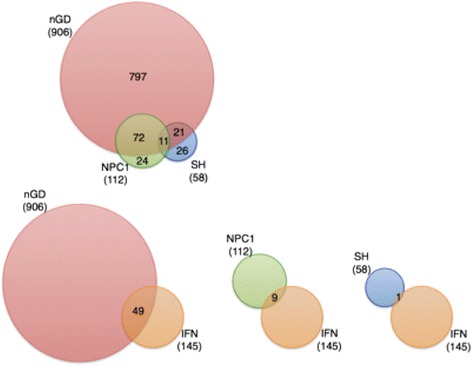
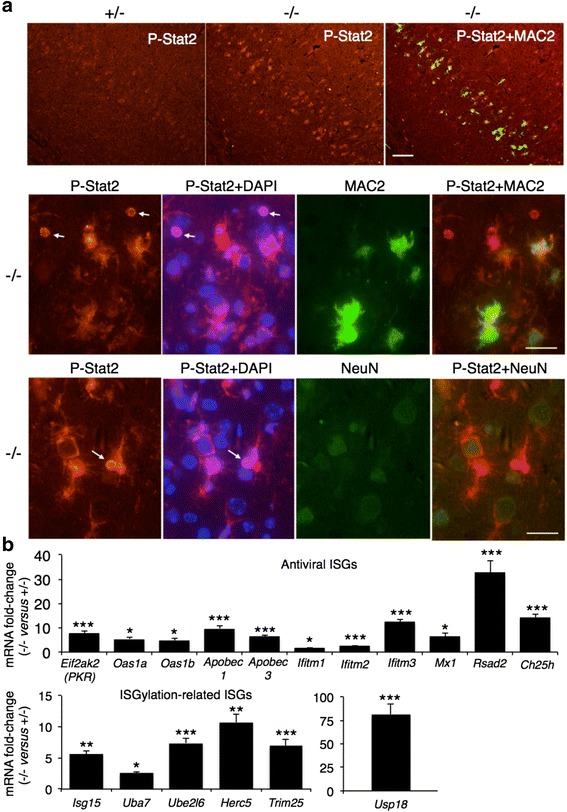
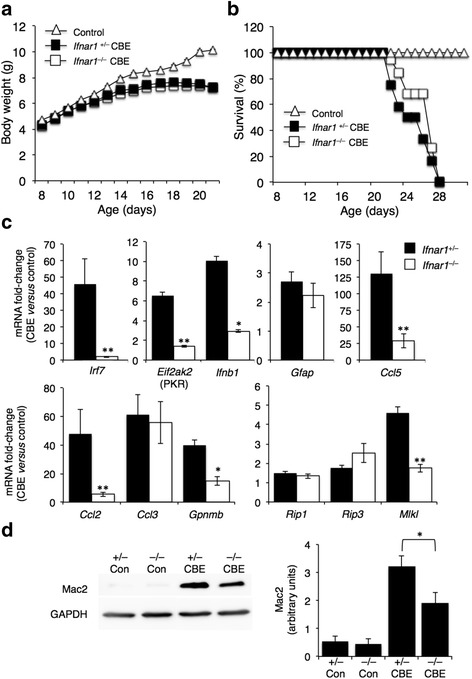
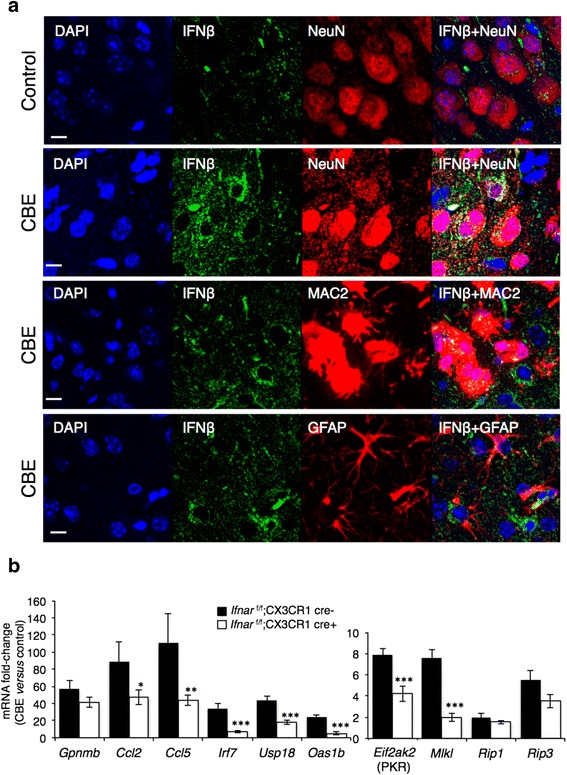
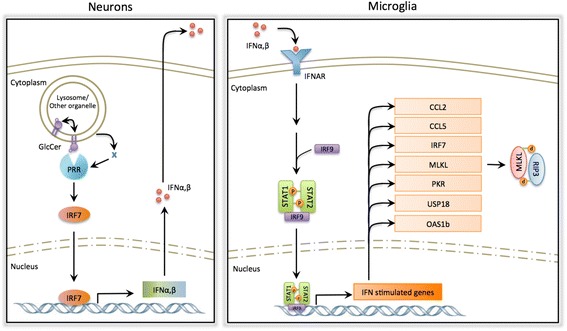
The 10 most up-regulated genes in the ventral posteromedial/posterolateral region of the thalamus were inflammatory genes, with the gene expression signature significantly enriched in interferon signaling genes. Interferon β levels were elevated in neurons, and interferon-stimulated genes were elevated mainly in microglia. Interferon signaling pathways were elevated to a small extent in the brain of another lysosomal storage disease mouse model, Krabbe disease, but not in Niemann-Pick C or Sandhoff mouse brain. Ablation of the type I interferon receptor attenuated neuroinflammation but had no effect on GD mouse viability.
Our results imply that the type I interferon response is involved in the development of nGD pathology, and possibly in other lysosomal storage diseases in which simple glycosphingolipids accumulate, and support the notion that interferon signaling pathways play a vital role in the sterile inflammation that often occurs during chronic neurodegenerative diseases in which neuroinflammation is present.
神经炎症是许多神经退行性疾病发病机制中的关键现象。了解脑部炎症发生的机制,明确免疫反应中的关键参与者及其对脑部病理的影响,对于确定这些毁灭性疾病的新治疗靶点至关重要。戈谢病是最常见的溶酶体贮积病,由GBA1基因突变引起,是帕金森病的重要危险因素;在某些形式的戈谢病中,可观察到神经炎症。
对一只处于症状前期的戈谢病神经型小鼠严重受影响的脑区进行无偏基因谱分析;本研究使用的小鼠Gba(flox/flox);nestin-Cre小鼠经过基因工程改造,使得GBA1缺乏仅限于神经谱系细胞,即神经元和大胶质细胞。
丘脑腹后内侧/后外侧区域上调最明显的10个基因是炎症基因,基因表达特征在干扰素信号基因中显著富集。神经元中的干扰素β水平升高,干扰素刺激基因主要在小胶质细胞中升高。在另一种溶酶体贮积病小鼠模型克-雅病的脑中,I型干扰素信号通路有一定程度的升高,但在尼曼-皮克C病或桑德霍夫病小鼠脑中未升高。敲除I型干扰素受体可减轻神经炎症,但对戈谢病小鼠的生存能力无影响。
我们的结果表明,I型干扰素反应参与了神经型戈谢病病理的发展,可能也参与了其他简单糖鞘脂蓄积的溶酶体贮积病,并支持了干扰素信号通路在慢性神经退行性疾病中常出现的无菌性炎症中起关键作用的观点,这些疾病存在神经炎症。