Kim Ji-Hye, Lee Hyung-Young, Ban Ga-Young, Shin Yoo-Seob, Park Hae-Sim, Ye Young-Min
From the Department of Allergy and Clinical Immunology, Ajou University School of Medicine, Suwon, Korea.
Medicine (Baltimore). 2016 May;95(19):e3688. doi: 10.1097/MD.0000000000003688.
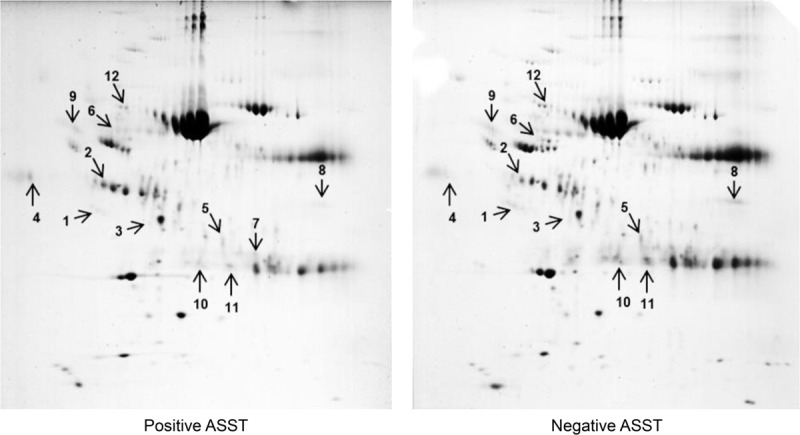
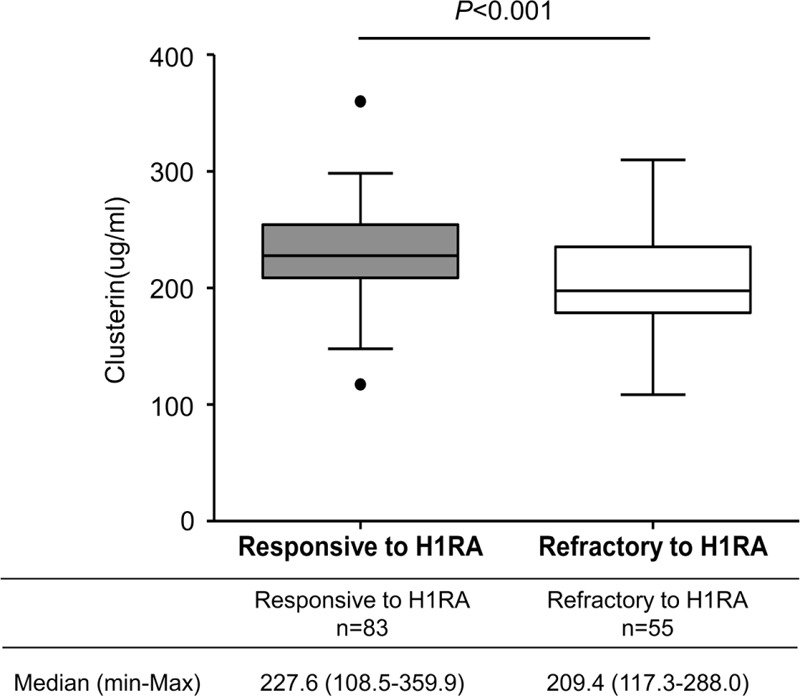
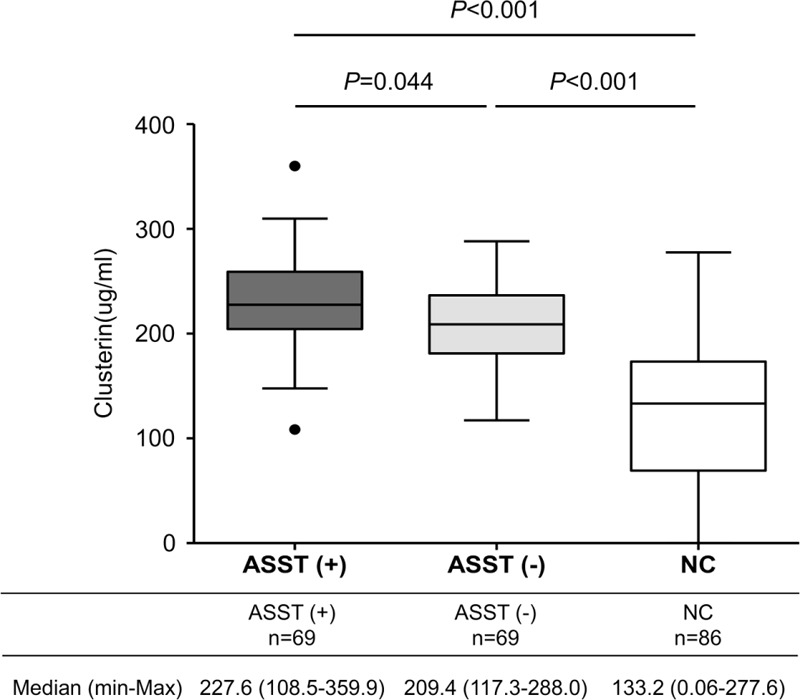
A substantial proportion of patients with chronic spontaneous urticaria (CSU) are refractory to antihistamines. However, identifying the subpopulation whose urticaria is not completely controlled by antihistamines remains difficult. The response of autologous serum skin test (ASST), a clinical test for the detection of basophil histamine-releasing activity upon autoantibodies or autoreactive stimulation, has been suggested as a potential predictor in the control of urticaria. We sought to identify proteins that were differentially expressed in the sera of patients with positive and negative ASST results and to investigate their association with urticaria control.Proteomics analysis was performed using sera from 3 CSU patients with positive ASST results compared with those showing negative ASST results. Seven upregulated and 5 downregulated proteins were identified by matrix-assisted laser desorption/ionization time-of-flight mass spectrometry in the ASST-positive group compared with the ASST-negative group.Proteins that were differentially expressed according to the ASST results in CSU patients were classified into 6 groups: apolipoproteins, glycoproteins, modified albumin, haptoglobulin, plectin, and others. Among these, apolipoprotein J or clusterin was validated using an enzyme-linked immunosorbent assay. Clusterin levels in 69 ASST-positive patients were significantly higher than those in 69 ASST-negative patients and in 86 healthy controls (231.2 ± 44.0 vs 210.2 ± 36.1 vs 118.7 ± 71.9 μg/mL, P < 0.001). Furthermore, clusterin levels differed significantly between patients with responsive and refractory responses to antihistamine treatment within 3 months (231.0 ± 39.1 vs 205.1 ± 40.4 μg/mL, P < 0.001). ASST results and serum clusterin levels can predict 92.7% of CSU patients whose urticaria would be refractory to antihistamines. Serum clusterin can be a prognostic marker to determine the responsiveness to antihistamine treatment in patients with CSU.
相当一部分慢性自发性荨麻疹(CSU)患者对抗组胺药难治。然而,识别荨麻疹未被抗组胺药完全控制的亚群仍然困难。自体血清皮肤试验(ASST)是一种用于检测自身抗体或自身反应性刺激后嗜碱性粒细胞组胺释放活性的临床试验,其反应已被认为是控制荨麻疹的潜在预测指标。我们试图鉴定ASST结果为阳性和阴性的患者血清中差异表达的蛋白质,并研究它们与荨麻疹控制的关联。
使用3例ASST结果为阳性的CSU患者的血清与ASST结果为阴性的患者血清进行蛋白质组学分析。与ASST阴性组相比,基质辅助激光解吸/电离飞行时间质谱法在ASST阳性组中鉴定出7种上调蛋白和5种下调蛋白。
根据CSU患者ASST结果差异表达的蛋白质分为6组:载脂蛋白、糖蛋白、修饰白蛋白、触珠蛋白、网蛋白和其他。其中,载脂蛋白J或聚集素通过酶联免疫吸附测定进行验证。69例ASST阳性患者的聚集素水平显著高于69例ASST阴性患者和86例健康对照(231.2±44.0 vs 210.2±36.1 vs 118.7±71.9μg/mL,P<0.001)。此外,在3个月内对抗组胺治疗有反应和难治性反应的患者之间,聚集素水平差异显著(231.0±39.1 vs 205.1±40.4μg/mL,P<0.001)。ASST结果和血清聚集素水平可预测92.7%的CSU患者其荨麻疹对抗组胺药难治。血清聚集素可作为判断CSU患者对抗组胺治疗反应性的预后标志物。