Carey Lawrence M, Slivicki Richard A, Leishman Emma, Cornett Ben, Mackie Ken, Bradshaw Heather, Hohmann Andrea G
Department of Psychological and Brain Sciences, Indiana University, Bloomington, IN, USA Program in Neuroscience, Indiana University, Bloomington, IN, USA.
Department of Psychological and Brain Sciences, Indiana University, Bloomington, IN, USA.
Mol Pain. 2016 May 13;12. doi: 10.1177/1744806916649192. Print 2016.
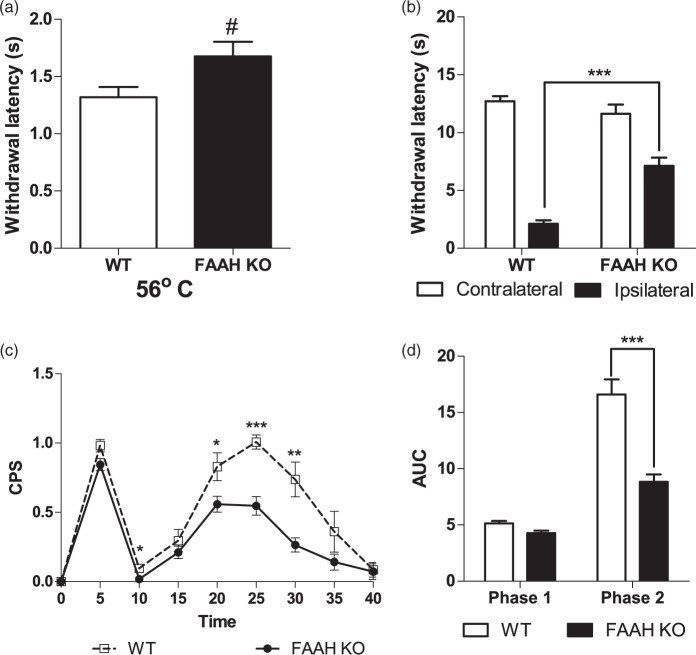
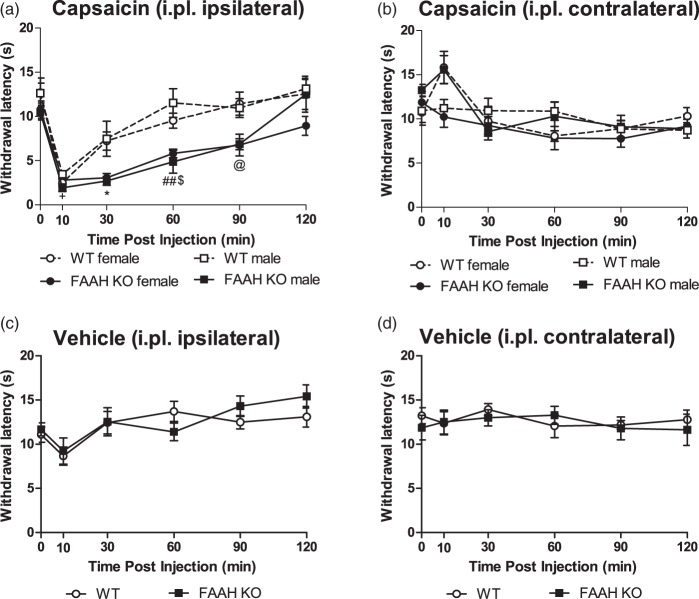
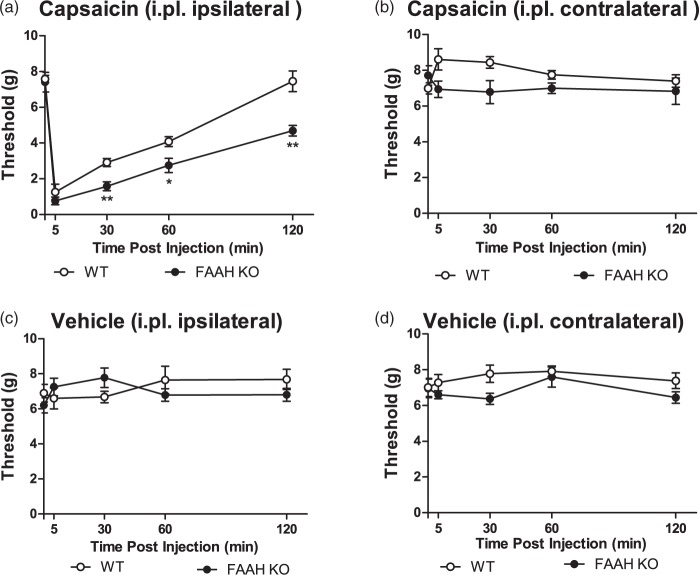
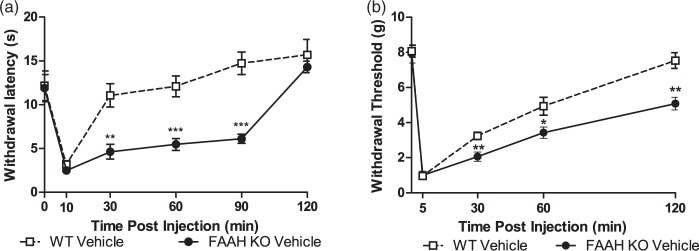
Fatty-acid amide hydrolase (FAAH) is the major enzyme responsible for degradation of anandamide, an endocannabinoid. Pharmacological inhibition or genetic deletion of FAAH (FAAH KO) produces antinociception in preclinical pain models that is largely attributed to anandamide-induced activation of cannabinoid receptors. However, FAAH metabolizes a wide range of structurally related, biologically active lipid signaling molecules whose functions remain largely unknown. Some of these endogenous lipids, including anandamide itself, may exert pro-nociceptive effects under certain conditions. In our study, FAAH KO mice exhibited a characteristic analgesic phenotype in the tail flick test and in both formalin and carrageenan models of inflammatory nociception. Nonetheless, intradermal injection of the transient receptor potential channel V1 (TRPV1) agonist capsaicin increased nocifensive behavior as well as mechanical and heat hypersensitivity in FAAH KO relative to wild-type mice. This pro-nociceptive phenotype was accompanied by increases in capsaicin-evoked Fos-like immunoreactive (FLI) cells in spinal dorsal horn regions implicated in nociceptive processing and was attenuated by CB1 (AM251) and TRPV1 (AMG9810) antagonists. When central sensitization was established, FAAH KO mice displayed elevated levels of anandamide, other fatty-acid amides, and endogenous TRPV1 agonists in both paw skin and lumbar spinal cord relative to wild-type mice. Capsaicin decreased spinal cord 2-AG levels and increased arachidonic acid and prostaglandin E2 levels in both spinal cord and paw skin irrespective of genotype. Our studies identify a previously unrecognized pro-nociceptive phenotype in FAAH KO mice that was unmasked by capsaicin challenge. The heightened nociceptive response was mediated by CB1 and TRPV1 receptors and accompanied by enhanced spinal neuronal activation. Moreover, genetic deletion of FAAH has a profound impact on the peripheral and central lipidome. Thus, genetic deletion of FAAH may predispose animals to increased sensitivity to certain types of pain. More work is necessary to determine whether such changes could explain the lack of efficacy of FAAH inhibitors in clinical trials.
脂肪酸酰胺水解酶(FAAH)是负责降解内源性大麻素花生四烯乙醇胺的主要酶。在临床前疼痛模型中,对FAAH进行药理学抑制或基因敲除(FAAH KO)可产生抗伤害感受作用,这在很大程度上归因于花生四烯乙醇胺诱导的大麻素受体激活。然而,FAAH可代谢多种结构相关的生物活性脂质信号分子,其功能在很大程度上仍不清楚。其中一些内源性脂质,包括花生四烯乙醇胺本身,在某些情况下可能发挥促伤害感受作用。在我们的研究中,FAAH KO小鼠在甩尾试验以及福尔马林和角叉菜胶炎症性伤害感受模型中均表现出特征性的镇痛表型。尽管如此,与野生型小鼠相比,皮内注射瞬时受体电位通道V1(TRPV1)激动剂辣椒素会增加FAAH KO小鼠的伤害性防御行为以及机械性和热超敏反应。这种促伤害感受表型伴随着辣椒素诱发的、与伤害性处理相关的脊髓背角区域Fos样免疫反应性(FLI)细胞增加,并被CB1(AM251)和TRPV1(AMG9810)拮抗剂减弱。当建立中枢敏化时,与野生型小鼠相比,FAAH KO小鼠的爪部皮肤和腰脊髓中花生四烯乙醇胺、其他脂肪酸酰胺以及内源性TRPV1激动剂的水平升高。无论基因型如何,辣椒素均可降低脊髓中2-花生四烯酸甘油(2-AG)水平,并增加脊髓和爪部皮肤中花生四烯酸和前列腺素E2水平。我们的研究确定了FAAH KO小鼠中一种先前未被认识的促伤害感受表型,该表型在辣椒素激发下得以显现。增强的伤害感受反应由CB1和TRPV1受体介导,并伴有脊髓神经元激活增强。此外,FAAH基因敲除对外周和中枢脂质组有深远影响。因此,FAAH基因敲除可能使动物对某些类型的疼痛敏感性增加。需要开展更多工作来确定这些变化是否可以解释FAAH抑制剂在临床试验中缺乏疗效的原因。