Department of Psychological and Brain Sciences, Indiana University Bloomington, IN, USA.
Department of Chemistry, Indiana University Bloomington IN, USA.
Front Cell Neurosci. 2014 Aug 1;8:195. doi: 10.3389/fncel.2014.00195. eCollection 2014.
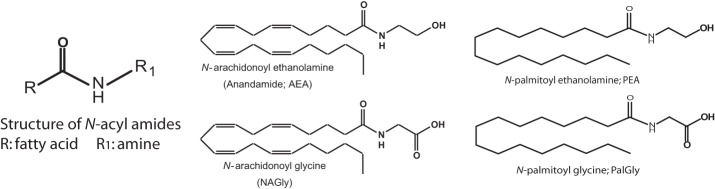
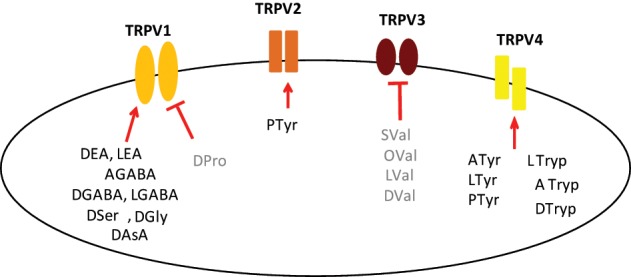
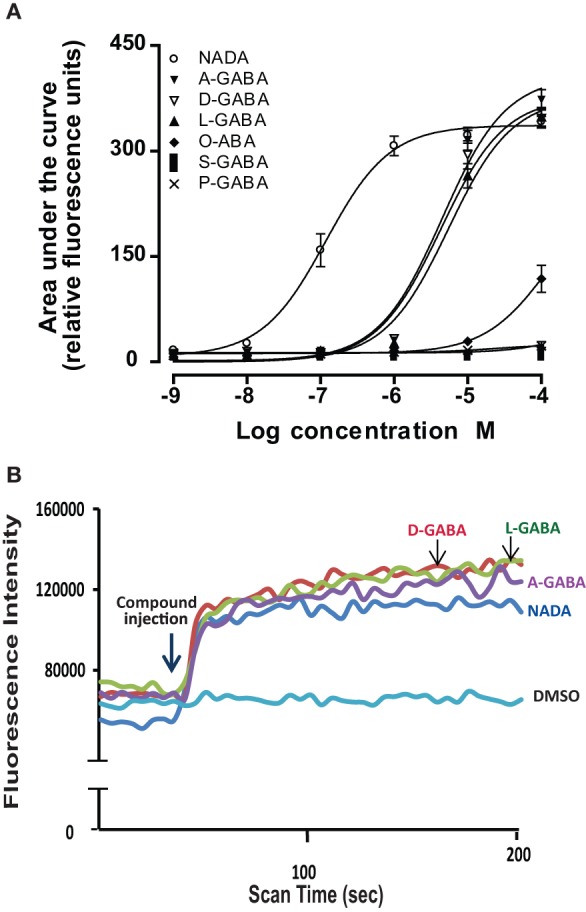
A family of endogenous lipids, structurally analogous to the endogenous cannabinoid, N-arachidonoyl ethanolamine (Anandamide), and called N-acyl amides have emerged as a family of biologically active compounds at TRP receptors. N-acyl amides are constructed from an acyl group and an amine via an amide bond. This same structure can be modified by changing either the fatty acid or the amide to form potentially hundreds of lipids. More than 70 N-acyl amides have been identified in nature. We have ongoing studies aimed at isolating and characterizing additional members of the family of N-acyl amides in both central and peripheral tissues in mammalian systems. Here, using a unique in-house library of over 70 N-acyl amides we tested the following three hypotheses: (1) Additional N-acyl amides will have activity at TRPV1-4, (2) Acute peripheral injury will drive changes in CNS levels of N-acyl amides, and (3) N-acyl amides will regulate calcium in CNS-derived microglia. Through these studies, we have identified 20 novel N-acyl amides that collectively activate (stimulating or inhibiting) TRPV1-4. Using lipid extraction and HPLC coupled to tandem mass spectrometry we showed that levels of at least 10 of these N-acyl amides that activate TRPVs are regulated in brain after intraplantar carrageenan injection. We then screened the BV2 microglial cell line for activity with this N-acyl amide library and found overlap with TRPV receptor activity as well as additional activators of calcium mobilization from these lipids. Together these data provide new insight into the family of N-acyl amides and their roles as signaling molecules at ion channels, in microglia, and in the brain in the context of inflammation.
一种内源性脂质家族,在结构上与内源性大麻素 N-花生四烯酰乙醇胺(大麻素)类似,被称为 N-酰基酰胺,已成为 TRP 受体中具有生物活性的化合物家族。N-酰基酰胺由酰基基团和胺通过酰胺键构成。通过改变脂肪酸或酰胺,可以修饰这种相同的结构,从而形成潜在的数百种脂质。在自然界中已经鉴定出超过 70 种 N-酰基酰胺。我们正在进行研究,旨在分离和鉴定哺乳动物系统中枢和外周组织中 N-酰基酰胺家族的其他成员。在这里,我们使用一个独特的 70 多种 N-酰基酰胺的内部文库,测试了以下三个假设:(1)其他 N-酰基酰胺将在 TRPV1-4 上具有活性,(2)急性外周损伤将导致中枢神经系统 N-酰基酰胺水平发生变化,(3)N-酰基酰胺将调节中枢神经系统来源的小胶质细胞中的钙。通过这些研究,我们鉴定了 20 种新型 N-酰基酰胺,它们共同激活(刺激或抑制)TRPV1-4。通过脂质提取和 HPLC 与串联质谱联用,我们表明,在足底注射角叉菜胶后,至少 10 种激活 TRPV 的 N-酰基酰胺的水平在大脑中受到调节。然后,我们在 BV2 小胶质细胞系中用这种 N-酰基酰胺文库进行筛选,发现与 TRPV 受体活性以及这些脂质中钙动员的其他激活剂有重叠。这些数据共同为 N-酰基酰胺家族及其作为离子通道、小胶质细胞和炎症背景下大脑中信号分子的作用提供了新的见解。