Milligan R J, Morris K J, Bett B J, Durden J M, Jones D O B, Robert K, Ruhl H A, Bailey D M
Halmos College of Natural Sciences and Oceanography, NOVA Southeastern University, 8000 North Ocean Drive, Dania Beach, Florida, 33004, USA.
Institute of Biodiversity, Animal Health and Comparative Medicine, Graham Kerr Building, University of Glasgow, Glasgow, G12 8QQ, UK.
Sci Rep. 2016 May 16;6:26095. doi: 10.1038/srep26095.
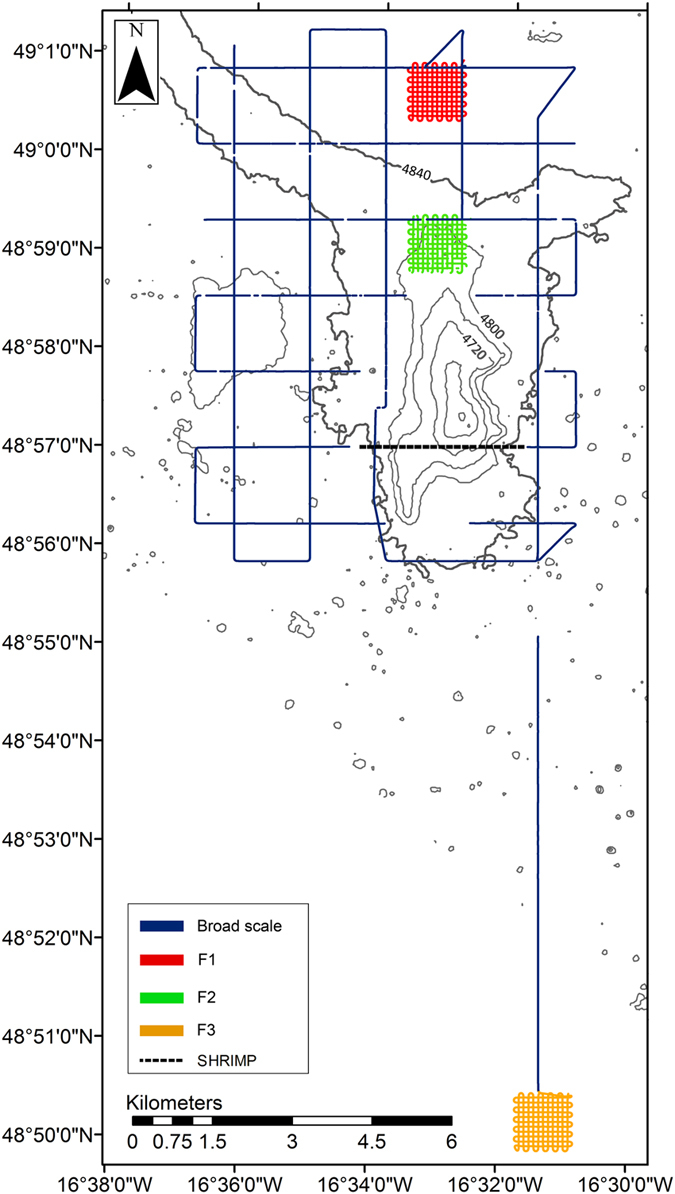
On abyssal plains, demersal fish are believed to play an important role in transferring energy across the seafloor and between the pelagic and benthic realms. However, little is known about their spatial distributions, making it difficult to quantify their ecological significance. To address this, we employed an autonomous underwater vehicle to conduct an exceptionally large photographic survey of fish distributions on the Porcupine Abyssal Plain (NE Atlantic, 4850 m water depth) encompassing two spatial scales (1-10 km(2)) on and adjacent to a small abyssal hill (240 m elevation). The spatial distributions of the total fish fauna and that of the two dominant morphotypes (Coryphaenoides sp. 1 and C. profundicolus) appeared to be random, a result contrary to common expectation but consistent with previous predictions for these fishes. We estimated total fish density on the abyssal plain to be 723 individuals km(-2) (95% CI: 601-844). This estimate is higher, and likely more precise, than prior estimates from trawl catch and baited camera techniques (152 and 188 individuals km(-2) respectively). We detected no significant difference in fish density between abyssal hill and plain, nor did we detect any evidence for the existence of fish aggregations at any spatial scale assessed.
在深海平原,底栖鱼类被认为在跨海底以及在水层和底栖生物领域之间传递能量方面发挥着重要作用。然而,人们对它们的空间分布知之甚少,这使得难以量化它们的生态意义。为了解决这个问题,我们使用了一艘自主水下航行器,对豪猪深海平原(东北大西洋,水深4850米)的鱼类分布进行了一次规模异常大的摄影调查,该调查涵盖了一个小深海山丘(海拔240米)及其附近的两个空间尺度(1 - 10平方千米)。整个鱼类群落以及两种主要形态类型(Coryphaenoides sp. 1和C. profundicolus)的空间分布似乎是随机的,这一结果与普遍预期相反,但与之前对这些鱼类的预测一致。我们估计深海平原上的鱼类总密度为每平方千米723只个体(95%置信区间:601 - 844)。这个估计值比之前通过拖网捕捞和诱饵相机技术得出的估计值(分别为每平方千米152只和188只个体)更高,而且可能更精确。我们没有检测到深海山丘和平原之间鱼类密度的显著差异,在任何评估的空间尺度上也没有发现鱼类聚集存在的证据。