
RAC1 GTP酶在超分割放射治疗中促进乳腺癌细胞的存活。
RAC1 GTPase promotes the survival of breast cancer cells in response to hyper-fractionated radiation treatment.
作者信息
Hein A L, Post C M, Sheinin Y M, Lakshmanan I, Natarajan A, Enke C A, Batra S K, Ouellette M M, Yan Y
机构信息
Department of Radiation Oncology, University of Nebraska Medical Center, Omaha, NE, USA.
Department of Pathology and Microbiology, University of Nebraska Medical Center, Omaha, NE, USA.
出版信息
Oncogene. 2016 Dec 8;35(49):6319-6329. doi: 10.1038/onc.2016.163. Epub 2016 May 16.
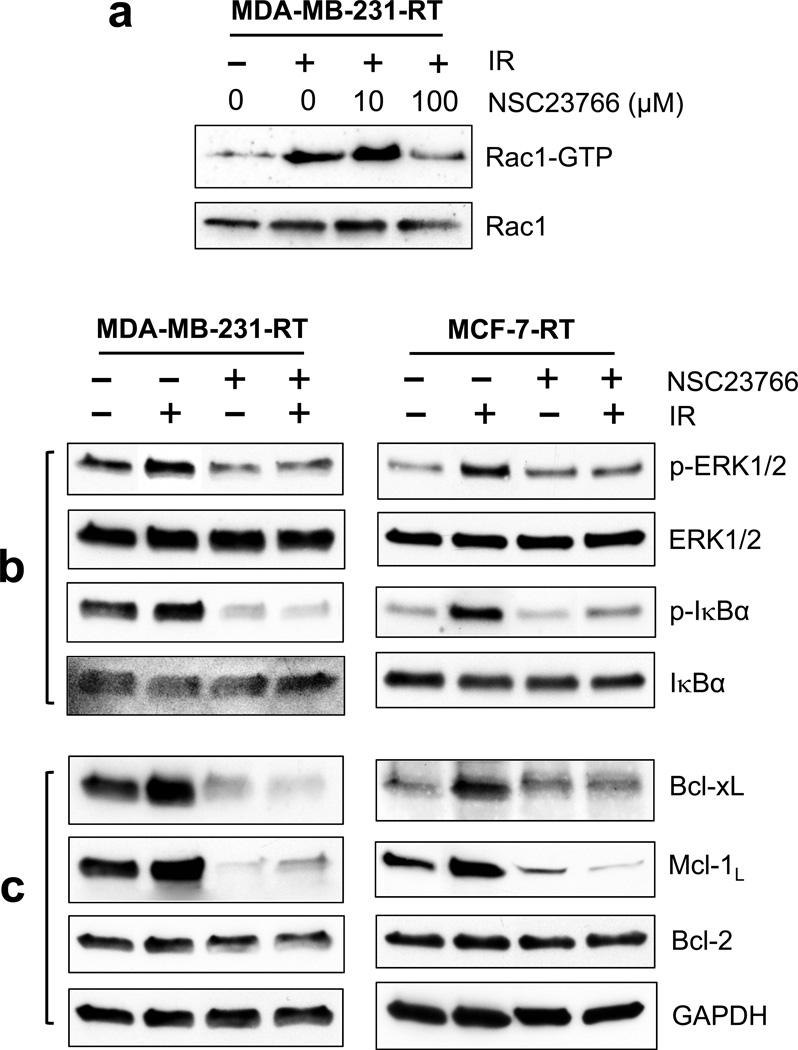
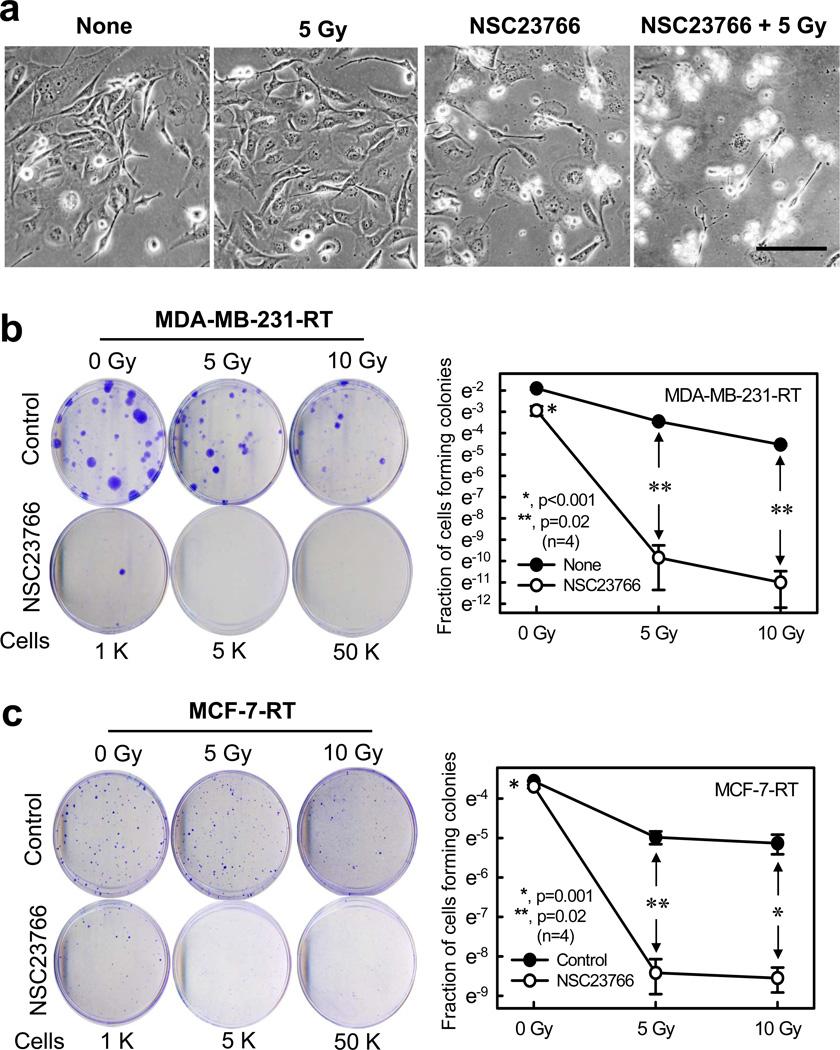
Radiation therapy is a staple approach for cancer treatment, whereas radioresistance of cancer cells remains a substantial clinical problem. In response to ionizing radiation (IR) induced DNA damage, cancer cells can sustain/activate pro-survival signaling pathways, leading to apoptotic resistance and induction of cell cycle checkpoint/DNA repair. Previous studies show that Rac1 GTPase is overexpressed/hyperactivated in breast cancer cells and is associated with poor prognosis. Studies from our laboratory reveal that Rac1 activity is necessary for G2/M checkpoint activation and cell survival in response to IR exposure of breast and pancreatic cancer cells. In this study, we investigated the effect of Rac1 on the survival of breast cancer cells treated with hyper-fractionated radiation (HFR), which is used clinically for cancer treatment. Results in this report indicate that Rac1 protein expression is increased in the breast cancer cells that survived HFR compared with parental cells. Furthermore, this increase of Rac1 is associated with enhanced activities of extracellular signal-regulated kinases 1 and 2 (ERK1/2) and nuclear factor-κB (NF-κB) signaling pathways and increased levels of anti-apoptotic protein Bcl-xL and Mcl-1, which are downstream targets of ERK1/2 and NF-κB signaling pathways. Using Rac1-specific inhibitor and dominant-negative mutant N17Rac1, here we demonstrate that Rac1 inhibition decreases the phosphorylation of ERK1/2 and inhibitory κBα (IκBα), as well as the levels of Bcl-xL and Mcl-1 protein in the HFR-selected breast cancer cells. Moreover, inhibition of Rac1 using either small molecule inhibitor or dominant-negative N17Rac1 abrogates clonogenic survival of HFR-selected breast cancer cells and decreases the level of intact poly(ADP-ribose) polymerase, which is indicative of apoptosis induction. Collectively, results in this report suggest that Rac1 signaling is essential for the survival of breast cancer cells subjected to HFR and implicate Rac1 in radioresistance of breast cancer cells. These studies also provide the basis to explore Rac1 as a therapeutic target for radioresistant breast cancer cells.
放射治疗是癌症治疗的主要方法,然而癌细胞的放射抗性仍然是一个重大的临床问题。响应电离辐射(IR)诱导的DNA损伤,癌细胞可以维持/激活促生存信号通路,导致凋亡抗性并诱导细胞周期检查点/DNA修复。先前的研究表明,Rac1 GTP酶在乳腺癌细胞中过表达/过度激活,并且与预后不良相关。我们实验室的研究表明,Rac1活性对于G2/M检查点激活以及乳腺癌和胰腺癌细胞暴露于IR后的细胞存活是必需的。在本研究中,我们研究了Rac1对接受超分割放疗(HFR)治疗的乳腺癌细胞存活的影响,HFR在临床上用于癌症治疗。本报告的结果表明,与亲代细胞相比,在经受HFR后存活的乳腺癌细胞中Rac1蛋白表达增加。此外,Rac1的这种增加与细胞外信号调节激酶1和2(ERK1/2)以及核因子-κB(NF-κB)信号通路的活性增强以及抗凋亡蛋白Bcl-xL和Mcl-1水平升高相关,它们是ERK1/2和NF-κB信号通路的下游靶点。使用Rac1特异性抑制剂和显性负性突变体N17Rac1,我们在此证明,Rac1抑制降低了HFR选择的乳腺癌细胞中ERK1/2和抑制性κBα(IκBα)的磷酸化,以及Bcl-xL和Mcl-1蛋白的水平。此外,使用小分子抑制剂或显性负性N17Rac1抑制Rac1可消除HFR选择的乳腺癌细胞的克隆形成存活,并降低完整多聚(ADP-核糖)聚合酶的水平,这表明诱导了凋亡。总体而言,本报告的结果表明,Rac1信号对于经受HFR的乳腺癌细胞的存活至关重要,并表明Rac1与乳腺癌细胞的放射抗性有关。这些研究还为探索将Rac1作为放射抗性乳腺癌细胞的治疗靶点提供了基础。



 Zotero 插件