Monahan Zachary, Shewmaker Frank, Pandey Udai Bhan
Department of Pharmacology, Uniformed Services University of the Health Sciences, Bethesda, MD, United States.
Department of Pediatrics, Division of Child Neurology, Children's Hospital of Pittsburgh, University of Pittsburgh School of Medicine, Pittsburgh, PA, United States; Department of Human Genetics, University of Pittsburgh Graduate School of Public Health, Pittsburgh, PA, United States; Department of Neurology, University of Pittsburgh School of Medicine, Pittsburgh, PA, United States.
Brain Res. 2016 Oct 15;1649(Pt B):189-200. doi: 10.1016/j.brainres.2016.05.022. Epub 2016 May 13.
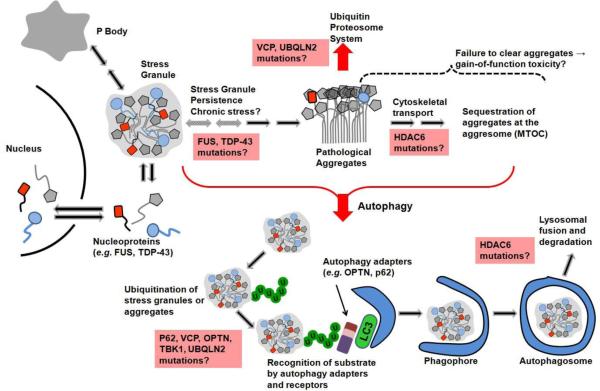
Amyotrophic lateral sclerosis (ALS) is a progressive, fatal disease caused by loss of upper and lower motor neurons. The majority of ALS cases are classified as sporadic (80-90%), with the remaining considered familial based on patient history. The last decade has seen a surge in the identification of ALS-causing genes - including TARDBP (TDP-43), FUS, MATR3 (Matrin-3), C9ORF72 and several others - providing important insights into the molecular pathways involved in pathogenesis. Most of the protein products of ALS-linked genes fall into two functional categories: RNA-binding/homeostasis and protein-quality control (i.e. autophagy and proteasome). The RNA-binding proteins tend to be aggregation-prone with low-complexity domains similar to the prion-forming domains of yeast. Many also incorporate into stress granules (SGs), which are cytoplasmic ribonucleoprotein complexes that form in response to cellular stress. Mutant forms of TDP-43 and FUS perturb SG dynamics, lengthening their cytoplasmic persistence. Recent evidence suggests that SGs are regulated by the autophagy pathway, suggesting a unifying connection between many of the ALS-linked genes. Persistent SGs may give rise to intractable aggregates that disrupt neuronal homeostasis, thus failure to clear SGs by autophagic processes may promote ALS pathogenesis. This article is part of a Special Issue entitled SI:Autophagy.
肌萎缩侧索硬化症(ALS)是一种由上、下运动神经元丧失引起的进行性致命疾病。大多数ALS病例被归类为散发性(80-90%),其余病例根据患者病史被认为是家族性的。在过去十年中,导致ALS的基因大量被发现,包括TARDBP(TDP-43)、FUS、MATR3(核纤层蛋白-3)、C9ORF72等,这为发病机制中涉及的分子途径提供了重要见解。与ALS相关的基因的大多数蛋白质产物可分为两个功能类别:RNA结合/内稳态和蛋白质质量控制(即自噬和蛋白酶体)。RNA结合蛋白往往容易聚集,具有与酵母朊病毒形成结构域相似的低复杂性结构域。许多蛋白还会整合到应激颗粒(SGs)中,应激颗粒是细胞应激时形成的细胞质核糖核蛋白复合物。TDP-43和FUS的突变形式会扰乱SG动态,延长其在细胞质中的存留时间。最近的证据表明,SGs受自噬途径调控,这表明许多与ALS相关的基因之间存在统一联系。持续存在的SGs可能会产生难以处理的聚集体从而破坏神经元内稳态,因此通过自噬过程无法清除SGs可能会促进ALS发病机制。本文是名为“自噬”特刊的一部分。