Brown Martha, Hablützel Pascal, Friberg Ida M, Thomason Anna G, Stewart Alexander, Pachebat Justin A, Jackson Joseph A
IBERS, Aberystwyth University, Aberystwyth, SY23 3DA, UK.
School of Environment and Life sciences, University of Salford, Salford, M5 4WT, UK.
BMC Genomics. 2016 May 18;17:369. doi: 10.1186/s12864-016-2701-7.
Fishes show seasonal patterns of immunity, but such phenomena are imperfectly understood in vertebrates generally, even in humans and mice. As these seasonal patterns may link to infectious disease risk and individual condition, the nature of their control has real practical implications. Here we characterize seasonal dynamics in the expression of conserved vertebrate immunity genes in a naturally-occurring piscine model, the three-spined stickleback.
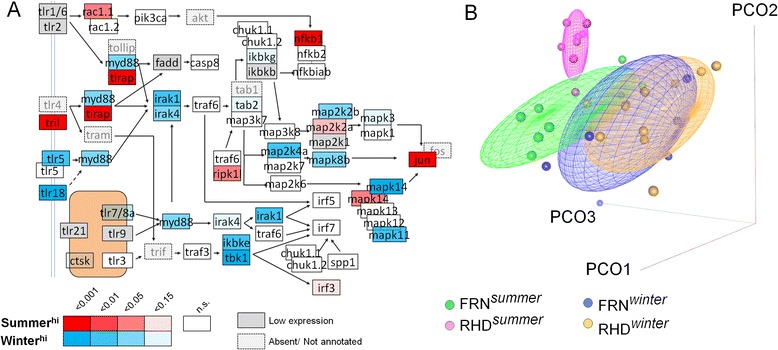
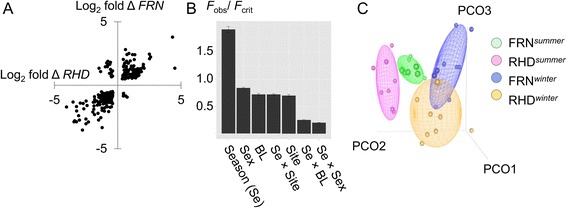
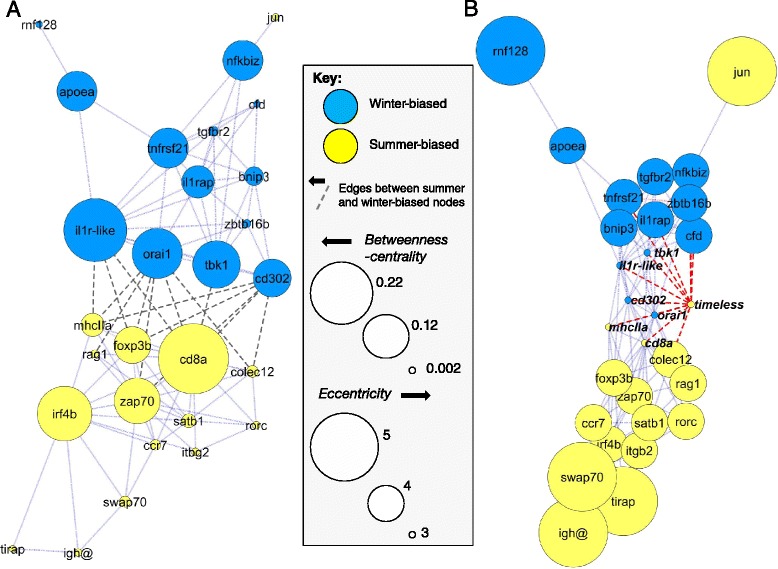
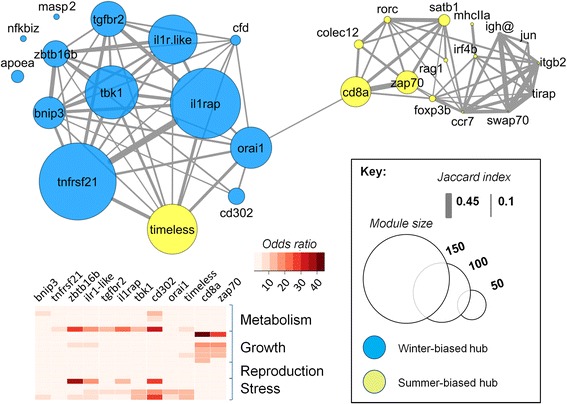
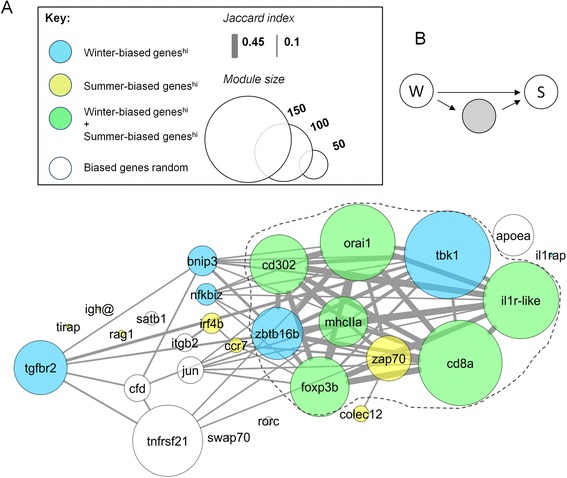
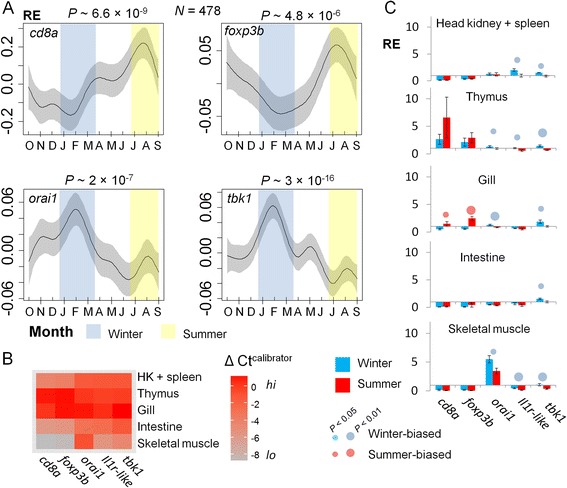
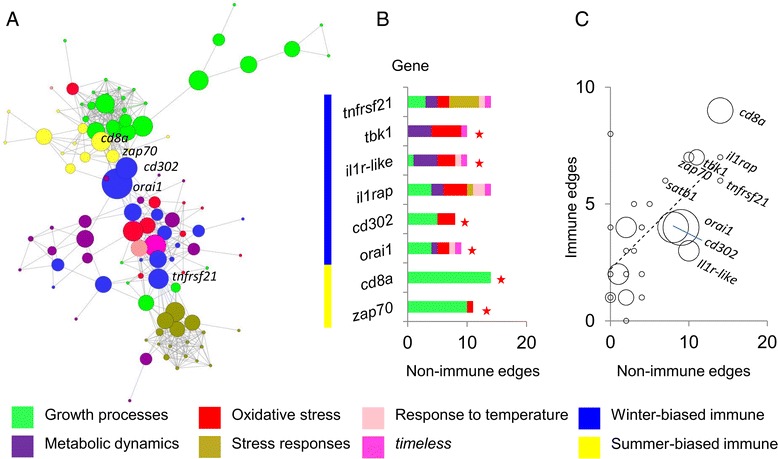
We made genome-wide measurements (RNAseq) of whole-fish mRNA pools (n = 36) at the end of summer and winter in contrasting habitats (riverine and lacustrine) and focussed on common trends to filter habitat-specific from overarching temporal responses. We corroborated this analysis with targeted year-round whole-fish gene expression (Q-PCR) studies in a different year (n = 478). We also considered seasonal tissue-specific expression (6 tissues) (n = 15) at a third contrasting (euryhaline) locality by Q-PCR, further validating the generality of the patterns seen in whole fish analyses. Extremes of season were the dominant predictor of immune expression (compared to sex, ontogeny or habitat). Signatures of adaptive immunity were elevated in late summer. In contrast, late winter was accompanied by signatures of innate immunity (including IL-1 signalling and non-classical complement activity) and modulated toll-like receptor signalling. Negative regulators of T-cell activity were prominent amongst winter-biased genes, suggesting that adaptive immunity is actively down-regulated during winter rather than passively tracking ambient temperature. Network analyses identified a small set of immune genes that might lie close to a regulatory axis. These genes acted as hubs linking summer-biased adaptive pathways, winter-biased innate pathways and other organismal processes, including growth, metabolic dynamics and responses to stress and temperature. Seasonal change was most pronounced in the gill, which contains a considerable concentration of T-cell activity in the stickleback.
Our results suggest major and predictable seasonal re-adjustments of immunity. Further consideration should be given to the effects of such responses in seasonally-occurring disease.
鱼类呈现出季节性免疫模式,但这类现象在整个脊椎动物中,甚至在人类和小鼠中,都尚未得到充分理解。由于这些季节性模式可能与传染病风险及个体状况相关,其调控本质具有实际的现实意义。在此,我们在一种自然存在的鱼类模型——三刺鱼中,对保守的脊椎动物免疫基因表达的季节性动态进行了表征。
我们在夏季末和冬季末,于不同生境(河流和湖泊)中对全鱼mRNA库进行了全基因组测量(RNA测序)(n = 36),并着重关注共同趋势,以从总体时间响应中筛选出特定生境的响应。我们在不同年份通过靶向全年全鱼基因表达(定量聚合酶链反应)研究(n = 478)对该分析进行了证实。我们还通过定量聚合酶链反应,在第三个对比(广盐性)地点考虑了季节性组织特异性表达(6种组织)(n = 15),进一步验证了全鱼分析中所见模式的普遍性。季节极端情况是免疫表达的主要预测因子(与性别、个体发育或生境相比)。适应性免疫特征在夏末升高。相比之下,冬末伴随着先天免疫特征(包括白细胞介素-1信号传导和非经典补体活性)以及受调控的Toll样受体信号传导。T细胞活性的负调节因子在冬季偏向的基因中很突出,这表明适应性免疫在冬季是被主动下调的,而非被动地随环境温度变化。网络分析确定了一小部分可能位于调控轴附近的免疫基因。这些基因作为枢纽,连接着夏季偏向的适应性途径、冬季偏向的先天途径以及其他机体过程,包括生长、代谢动态以及对压力和温度的反应。季节性变化在鳃中最为明显,三刺鱼的鳃中含有相当浓度的T细胞活性。
我们的结果表明免疫存在重大且可预测的季节性重新调整。应进一步考虑此类反应在季节性疾病中的影响。