Institut des Neurosciences de la Timone, Marseille, Aix-Marseille Université and CNRS UMR7289, France.
Services d'Anatomie Pathologique-Neuropathologique et de Pharmacie, Assistance Publique - Hopitaux de Marseille, Marseille, France.
Sci Rep. 2016 May 19;6:26381. doi: 10.1038/srep26381.
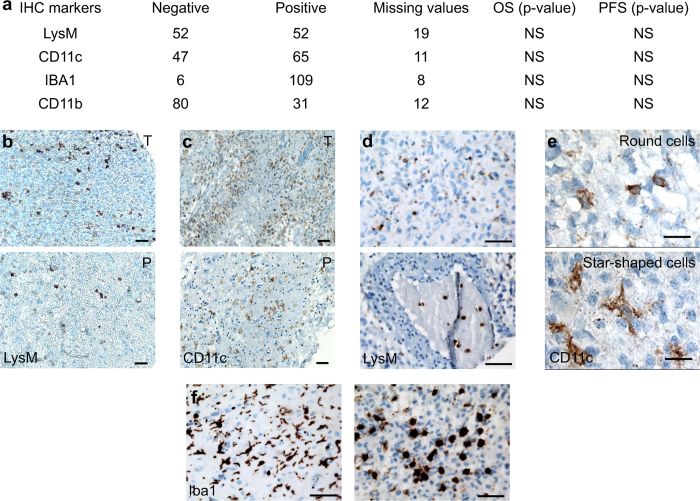
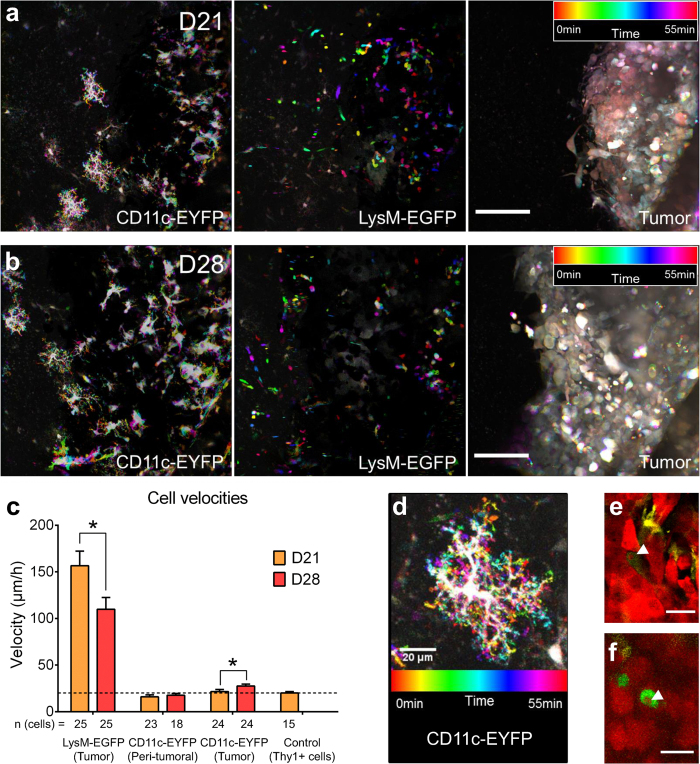
Inflammatory cells, an integral component of tumor evolution, are present in Glioblastomas multiforme (GBM). To address the cellular basis and dynamics of the inflammatory microenvironment in GBM, we established an orthotopic syngenic model by grafting GL261-DsRed cells in immunocompetent transgenic LysM-EGFP//CD11c-EYFP reporter mice. We combined dynamic spectral two-photon imaging with multiparametric cytometry and multicolor immunostaining to characterize spatio-temporal distribution, morphology and activity of microglia and blood-derived infiltrating myeloid cells in live mice. Early stages of tumor development were dominated by microglial EYFP(+) cells invading the tumor, followed by massive recruitment of circulating LysM-EGFP(+) cells. Fluorescent invading cells were conventional XCR1(+) and monocyte-derived dendritic cells distributed in subpopulations of different maturation stages, located in different areas relative to the tumor core. The lethal stage of the disease was characterized by the progressive accumulation of EGFP(+)/EYFP(+) monocyte-derived dendritic cells. This local phenotypic regulation of monocyte subtypes marked a transition in the immune response.
炎症细胞是肿瘤进化的一个组成部分,存在于多形性胶质母细胞瘤(GBM)中。为了研究 GBM 中炎症微环境的细胞基础和动态,我们通过将 GL261-DsRed 细胞移植到免疫活性转基因 LysM-EGFP//CD11c-EYFP 报告小鼠中,建立了一个原位同基因模型。我们结合动态光谱双光子成像与多参数细胞术和多色免疫染色,在活小鼠中描述小胶质细胞和血源性浸润髓样细胞的时空分布、形态和活性。肿瘤早期发展阶段以浸润肿瘤的 EYFP(+)小胶质细胞为主,随后大量循环的 LysM-EGFP(+)细胞募集。荧光浸润细胞是常规的 XCR1(+)和单核细胞衍生的树突状细胞,分布在不同成熟阶段的亚群中,位于肿瘤核心的不同区域。疾病的致死阶段的特征是 EGFP(+)/EYFP(+)单核细胞衍生的树突状细胞的逐渐积累。这种单核细胞亚型的局部表型调节标志着免疫反应的转变。