Geraldo Marcos Tadeu, Valente Guilherme Targino, Nakajima Rafael Takahiro, Martins Cesar
Integrative Genomics Laboratory, Department of Morphology, Institute of Biosciences, Sao Paulo State University-UNESP, Botucatu, SP, 18618-000, Brazil.
Systems Biology and Genomics Laboratory, Department of Bioprocess and Biotechnology, Agronomical Science Faculty, Sao Paulo State University-UNESP, Botucatu, SP, 18610-307, Brazil.
PLoS One. 2016 May 19;11(5):e0156199. doi: 10.1371/journal.pone.0156199. eCollection 2016.
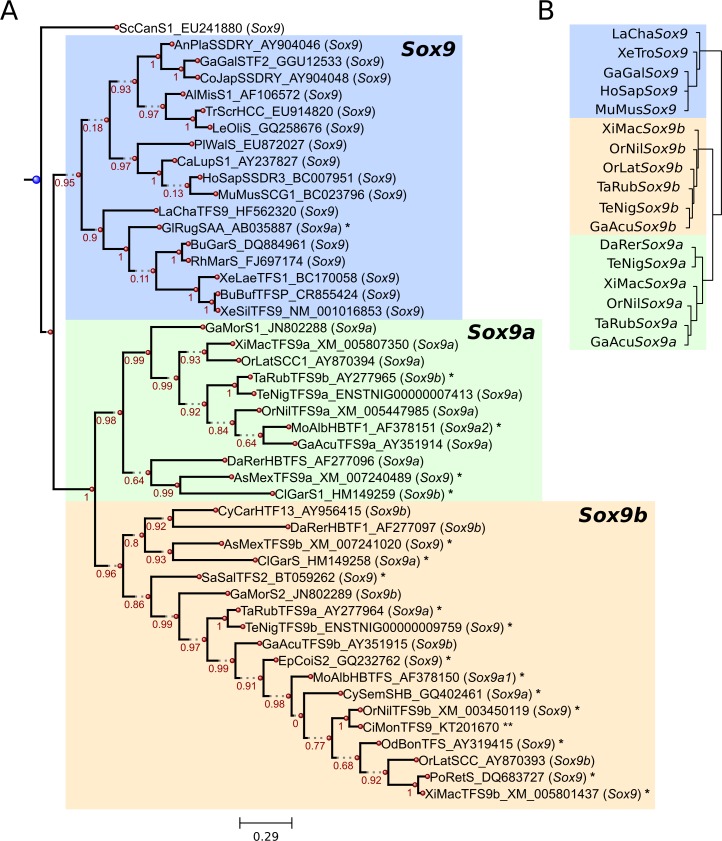
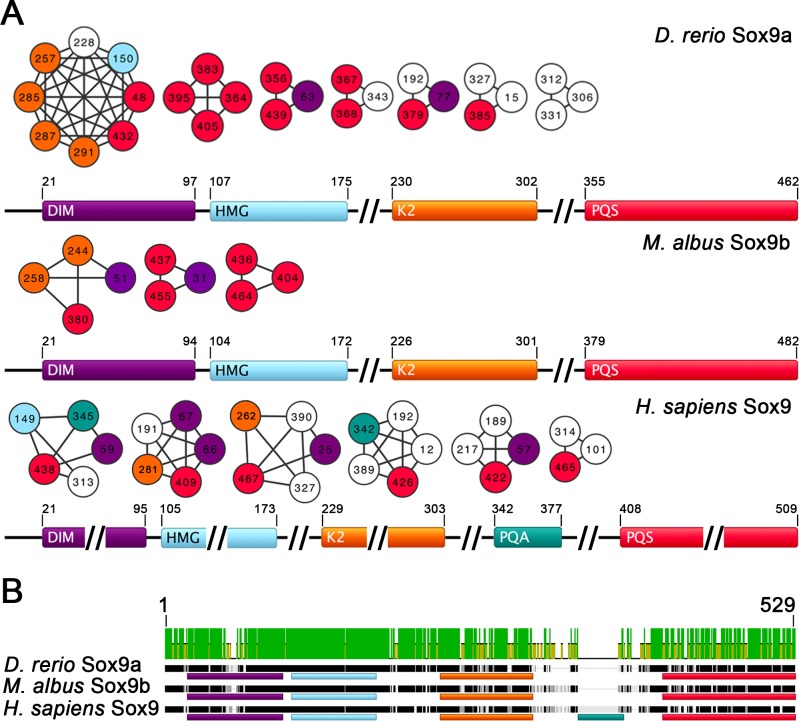
Sox9 plays an important role in a large variety of developmental pathways in vertebrates. It is composed of three domains: high-mobility group box (HMG box), dimerization (DIM) and transactivation (TAD). One of the main processes for regulation and variability of the pathways involving Sox9 is the self-gene expression regulation of Sox9. However, the subsequent roles of the Sox9 domains can also generate regulatory modulations. Studies have shown that TADs can bind to different types of proteins and its function seems to be influenced by DIM. Therefore, we hypothesized that both domains are directly associated and can be responsible for the functional variability of Sox9. We applied a method based on a broad phylogenetic context, using sequences of the HMG box domain, to ensure the homology of all the Sox9 copies used herein. The data obtained included 4,921 sequences relative to 657 metazoan species. Based on coevolutionary and selective pressure analyses of the Sox9 sequences, we observed coevolutions involving DIM and TADs. These data, along with the experimental data from literature, indicate a functional relationship between these domains. Moreover, DIM and TADs may be responsible for the functional plasticity of Sox9 because they are more tolerant for molecular changes (higher Ka/Ks ratio than the HMG box domain). This tolerance could allow a differential regulation of target genes or promote novel targets during transcriptional activation. In conclusion, we suggest that DIM and TADs functional association may regulate differentially the target genes or even promote novel targets during transcription activation mediated by Sox9 paralogs, contributing to the subfunctionalization of Sox9a and Sox9b in teleosts.
Sox9在脊椎动物多种发育途径中发挥着重要作用。它由三个结构域组成:高迁移率族盒(HMG盒)、二聚化(DIM)和反式激活(TAD)。涉及Sox9的途径的调控和变异性的主要过程之一是Sox9的自身基因表达调控。然而,Sox9结构域的后续作用也可产生调控调节。研究表明,TADs可与不同类型的蛋白质结合,其功能似乎受DIM影响。因此,我们推测这两个结构域直接相关,且可能是Sox9功能变异性的原因。我们应用了一种基于广泛系统发育背景的方法,使用HMG盒结构域的序列,以确保本文所用所有Sox9拷贝的同源性。获得的数据包括相对于657种后生动物物种的4921个序列。基于对Sox9序列的共进化和选择压力分析,我们观察到涉及DIM和TADs的共进化。这些数据,连同文献中的实验数据,表明了这些结构域之间的功能关系。此外,DIM和TADs可能是Sox9功能可塑性的原因,因为它们对分子变化的耐受性更强(Ka/Ks比值高于HMG盒结构域)。这种耐受性可能允许对靶基因进行差异调控,或在转录激活过程中促进新的靶标。总之,我们认为DIM和TADs的功能关联可能在由Sox9旁系同源物介导的转录激活过程中对靶基因进行差异调控,甚至促进新的靶标,这有助于硬骨鱼中Sox9a和Sox9b的亚功能化。