Bhetariya Preetida J, Prajapati Madhvi, Bhaduri Asani, Mandal Rahul Shubhra, Varma Anupam, Madan Taruna, Singh Yogendra, Sarma P Usha
Division of Plant Pathology, Indian Agricultural Research Institute, Pusa Campus, New Delhi, India.
Cluster innovation Centre, University of Delhi, Delhi, India.
Evol Bioinform Online. 2016 May 10;12:109-19. doi: 10.4137/EBO.S32694. eCollection 2016.
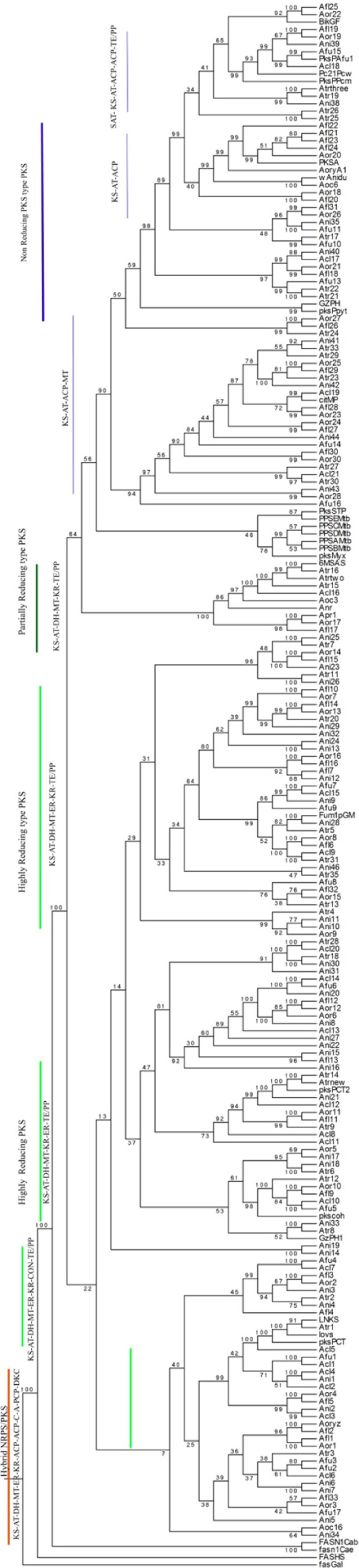
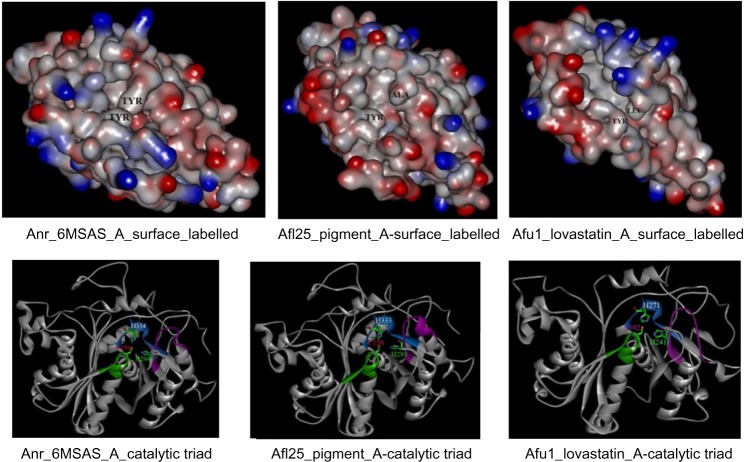
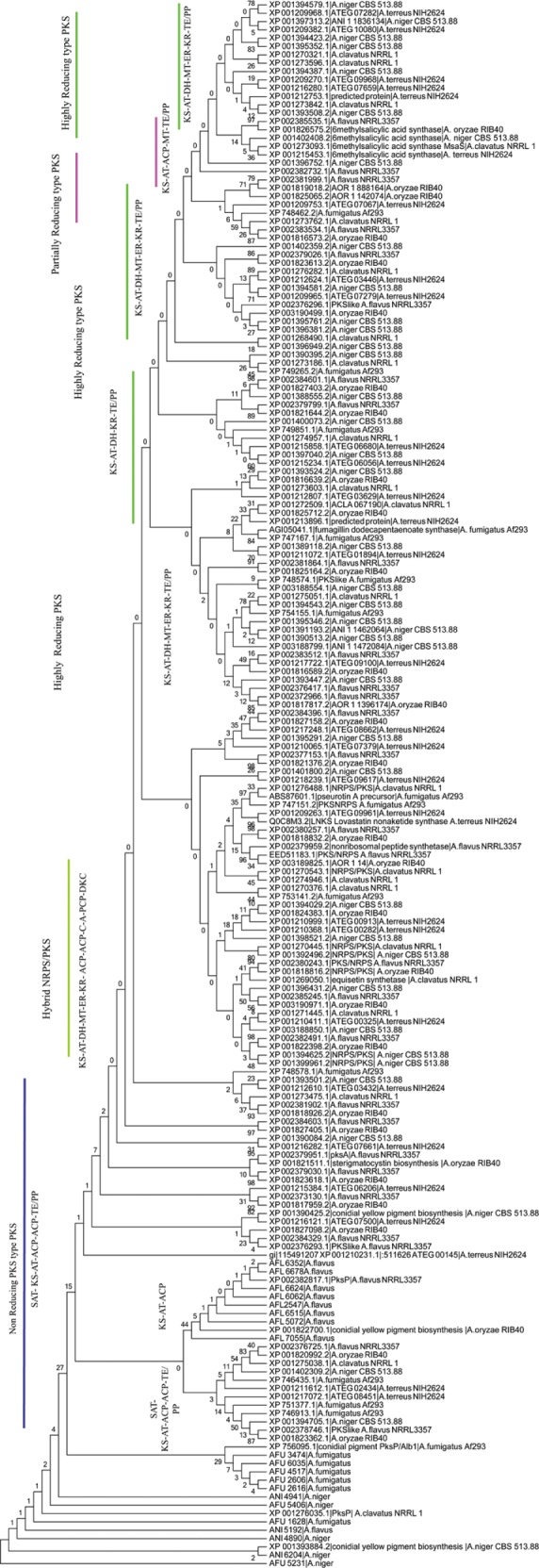
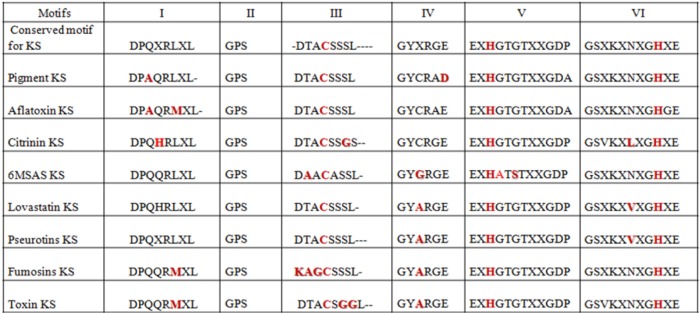
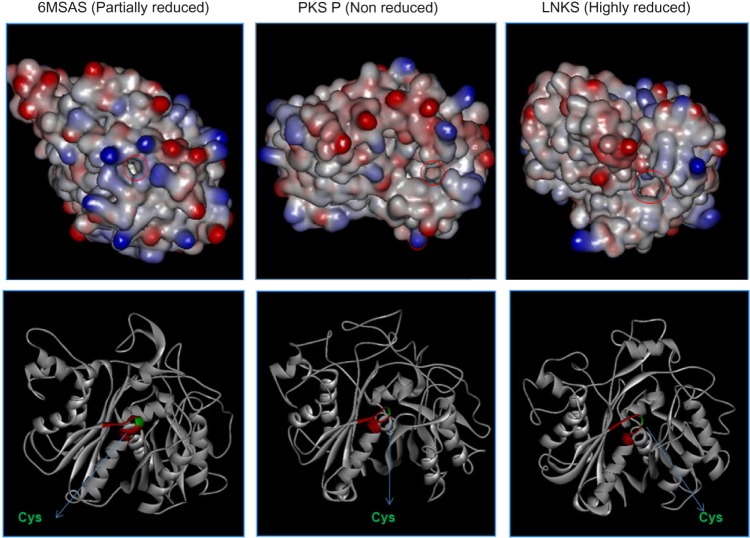
Polyketide synthases (PKSs) of Aspergillus species are multidomain and multifunctional megaenzymes that play an important role in the synthesis of diverse polyketide compounds. Putative PKS protein sequences from Aspergillus species representing medically, agriculturally, and industrially important Aspergillus species were chosen and screened for in silico studies. Six candidate Aspergillus species, Aspergillus fumigatus Af293, Aspergillus flavus NRRL3357, Aspergillus niger CBS 513.88, Aspergillus terreus NIH2624, Aspergillus oryzae RIB40, and Aspergillus clavatus NRRL1, were selected to study the PKS phylogeny. Full-length PKS proteins and only ketosynthase (KS) domain sequence were retrieved for independent phylogenetic analysis from the aforementioned species, and phylogenetic analysis was performed with characterized fungal PKS. This resulted into grouping of Aspergilli PKSs into nonreducing (NR), partially reducing (PR), and highly reducing (HR) PKS enzymes. Eight distinct clades with unique domain arrangements were classified based on homology with functionally characterized PKS enzymes. Conserved motif signatures corresponding to each type of PKS were observed. Three proteins from Protein Data Bank corresponding to NR, PR, and HR type of PKS (XP_002384329.1, XP_753141.2, and XP_001402408.2, respectively) were selected for mapping of conserved motifs on three-dimensional structures of KS domain. Structural variations were found at the active sites on modeled NR, PR, and HR enzymes of Aspergillus. It was observed that the number of iteration cycles was dependent on the size of the cavity in the active site of the PKS enzyme correlating with a type with reducing or NR products, such as pigment, 6MSA, and lovastatin. The current study reports the grouping and classification of PKS proteins of Aspergilli for possible exploration of novel polyketides based on sequence homology; this information can be useful for selection of PKS for polyketide exploration and specific detection of Aspergilli.
曲霉属物种的聚酮合酶(PKSs)是多结构域和多功能的巨型酶,在多种聚酮化合物的合成中发挥重要作用。选择了代表医学、农业和工业上重要曲霉属物种的曲霉属物种的假定PKS蛋白序列,并进行计算机模拟研究筛选。选择了六个候选曲霉属物种,烟曲霉Af293、黄曲霉NRRL3357、黑曲霉CBS 513.88、土曲霉NIH2624、米曲霉RIB40和棒曲霉NRRL1,来研究PKS系统发育。从上述物种中检索全长PKS蛋白和仅酮缩合酶(KS)结构域序列用于独立的系统发育分析,并与已鉴定的真菌PKS进行系统发育分析。这导致曲霉属PKSs被分为非还原型(NR)、部分还原型(PR)和高度还原型(HR)PKS酶。基于与功能已鉴定的PKS酶的同源性,分类出八个具有独特结构域排列的不同进化枝。观察到对应于每种类型PKS的保守基序特征。从蛋白质数据库中选择了对应于NR、PR和HR型PKS的三种蛋白质(分别为XP_002384329.1、XP_753141.2和XP_001402408.2),用于在KS结构域的三维结构上绘制保守基序。在曲霉属的模拟NR、PR和HR酶的活性位点发现了结构变异。观察到迭代循环的次数取决于PKS酶活性位点中腔的大小,这与产生还原型或NR产物(如色素、6MSA和洛伐他汀)的类型相关。当前研究报告了曲霉属PKS蛋白的分组和分类,以便基于序列同源性探索新型聚酮化合物;该信息可用于选择用于聚酮化合物探索的PKS以及曲霉属的特异性检测。