Rich Alisa L, Orimoloye Helen T
Department of Environmental and Occupational Health Science, University of North Texas Health Science Center, Fort Worth, TX, USA.; WHO Chemical Risk Assessment Network, Geneva, Switzerland.
Department of Environmental and Occupational Health Science, University of North Texas Health Science Center, Fort Worth, TX, USA.
Environ Health Insights. 2016 May 15;10:75-82. doi: 10.4137/EHI.S33314. eCollection 2016.
The advancement of natural gas (NG) extraction across the United States (U.S.) raises concern for potential exposure to hazardous air pollutants (HAPs). Benzene, a HAP and a primary chemical of concern due to its classification as a known human carcinogen, is present in petroleum-rich geologic formations and is formed during the combustion of bypass NG. It is a component in solvents, paraffin breakers, and fuels used in NG extraction and processing (E&P).
The objectives of this study are to confirm the presence of benzene and benzene-related compounds (benzene[s]) in residential areas, where unconventional shale E&P is occurring, and to determine if benzene[s] exists in elevated atmospheric concentrations when compared to national background levels.
Ambient air sampling was conducted in six counties in the Dallas/Fort Worth Metroplex with passive samples collected in evacuated 6-L Summa canisters. Samples were analyzed by gas chromatography/mass spectrometry, with sampling performed at variable distances from the facility fence line.
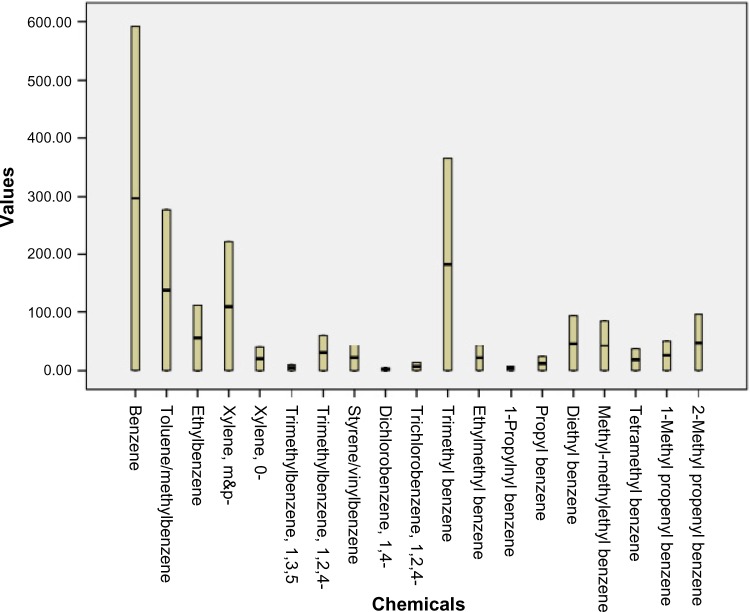
Elevated concentrations of benzene[s] in the atmosphere were identified when compared to U.S. Environmental Protection Agency's Urban Air Toxics Monitoring Program. The 24-hour benzene concentrations ranged from 0.6 parts per billion by volume (ppbv) to 592 ppbv, with 1-hour concentrations from 2.94 ppbv to 2,900.20 ppbv.
Benzene is a known human carcinogen capable of multisystem health effects. Exposure to benzene is correlated with bone marrow and blood-forming organ damage and immune system depression. Sensitive populations (children, pregnant women, elderly, immunocompromised) and occupational workers are at increased risk for adverse health effects from elevated atmospheric levels of benzene[s] in residential areas with unconventional shale E&P.
美国各地天然气(NG)开采活动的增加引发了人们对潜在接触有害空气污染物(HAPs)的担忧。苯是一种HAP,由于其被列为已知的人类致癌物,是主要关注的化学品,它存在于富含石油的地质构造中,并且在伴生气燃烧过程中形成。它是天然气开采和加工(勘探与生产,E&P)中使用的溶剂、石蜡破乳剂和燃料的成分之一。
本研究的目的是确认在进行非常规页岩勘探与生产的居民区中是否存在苯及苯相关化合物(苯类物质),并确定与国家背景水平相比,苯类物质在大气中的浓度是否升高。
在达拉斯/沃思堡都会区的六个县进行了环境空气采样,使用抽空的6升苏玛罐收集被动样品。样品通过气相色谱/质谱法进行分析,采样在距设施围栏线不同距离处进行。
与美国环境保护局的城市空气有毒物质监测计划相比,大气中苯类物质的浓度升高。24小时苯浓度范围为每体积十亿分之0.6(ppbv)至592 ppbv,1小时浓度范围为2.94 ppbv至2900.20 ppbv。
苯是一种已知的人类致癌物,能够对多个系统产生健康影响。接触苯与骨髓和造血器官损伤以及免疫系统抑制有关。在进行非常规页岩勘探与生产的居民区,敏感人群(儿童、孕妇、老年人、免疫功能低下者)和职业工人因大气中苯类物质浓度升高而面临健康不良影响的风险增加。