Calabrese Evan
Center for In Vivo Microscopy, Department of Radiology, Duke University Medical Center Durham, NC, USA.
Front Neuroanat. 2016 May 2;10:45. doi: 10.3389/fnana.2016.00045. eCollection 2016.
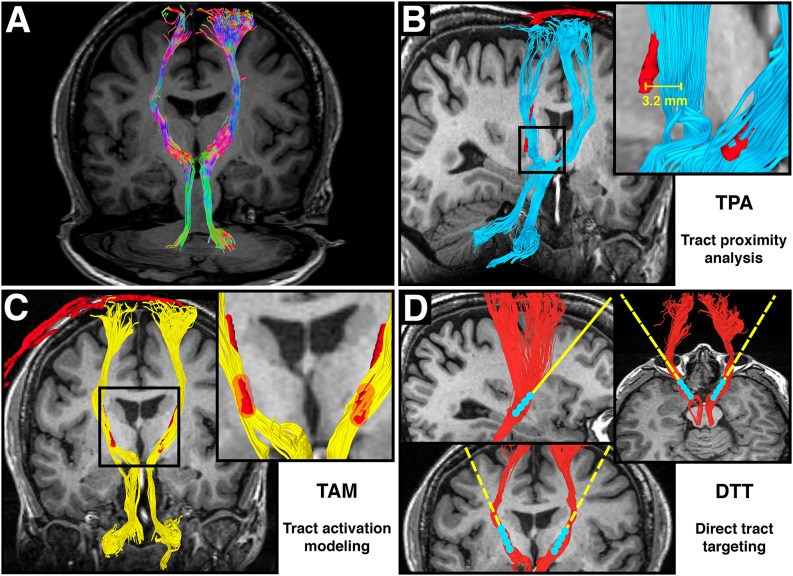
Deep brain stimulation (DBS) is believed to exert its therapeutic effects through modulation of brain circuitry, yet conventional preoperative planning does not allow direct targeting or visualization of white matter pathways. Diffusion MRI tractography (DT) is virtually the only non-invasive method of visualizing structural connectivity in the brain, leading many to suggest its use to guide DBS targeting. DT-guided DBS not only has the potential to allow direct white matter targeting for established applications [e.g., Parkinson's disease (PD), essential tremor (ET), dystonia], but may also aid in the discovery of new therapeutic targets for a variety of other neurologic and psychiatric diseases. Despite these exciting opportunities, DT lacks standardization and rigorous anatomic validation, raising significant concern for the use of such data in stereotactic brain surgery. This review covers the technical details, proposed methods, and initial clinical data for the use of DT in DBS surgery. Rather than focusing on specific disease applications, this review focuses on methods that can be applied to virtually any DBS target.
深部脑刺激(DBS)被认为是通过调节脑回路来发挥其治疗作用的,然而传统的术前规划并不允许直接针对白质通路进行靶向或可视化。磁共振扩散张量成像(DT)实际上是唯一一种可视化大脑结构连接性的非侵入性方法,这使得许多人建议使用它来指导DBS靶向。DT引导的DBS不仅有可能在既定应用中(如帕金森病(PD)、特发性震颤(ET)、肌张力障碍)实现对白质的直接靶向,还可能有助于发现多种其他神经和精神疾病的新治疗靶点。尽管有这些令人兴奋的机会,但DT缺乏标准化和严格的解剖学验证,这引发了人们对在立体定向脑手术中使用此类数据的重大担忧。这篇综述涵盖了DT在DBS手术中的技术细节、提议的方法和初步临床数据。本综述并非专注于特定疾病的应用,而是侧重于可应用于几乎任何DBS靶点的方法。