Brown Derrick D, Meulenbroek Ruud G J
Donders Institute for Brain, Cognition and Behavior - Donders Centre for Cognition, Radboud University Nijmegen Nijmegen, Netherlands.
Front Psychol. 2016 May 2;7:614. doi: 10.3389/fpsyg.2016.00614. eCollection 2016.
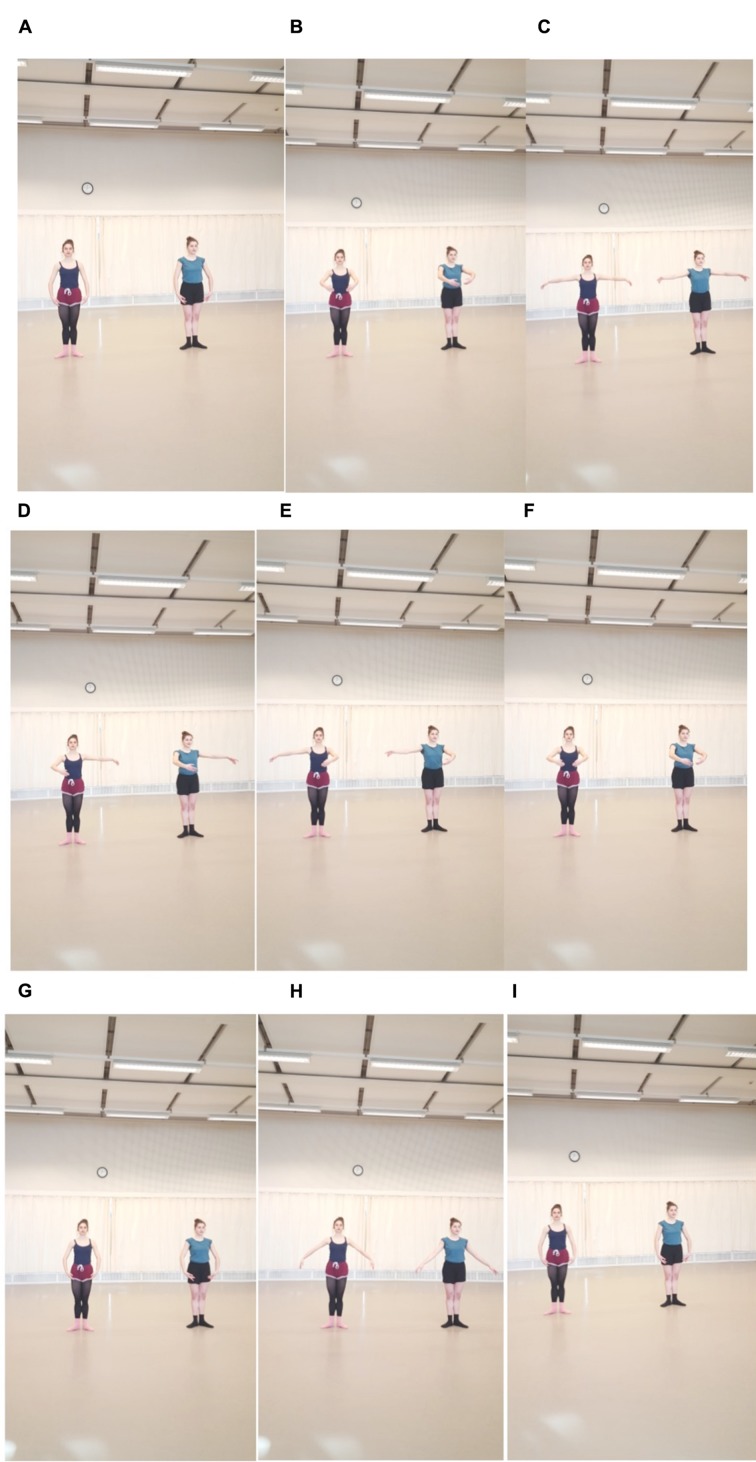
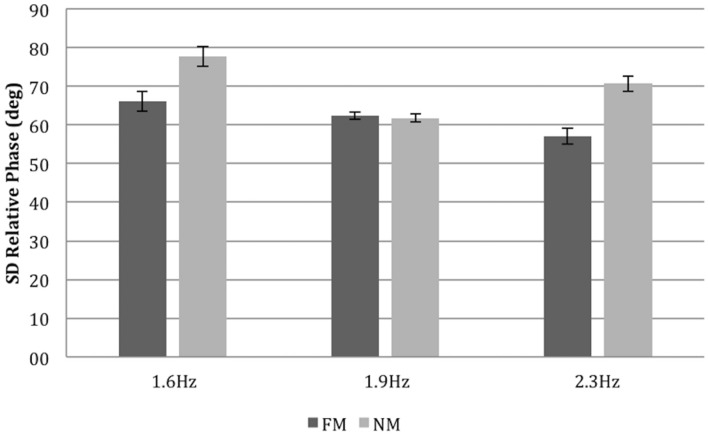
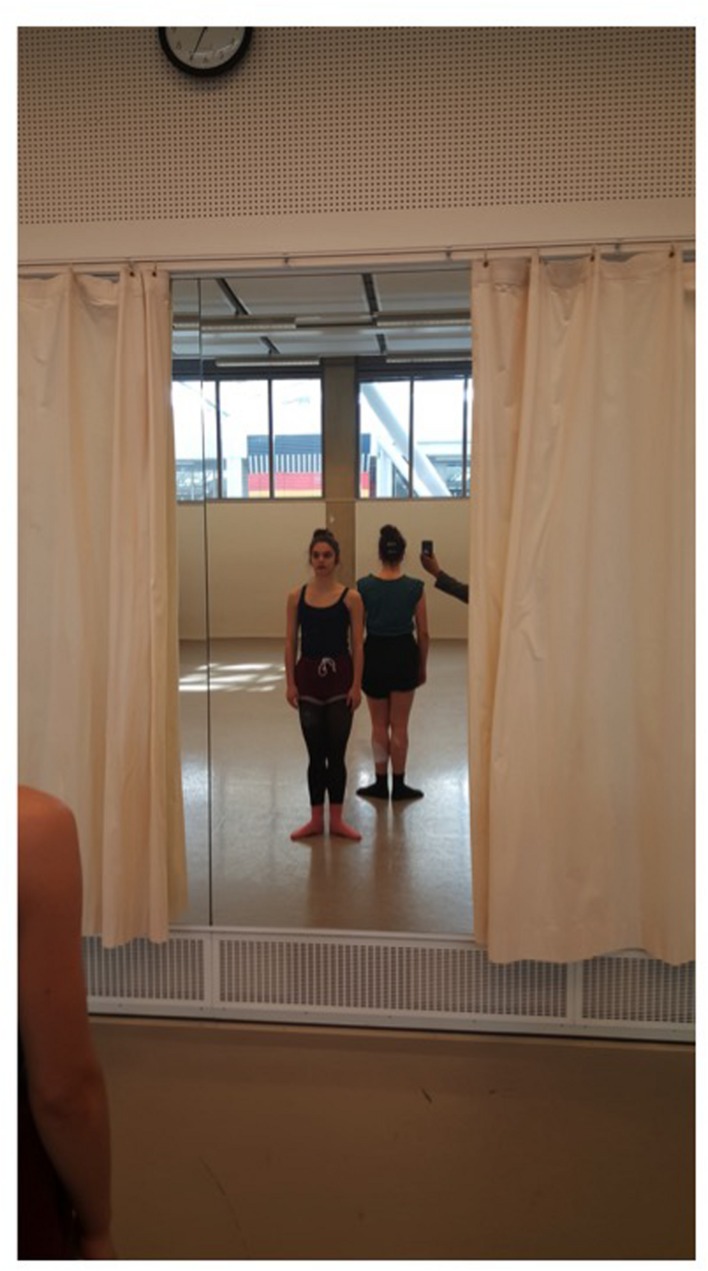
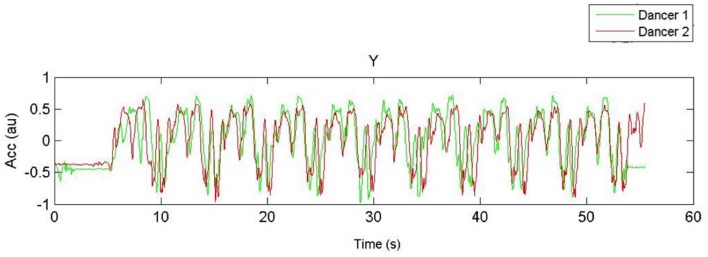
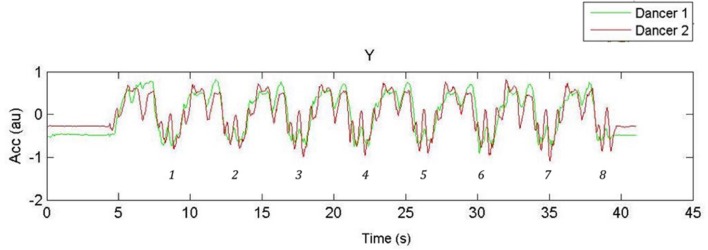
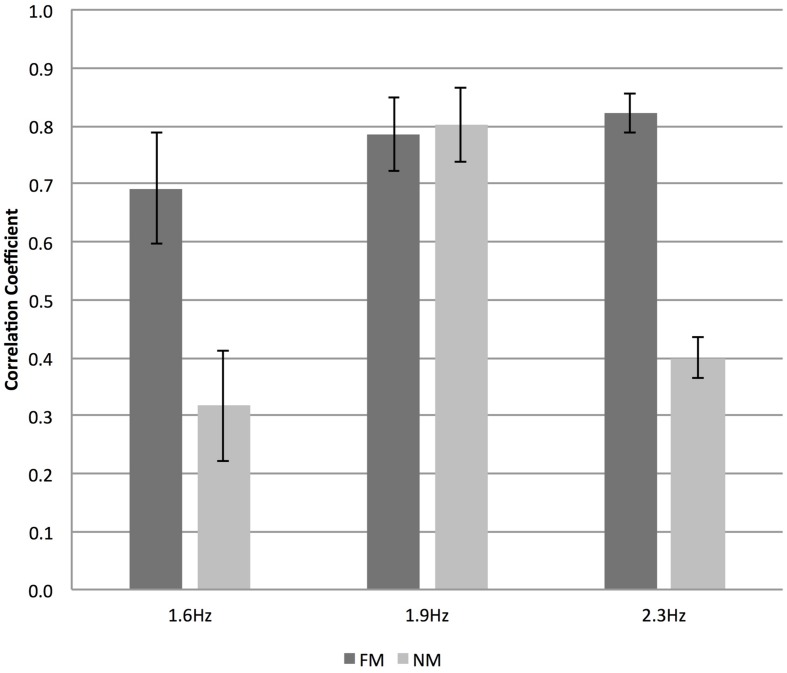
In this study we investigated the effects of a mirror-mediated, partial view of one's dance partner on interpersonal coordination in dance duets. Fourteen participant pairs (dyads) were asked to perform a reflectionally-symmetric eight-segment dance-relevant arm movement sequence in two visual conditions: with one dancer facing the mirror and providing a partial view on the dance partner, or both dancers facing back to back with, for both dancers, no view on one's partner. During an eight-count beat-preparation phase, the task was paced via a metronome at three TEMPI; 1.6, 1.9, and 2.3 Hz, which was subsequently removed after which the movement sequence continued in silence. Interpersonal coordination was assessed using two tri-axial wireless accelerometers, one fixed to each dancer, that allowed the off-line kinematic analyses of dyad correlation, mean relative phase and mean standard deviation of relative phase of the up-down movements of (one of) the hands of the two dancers. In addition, two independent raters estimated the realized movement frequencies and percentage of the trial duration that the dancers moved in sync. Repeated measure ANOVAs revealed systematic effects of tempo on the performance measures, a positive effect of the use of the mirror on the coordination of the dancers' movements but no facilitating effect of the mirror on the dancers' synchronization. Overall, the results support the contention that when dancing to an internalized rhythmic beat the use of a mirror provides an ecological means to stabilize interpersonal coordination in dance duets without an effect on synchronization.
在本研究中,我们调查了在双人舞蹈中,通过镜子介导的、对舞伴的部分视野对人际协调的影响。十四对参与者(二元组)被要求在两种视觉条件下执行一个反射对称的八段与舞蹈相关的手臂动作序列:一种是一名舞者面对镜子,为舞伴提供部分视野;另一种是两名舞者背靠背,双方都看不到对方。在八拍的节拍准备阶段,任务通过节拍器以三种节奏进行;1.6、1.9和2.3赫兹,随后节拍器移除,动作序列在静音状态下继续。人际协调通过两个三轴无线加速度计进行评估,每个舞者身上固定一个,这使得能够对二元组相关性、平均相对相位以及两名舞者(其中一人)手部上下运动的相对相位的平均标准偏差进行离线运动学分析。此外,两名独立的评分者估计了实际的运动频率以及舞者同步移动的试验持续时间百分比。重复测量方差分析揭示了节奏对表现指标的系统性影响,使用镜子对舞者动作协调有积极影响,但对舞者同步没有促进作用。总体而言,结果支持这样的观点,即在跟随内化的节奏节拍跳舞时,使用镜子提供了一种生态手段来稳定双人舞蹈中的人际协调,而不会对同步产生影响。