Maeda Yoko, Kawahara Takashi, Koizumi Mitsuyuki, Ito Hiroki, Kumano Yohei, Ohtaka Mari, Kondo Takuya, Mochizuki Taku, Hattori Yusuke, Teranishi Jun-Ichi, Yumura Yasushi, Miyoshi Yasuhide, Yao Masahiro, Miyamoto Hiroshi, Uemura Hiroji
Departments of Urology and Renal Transportation, Yokohama City University Medical Center, Yokohama 2320024, Japan.
Departments of Urology and Renal Transportation, Yokohama City University Medical Center, Yokohama 2320024, Japan; Department of Urology, Yokohama City University, Graduate School of Medicine, Yokohama 2360004, Japan.
Biomed Res Int. 2016;2016:6197353. doi: 10.1155/2016/6197353. Epub 2016 Apr 20.
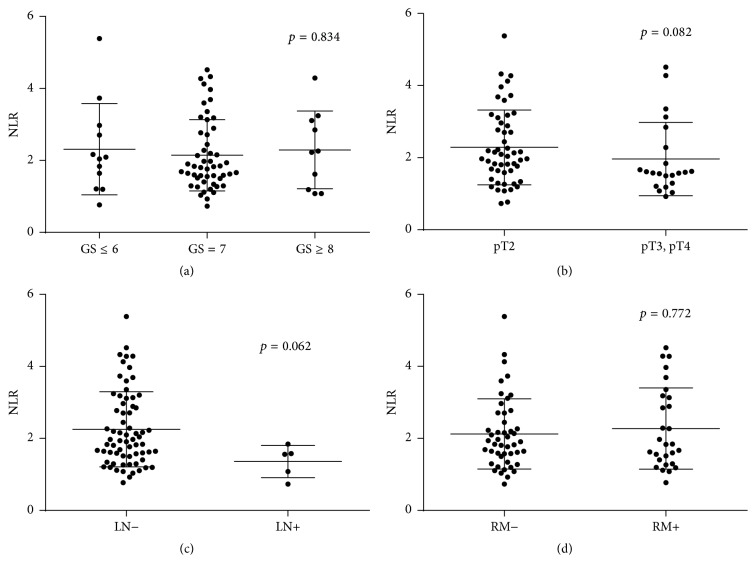
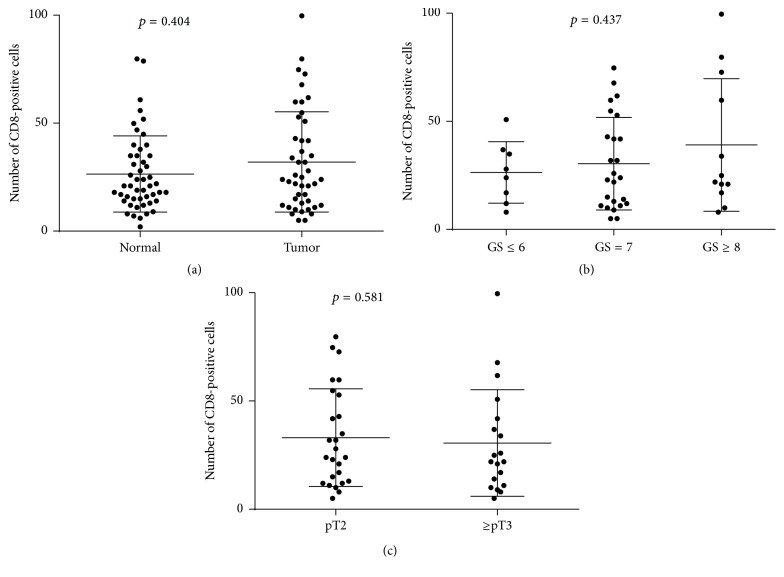
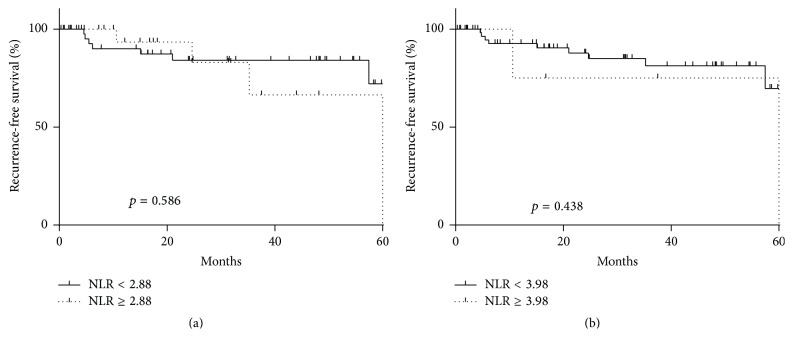
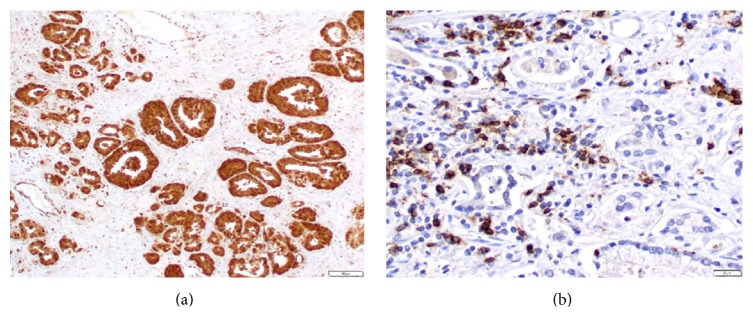
Introduction. The neutrophil-to-lymphocyte ratio (NLR), which can be easily calculated from routine complete blood counts of the peripheral blood, has been suggested to serve as a prognostic factor for some solid malignancies. In the present study, we aimed to determine the relationship between NLR in prostate cancer patients undergoing radical prostatectomy (RP) and their prognosis. Materials and Methods. We assessed NLR in 73 men (patients) who received RP for their prostate cancer. We also performed immunohistochemistry for CD8 and CD66b in a separate set of RP specimens. Results. The median NLR in the 73 patients was 1.85. There were no significant correlations of NLR with tumor grade (p = 0.834), pathological T stage (p = 0.082), lymph node metastasis (p = 0.062), or resection margin status (p = 0.772). Based on the area under the receiver operator characteristic curve (AUROC) to predict biochemical recurrence after RP, potential NLR cut-off point was determined to be 2.88 or 3.88. However, both of these cut-off points did not precisely predict the prognosis. There were no statistically significant differences in the number of CD66b-positive neutrophils or CD8-positive lymphocytes between stromal tissues adjacent to cancer glands and stromal tissues away from cancer glands and between different grades or stages of tumors. Conclusions. There was no association between NLR and biochemical failure after prostatectomy.
引言。中性粒细胞与淋巴细胞比值(NLR)可通过外周血常规全血细胞计数轻松计算得出,已被认为是某些实体恶性肿瘤的预后因素。在本研究中,我们旨在确定接受根治性前列腺切除术(RP)的前列腺癌患者的NLR与其预后之间的关系。材料与方法。我们评估了73名因前列腺癌接受RP的男性(患者)的NLR。我们还在另一组RP标本中对CD8和CD66b进行了免疫组织化学检测。结果。73例患者的NLR中位数为1.85。NLR与肿瘤分级(p = 0.834)、病理T分期(p = 0.082)、淋巴结转移(p = 0.062)或切缘状态(p = 0.772)均无显著相关性。根据预测RP后生化复发的受试者工作特征曲线下面积(AUROC),确定潜在的NLR切点为2.88或3.88。然而,这两个切点均不能准确预测预后。癌腺周围的基质组织与远离癌腺的基质组织之间以及不同分级或分期的肿瘤之间,CD66b阳性中性粒细胞或CD8阳性淋巴细胞的数量均无统计学显著差异。结论。前列腺切除术后NLR与生化失败之间无关联。