Kauff D W, Kronfeld K, Gorbulev S, Wachtlin D, Lang H, Kneist W
Department of General, Visceral and Transplant Surgery, University Medicine of the Johannes Gutenberg-University, Mainz, Germany.
Interdisciplinary Center for Clinical Trials (IZKS), University Medicine of the Johannes Gutenberg-University, Mainz, Germany.
BMC Cancer. 2016 May 21;16:323. doi: 10.1186/s12885-016-2348-4.
Urinary, sexual and anorectal sequelae are frequent after rectal cancer surgery and were found to be related to intraoperative neurogenic impairment. Neuromonitoring methods have been developed to identify and preserve the complex pelvic autonomic nervous system in order to maintain patients' quality of life. So far no randomized study has been published dealing with the role of neuromonitoring in rectal cancer surgery.
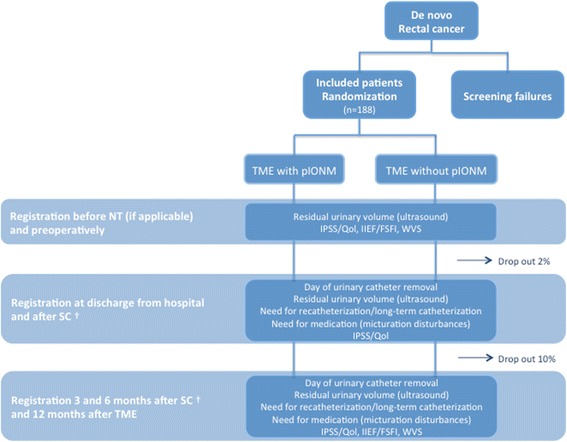
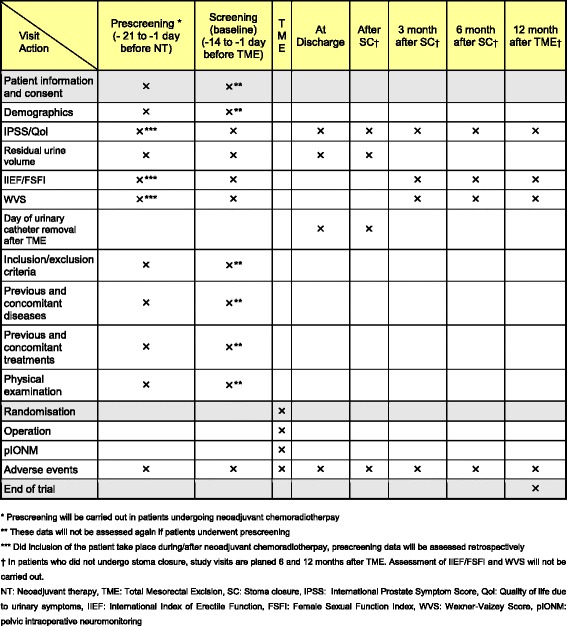
METHODS/DESIGN: NEUROS is a prospective two-arm randomized controlled multicenter clinical trial comparing the functional outcome in rectal cancer patients undergoing total mesorectal excision (TME) with and without pelvic intraoperative neuromonitoring (pIONM). A total of 188 patients will be included. Primary endpoint is the urinary function measured by the International Prostate Symptom Score. Secondary endpoints consist of sexual, anorectal functional outcome and safety, especially oncologic safety and quality of TME. Sexual function is assessed in females with the Female Sexual Function Index and in males with the International Index of Erectile Function. For evaluation of anorectal function the Wexner-Vaizey score is used. Functional evaluation is scheduled before radiochemotherapy (if applicable), preoperatively (baseline), before hospital discharge, 3 and 6 months after stoma closure and 12 months after surgery. For assessment of safety adverse events, the rates of positive resection margins and quality of mesorectum are documented.
This study will provide high quality evidence on the efficacy of pIONM aiming for improvement of functional outcome in rectal cancer patients undergoing TME.
Clinicaltrials.gov: NCT01585727 . Registration date is 04/25/2012.
直肠癌手术后泌尿、性和肛门直肠后遗症很常见,且发现与术中神经损伤有关。已开发出神经监测方法来识别和保留复杂的盆腔自主神经系统,以维持患者的生活质量。迄今为止,尚未发表关于神经监测在直肠癌手术中作用的随机研究。
方法/设计:NEUROS是一项前瞻性双臂随机对照多中心临床试验,比较接受全直肠系膜切除术(TME)的直肠癌患者在有和没有盆腔术中神经监测(pIONM)情况下的功能结局。总共将纳入188例患者。主要终点是通过国际前列腺症状评分测量的泌尿功能。次要终点包括性、肛门直肠功能结局和安全性,尤其是肿瘤学安全性和TME的质量。女性性功能通过女性性功能指数评估,男性性功能通过国际勃起功能指数评估。使用Wexner-Vaizey评分评估肛门直肠功能。功能评估计划在放化疗前(如适用)、术前(基线)、出院前、造口关闭后3个月和6个月以及手术后12个月进行。为评估安全性,记录不良事件、切缘阳性率和直肠系膜质量。
本研究将为pIONM改善接受TME的直肠癌患者功能结局的疗效提供高质量证据。
Clinicaltrials.gov:NCT01585727。注册日期为2012年4月25日。