Gadhamsetty Saikrishna, Coorens Tim, de Boer Rob J
Theoretical Biology, Utrecht University, Utrecht, The Netherlands.
University College Utrecht, Campusplein, Utrecht, The Netherlands.
J Virol. 2016 Jul 27;90(16):7066-7083. doi: 10.1128/JVI.00306-16. Print 2016 Aug 15.
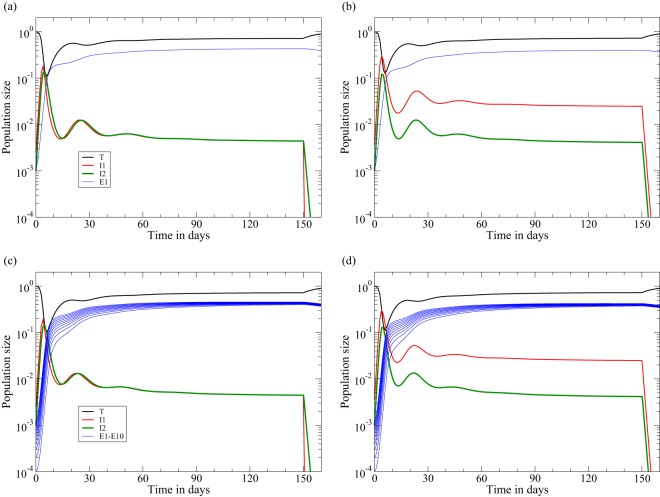
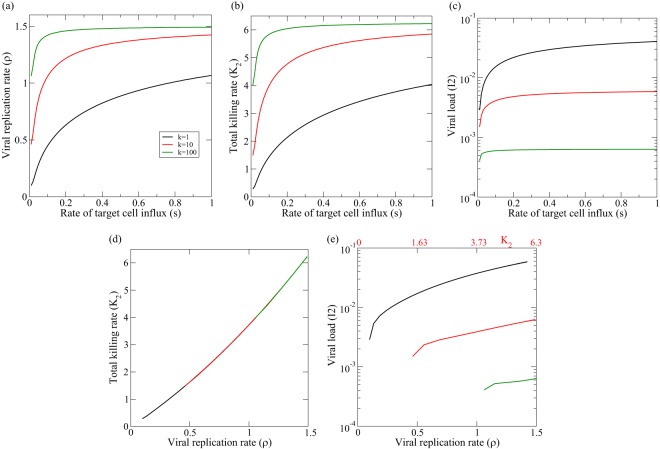
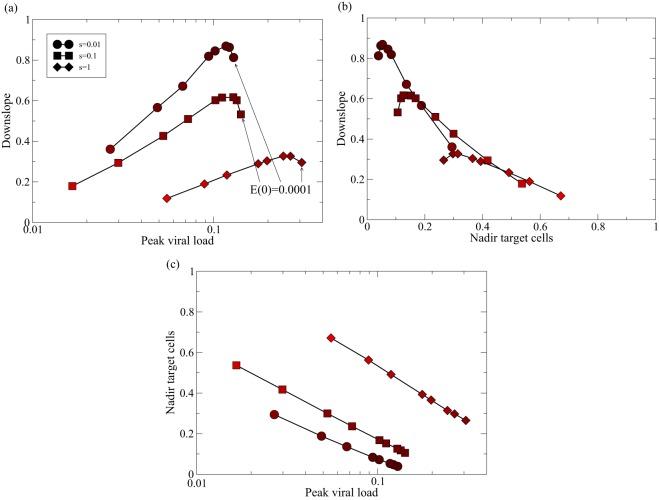
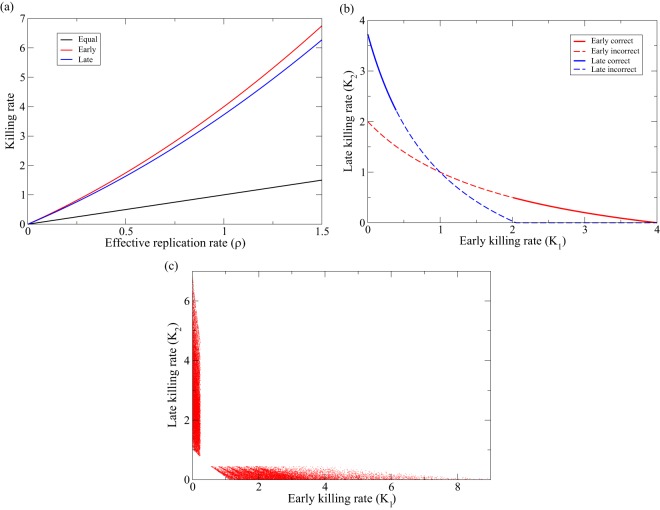
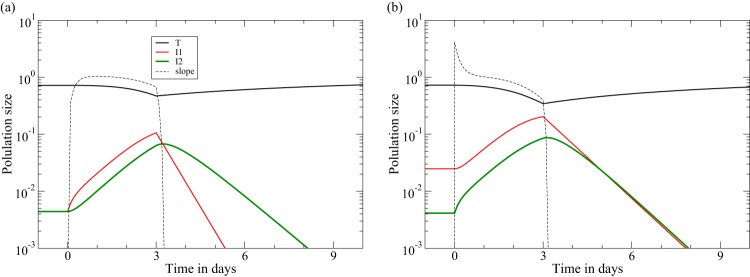
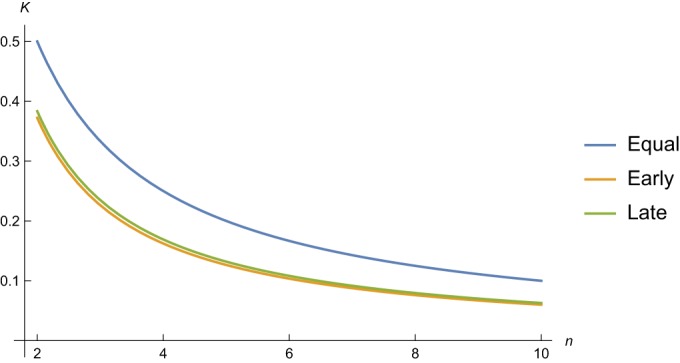
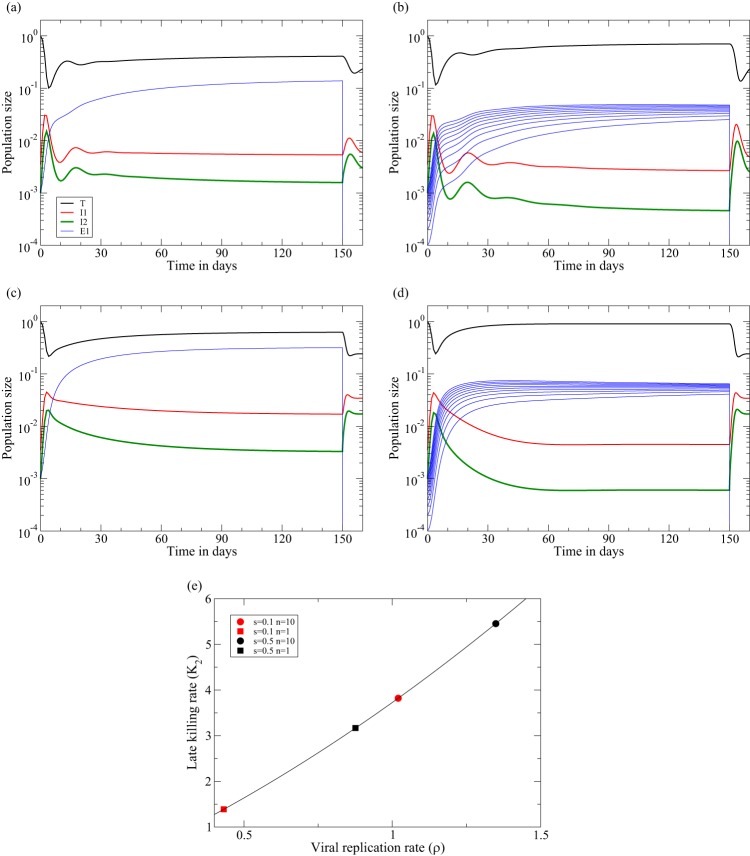
Several experiments suggest that in the chronic phase of human immunodeficiency virus type 1 (HIV-1) infection, CD8(+) cytotoxic T lymphocytes (CTL) contribute very little to the death of productively infected cells. First, the expected life span of productively infected cells is fairly long, i.e., about 1 day. Second, this life span is hardly affected by the depletion of CD8(+) T cells. Third, the rate at which mutants escaping a CTL response take over the viral population tends to be slow. Our main result is that all these observations are perfectly compatible with killing rates that are much faster than one per day once we invoke the fact that infected cells proceed through an eclipse phase of about 1 day before they start producing virus. Assuming that the major protective effect of CTL is cytolytic, we demonstrate that mathematical models with an eclipse phase account for the data when the killing is fast and when it varies over the life cycle of infected cells. Considering the steady state corresponding to the chronic phase of the infection, we find that the rate of immune escape and the rate at which the viral load increases following CD8(+) T cell depletion should reflect the viral replication rate, ρ. A meta-analysis of previous data shows that viral replication rates during chronic infection vary between 0.5 ≤ ρ ≤ 1 day(-1) Balancing such fast viral replication requires killing rates that are several times larger than ρ, implying that most productively infected cells would die by cytolytic effects.
Most current data suggest that cytotoxic T cells (CTL) mediate their control of human immunodeficiency virus type 1 (HIV-1) infection by nonlytic mechanisms; i.e., the data suggest that CTL hardly kill. This interpretation of these data has been based upon the general mathematical model for HIV infection. Because this model ignores the eclipse phase between the infection of a target cell and the start of viral production by that cell, we reanalyze the same data sets with novel models that do account for the eclipse phase. We find that the data are perfectly consistent with lytic control by CTL and predict that most productively infected cells are killed by CTL. Because the killing rate should balance the viral replication rate, we estimate both parameters from a large set of published experiments in which CD8(+) T cells were depleted in simian immunodeficiency virus (SIV)-infected monkeys. This confirms that the killing rate can be much faster than is currently appreciated.
多项实验表明,在人类免疫缺陷病毒1型(HIV-1)感染的慢性期,CD8(+)细胞毒性T淋巴细胞(CTL)对高效感染细胞的死亡贡献很小。首先,高效感染细胞的预期寿命相当长,即约1天。其次,这种寿命几乎不受CD8(+) T细胞耗竭的影响。第三,逃避CTL反应的突变体接管病毒群体的速度往往较慢。我们的主要结果是,一旦我们考虑到感染细胞在开始产生病毒之前会经历约1天的隐蔽期这一事实,所有这些观察结果都与每天远超一个的杀伤率完全相符。假设CTL的主要保护作用是细胞溶解作用,我们证明,当杀伤速度快且在感染细胞的生命周期内变化时,具有隐蔽期的数学模型能够解释这些数据。考虑到与感染慢性期相对应的稳态,我们发现免疫逃逸率以及CD8(+) T细胞耗竭后病毒载量增加的速率应反映病毒复制率ρ。对先前数据的荟萃分析表明,慢性感染期间的病毒复制率在0.5≤ρ≤1天(-1)之间变化。要平衡如此快速的病毒复制,所需的杀伤率要比ρ大几倍,这意味着大多数高效感染细胞会因细胞溶解作用而死亡。
目前大多数数据表明,细胞毒性T细胞(CTL)通过非溶解机制介导其对人类免疫缺陷病毒1型(HIV-1)感染的控制;也就是说,数据表明CTL几乎不具有杀伤作用。对这些数据的这种解释一直基于HIV感染的通用数学模型。由于该模型忽略了靶细胞感染与该细胞开始产生病毒之间的隐蔽期,我们用考虑了隐蔽期的新模型重新分析了相同的数据集。我们发现这些数据与CTL的溶解控制完全一致,并预测大多数高效感染细胞会被CTL杀死。由于杀伤率应与病毒复制率相平衡,我们从大量已发表的实验中估计了这两个参数,这些实验中在感染猿猴免疫缺陷病毒(SIV)的猴子体内耗尽了CD8(+) T细胞。这证实了杀伤率可能比目前所认识的要快得多。