Sánchez Lucas, Chaouiya Claudine
Dpto. Biología Celular y Molecular, Centro de Investigaciones Biológicas (C. S. I. C.), c/Ramiro de Maeztu, 9, 28040, Madrid, Spain.
Instituto Gulbenkian de Ciência - IGC, Rua da Quinta Grande, 6, P-2780-156, Oeiras, Portugal.
BMC Syst Biol. 2016 May 26;10(1):37. doi: 10.1186/s12918-016-0282-3.
Primary sex determination in placental mammals is a very well studied developmental process. Here, we aim to investigate the currently established scenario and to assess its adequacy to fully recover the observed phenotypes, in the wild type and perturbed situations. Computational modelling allows clarifying network dynamics, elucidating crucial temporal constrains as well as interplay between core regulatory modules.
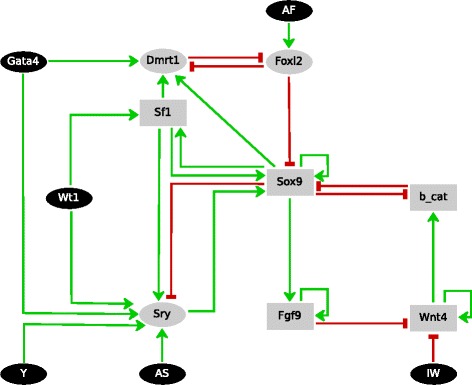
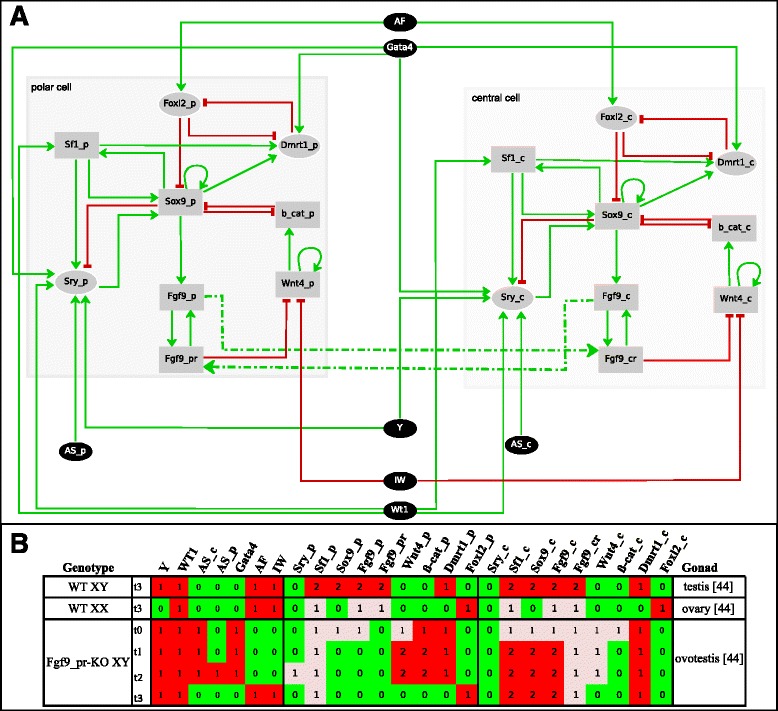
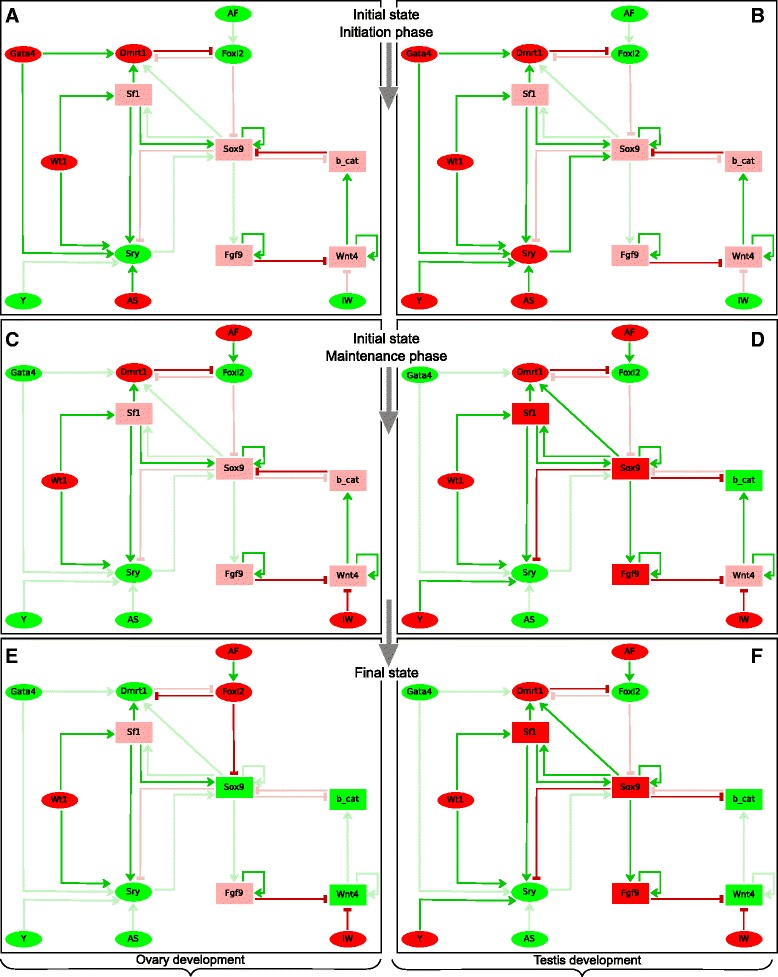
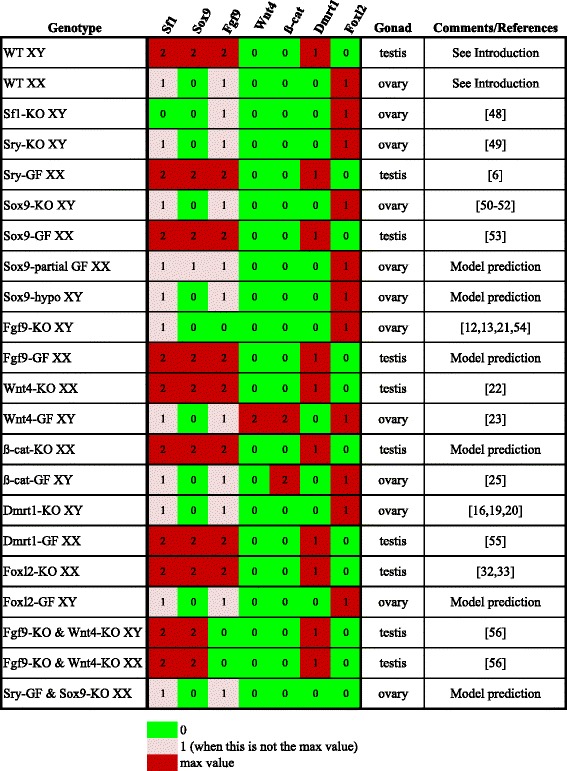
Relying on a comprehensive revision of the literature, we define a logical model that integrates the current knowledge of the regulatory network controlling this developmental process. Our analysis indicates the necessity for some genes to operate at distinct functional thresholds and for specific developmental conditions to ensure the reproducibility of the sexual pathways followed by bi-potential gonads developing into either testes or ovaries. Our model thus allows studying the dynamics of wild type and mutant XX and XY gonads. Furthermore, the model analysis reveals that the gonad sexual fate results from the operation of two sub-networks associated respectively with an initiation and a maintenance phases. At the core of the process is the resolution of two connected feedback loops: the mutual inhibition of Sox9 and ß-catenin at the initiation phase, which in turn affects the mutual inhibition between Dmrt1 and Foxl2, at the maintenance phase. Three developmental signals related to the temporal activity of those sub-networks are required: a signal that determines Sry activation, marking the beginning of the initiation phase, and two further signals that define the transition from the initiation to the maintenance phases, by inhibiting the Wnt4 signalling pathway on the one hand, and by activating Foxl2 on the other hand.
Our model reproduces a wide range of experimental data reported for the development of wild type and mutant gonads. It also provides a formal support to crucial aspects of the gonad sexual development and predicts gonadal phenotypes for mutations not tested yet.
胎盘哺乳动物的初级性别决定是一个经过充分研究的发育过程。在此,我们旨在研究当前已确立的情况,并评估其在野生型和受干扰情况下充分恢复所观察到的表型的能力。计算建模有助于阐明网络动态,阐明关键的时间限制以及核心调控模块之间的相互作用。
通过对文献的全面修订,我们定义了一个逻辑模型,该模型整合了控制这一发育过程的调控网络的现有知识。我们的分析表明,一些基因需要在不同的功能阈值下运作,并且需要特定的发育条件,以确保双潜能性腺发育为睾丸或卵巢所遵循的性途径的可重复性。因此,我们的模型允许研究野生型和突变型XX和XY性腺的动态。此外,模型分析表明,性腺的性命运是由分别与起始阶段和维持阶段相关的两个子网络的运作导致的。该过程的核心是解决两个相连的反馈回路:起始阶段Sox9和β-连环蛋白的相互抑制,这反过来又影响维持阶段Dmrt1和Foxl2之间的相互抑制。需要与这些子网络的时间活动相关的三个发育信号:一个决定Sry激活的信号,标志着起始阶段的开始,以及另外两个信号,一方面通过抑制Wnt4信号通路,另一方面通过激活Foxl2来定义从起始阶段到维持阶段的转变。
我们的模型再现了大量关于野生型和突变性腺发育的实验数据。它还为性腺性发育的关键方面提供了形式上的支持,并预测了尚未测试的突变的性腺表型。