Sharma Satya Pal, Bærheim Anders, Moe-Nilssen Rolf, Kvåle Alice
Research Group, Section for General Practice, Department of Global Health and Primary Care, University of Bergen, Kalfarveien 31, N-5018, Bergen, Norway.
Physiotherapy Research Group, Department of Global Public Health and Primary Care, University of Bergen, Bergen, Norway.
BMC Musculoskelet Disord. 2016 May 26;17:232. doi: 10.1186/s12891-016-1081-0.
Optimal management for adhesive shoulder capsulitis (frozen shoulder) is currently unclear. We intended to explore whether treatment by intra-articular injections with corticosteroid and distension is more effective than treating with corticosteroids alone or treatment-as-usual in a primary care setting in Norway.
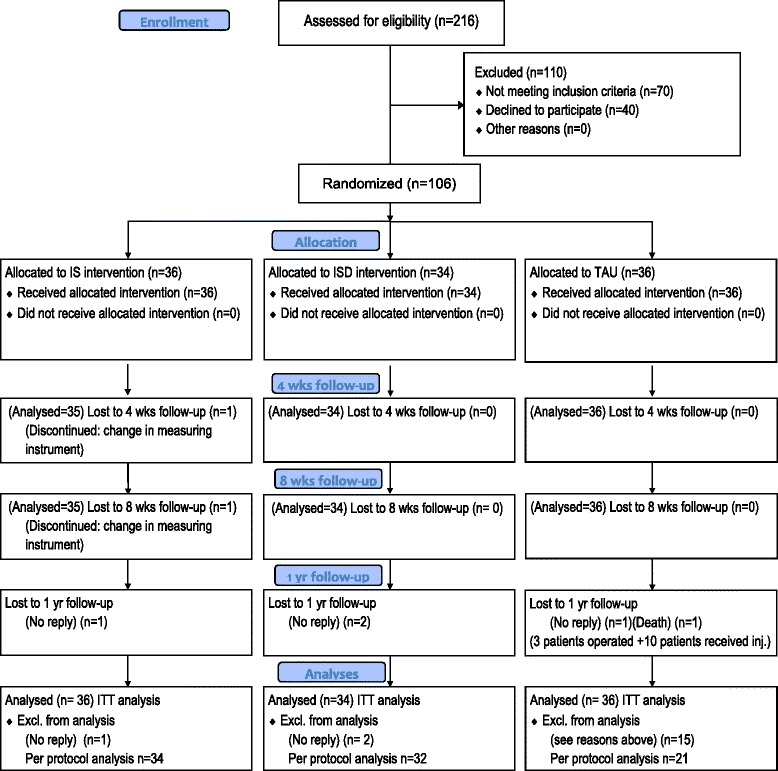
In this prospective randomised intention to treat parallel study, 106 patients were block randomised to three groups; 36 (analysed 35) receiving steroid injection and Lidocaine (IS), 34 receiving steroid and additional saline as distension (ISD) and 36 had treatment-as-usual (TAU). Intervention groups received four injections within 8 weeks, assessed on 1st visit, at the 4th and 8th week. Outcomes were Shoulder Pain and Disability Index (SPADI), Numerical pain rating scale (NPRS) and passive range of motion (PROM). Postal assessment was repeated after 1 year for SPADI. Patients in the IS and ISD groups were "blinded" for intervention received and the assessor was "blinded" to group allocation.
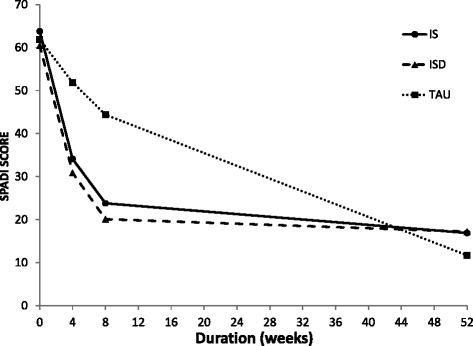
At baseline there were no differences between groups in outcome measures. There were no statistical significant differences between the intervention groups in SPADI, NPRS and PROM at baseline, at short-term (4-and 8 weeks) or long-term (12 months). There were statistically significant differences (p < 0.01) in change scores at short-term for SPADI when comparing the IS and TAU groups (-20.8; CI-28.9 to -12.7), and the ISD and TAU groups (-21.7; CI-29.4 to -14.0), respectively for NPRS (-2.0; CI-2.8 to -1.1 and -2.2; CI-3.0 to -1.4), and for PROM, but not at long-term for SPADI (p > 0.05). Effect size (ES) at 8 weeks was large between both injection groups and TAU (ES 1.2). At 12 months ES was reduced to 0.3 and 0.4 respectively. Transitory side effects as flushing and after-pain were reported by 14 % in intervention groups.
This intention to treat RCT in primary care indicates that four injections with corticosteroid with or without distension, given with increasing intervals during 8 weeks, were better than treatment-as-usual in treatment of adhesive shoulder capsulitis. However, in the long run no difference was found between any of the groups, indicating that natural healing takes place independent of treatment or not.
ClinicalTrials.gov, https://clinicaltrials.gov/ identifier: NCT01570985.
目前,粘连性肩关节囊炎(冻结肩)的最佳治疗方法尚不清楚。我们旨在探讨在挪威的初级医疗环境中,关节内注射皮质类固醇和扩张治疗是否比单独使用皮质类固醇治疗或常规治疗更有效。
在这项前瞻性随机意向性治疗平行研究中,106例患者被整群随机分为三组;36例(分析时为35例)接受类固醇注射和利多卡因(IS组),34例接受类固醇及额外的生理盐水扩张(ISD组),36例接受常规治疗(TAU组)。干预组在8周内接受4次注射,分别在第1次就诊时、第4周和第8周进行评估。观察指标为肩痛和功能障碍指数(SPADI)、数字疼痛评分量表(NPRS)和被动活动范围(PROM)。1年后对SPADI进行邮寄评估。IS组和ISD组的患者对所接受的干预措施“不知情”,评估者对分组情况“不知情”。
基线时,各组间观察指标无差异。干预组在基线、短期(4周和8周)或长期(12个月)时,SPADI、NPRS和PROM方面均无统计学显著差异。比较IS组和TAU组时,短期SPADI变化评分有统计学显著差异(p<0.01)(-20.8;可信区间-28.9至-12.7),NPRS方面(-2.0;可信区间-2.8至-1.1)以及PROM方面也是如此;ISD组和TAU组比较时,短期SPADI变化评分有统计学显著差异(-21.7;可信区间-29.4至-14.0),NPRS方面(-2.2;可信区间-3.0至-1.4)以及PROM方面也是如此,但长期时SPADI无差异(p>0.05)。8周时,两个注射组与TAU组之间的效应量(ES)较大(ES为1.2)。12个月时,ES分别降至0.3和0.4。干预组有14%的患者报告出现如脸红和注射后疼痛等短暂副作用。
这项在初级医疗环境中的意向性治疗随机对照试验表明,在8周内逐渐延长间隔时间给予4次皮质类固醇注射(无论是否扩张),在治疗粘连性肩关节囊炎方面优于常规治疗。然而,从长远来看,各组之间未发现差异,这表明无论是否接受治疗,自然愈合都会发生。
ClinicalTrials.gov,https://clinicaltrials.gov/ 标识符:NCT01570985