
初诊弥漫性大B细胞淋巴瘤患者治疗前18F-FDG摄取与临床病理因素及预后的相关性
Correlation of pretreatment 18F-FDG uptake with clinicopathological factors and prognosis in patients with newly diagnosed diffuse large B-cell lymphoma.
作者信息
Huang Honghui, Xiao Fei, Han Xiaofeng, Zhong Lu, Zhong Hua, Xu Lan, Zhu Jianyi, Ni Beiwen, Liu Jia, Fang Yi, Zhang Minyue, Shen Lijing, Wang Ting, Liu Jianjun, Shi Yiping, Chen Yumei, Zheng Luying, Liu Qiang, Chen Fangyuan, Wang Jianmin
机构信息
aDepartment of Hematology, Chang Hai Hospital, Second Military Medical UniversityDepartments of bHematologycNuclear MedicinedPathology, Ren Ji Hospital, School of Medicine, Shanghai Jiaotong University, Shanghai, China.
出版信息
Nucl Med Commun. 2016 Jul;37(7):689-98. doi: 10.1097/MNM.0000000000000496.
OBJECTIVES
The aim of this study is to determine the correlation of pretreatment fluorine-18 fluorodeoxyglucose uptake with clinicopathological factors and its prognostic value in patients with newly diagnosed diffuse large B-cell lymphoma (DLBCL).
PATIENTS AND METHODS
A cohort of 162 patients with newly diagnosed DLBCL who had undergone pretreatment PET/computed tomography was retrospectively reviewed. The relationship of pretreatment maximum standard uptake value (SUVmax) with clinical factors, molecular markers, and efficacy was evaluated. The value of SUVmax in predicting progression-free survival (PFS) and overall survival was analyzed.
RESULTS
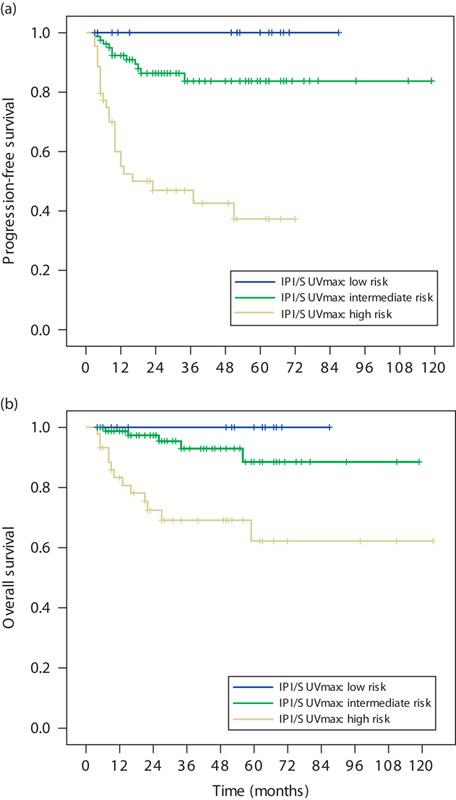
In all, 72.9% of the patients received R-CHOP treatment; the rest received CHOP chemotherapy. The median follow-up duration was 30 months (range, 4-124 months). The median SUVmax was 12.2 (range, 1.7-42.7). SUVmax between groups differed significantly with respect to each of International Prognostic Index (IPI) factors, except for age and performance status. High SUVmax was associated with high Ki-67 and Glut-3 protein expression, but not with Glut-1. Complete remission rate differed significantly between the low (SUVmax≤9.0) and the high SUVmax (SUVmax>9.0) groups (91.7 vs. 61.1%, P=0.000). Patients with low SUVmax showed favorable survival (3-year PFS: 92.2 vs. 63.6%, P=0.000; 3-year overall survival: 95.5 vs. 78.3%, P=0.003). On multivariate analyses, SUVmax predicted PFS independent of revised-IPI (SUVmax: P=0.011, hazard ratio 4.784; revised-IPI: P=0.004, hazard ratio 2.551).
CONCLUSION
Pretreatment SUVmax was associated with clinicopathological factors, efficacy, and survival outcome. A novel prognostic model on the basis of IPI score/pretreatment SUVmax might be useful for risk stratification of patients with newly diagnosed DLBCL Video abstract: http://links.lww.com/NMC/A55.
目的
本研究旨在确定初诊弥漫性大B细胞淋巴瘤(DLBCL)患者治疗前氟-18氟脱氧葡萄糖摄取与临床病理因素的相关性及其预后价值。
患者与方法
回顾性分析162例初诊DLBCL且接受过治疗前PET/计算机断层扫描的患者队列。评估治疗前最大标准摄取值(SUVmax)与临床因素、分子标志物及疗效的关系。分析SUVmax对无进展生存期(PFS)和总生存期的预测价值。
结果
总计72.9%的患者接受R-CHOP治疗;其余接受CHOP化疗。中位随访时间为30个月(范围4 - 124个月)。中位SUVmax为12.2(范围1.7 - 42.7)。除年龄和体能状态外,各国际预后指数(IPI)因素组间的SUVmax差异显著。高SUVmax与高Ki-67和Glut-3蛋白表达相关,但与Glut-1无关。低SUVmax组(SUVmax≤9.0)与高SUVmax组(SUVmax>9.0)的完全缓解率差异显著(91.7%对61.1%,P = 0.000)。低SUVmax患者生存良好(3年PFS:92.2%对63.6%,P = 0.000;3年总生存期:95.5%对78.3%,P = 0.003)。多因素分析显示,SUVmax独立于修订IPI预测PFS(SUVmax:P = 0.011,风险比4.784;修订IPI:P = 0.004,风险比2.551)。
结论
治疗前SUVmax与临床病理因素、疗效及生存结果相关。基于IPI评分/治疗前SUVmax的新型预后模型可能有助于初诊DLBCL患者的风险分层。视频摘要:http://links.lww.com/NMC/A55


 Zotero 插件