Bertin Gwladys I, Sabbagh Audrey, Argy Nicolas, Salnot Virginie, Ezinmegnon Sem, Agbota Gino, Ladipo Yélé, Alao Jules M, Sagbo Gratien, Guillonneau François, Deloron Philippe
Institut de Recherche pour le Développement (IRD), UMR216 - MERIT, Paris, France.
COMUE Sorbonne Paris Cité, Faculté de Pharmacie de Paris, Paris Descartes University, Paris 75006, France.
Sci Rep. 2016 Jun 1;6:26773. doi: 10.1038/srep26773.
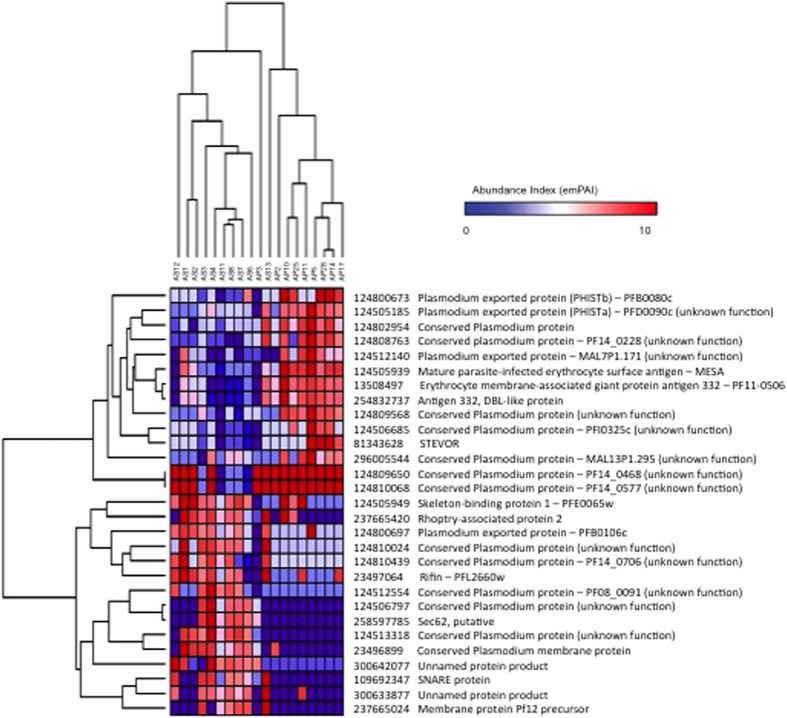
Plasmodium falciparum is responsible of severe malaria, including cerebral malaria (CM). During its intra-erythrocytic maturation, parasite-derived proteins are expressed, exported and presented at the infected erythrocyte membrane. To identify new CM-specific parasite membrane proteins, we conducted a mass spectrometry-based proteomic study and compared the protein expression profiles between 9 CM and 10 uncomplicated malaria (UM) samples. Among the 1097 Plasmodium proteins identified, we focused on the 499 membrane-associated and hypothetical proteins for comparative analysis. Filter-based feature selection methods combined with supervised data analysis identified a subset of 29 proteins distinguishing CM and UM samples with high classification accuracy. A hierarchical clustering analysis of these 29 proteins based on the similarity of their expression profiles revealed two clusters of 15 and 14 proteins, respectively under- and over-expressed in CM. Among the over-expressed proteins, the MESA protein is expressed at the erythrocyte membrane, involved in proteins trafficking and in the export of variant surface antigens (VSAs), but without antigenic function. Antigen 332 protein is exported at the erythrocyte, also involved in protein trafficking and in VSAs export, and exposed to the immune system. Our proteomics data demonstrate an association of selected proteins in the pathophysiology of CM.
恶性疟原虫是导致严重疟疾的病原体,包括脑型疟疾(CM)。在其红细胞内成熟过程中,寄生虫衍生的蛋白质会表达、输出并呈现在受感染的红细胞膜上。为了鉴定新的CM特异性寄生虫膜蛋白,我们进行了一项基于质谱的蛋白质组学研究,并比较了9例CM样本和10例非复杂性疟疾(UM)样本之间的蛋白质表达谱。在鉴定出的1097种疟原虫蛋白质中,我们重点关注499种与膜相关的和假设的蛋白质进行比较分析。基于过滤的特征选择方法与监督数据分析相结合,确定了一组29种蛋白质,它们能够以高分类准确率区分CM和UM样本。基于这29种蛋白质表达谱的相似性进行的层次聚类分析揭示了两个聚类,分别包含15种和14种蛋白质,在CM中分别为低表达和高表达。在高表达的蛋白质中,MESA蛋白在红细胞膜上表达,参与蛋白质运输和可变表面抗原(VSA)的输出,但没有抗原功能。抗原332蛋白在红细胞中输出,也参与蛋白质运输和VSA输出,并暴露于免疫系统。我们的蛋白质组学数据表明所选蛋白质与CM的病理生理学有关。