Ferrari Anna, Baraldi Carlo, Licata Manuela, Vandelli Daniele, Marchesi Filippo, Palazzoli Federica, Verri Patrizia, Rustichelli Cecilia, Giuliani Enrico, Silingardi Enrico
Unit of Medical Toxicology, Headache Centre and Drug Abuse, Department of Diagnostic, Clinical and Public Health Medicine, University of Modena and Reggio Emilia, Policlinico, Via del Pozzo, 71, 41124, Modena, Italy.
Forensic Toxicology Laboratory, Department of Diagnostic Medicine, Department of Diagnostic, Clinical and Public Health Medicine, University of Modena and Reggio Emilia, Via del Pozzo, 71, 41124, Modena, Italy.
Eur J Clin Pharmacol. 2016 Sep;72(9):1075-81. doi: 10.1007/s00228-016-2074-5. Epub 2016 May 31.
The aim of this study is to evaluate the detection rate of almotriptan, eletriptan, frovatriptan, sumatriptan, rizatriptan, and zolmitriptan in the hair of migraineurs taking these drugs; the degree of agreement between type of self-reported triptan and triptan found in hair; if the concentrations in hair were related to the reported cumulative doses of triptans; and whether hair analysis was able to distinguish occasional use from the overuse of these drugs.
Out of 300 headache patients consecutively enrolled, we included 147 migraine patients who reported to have taken at least one dose of one triptan in the previous 3 months; 51 % of the patients overused triptans. A detailed pharmacological history and a sample of hair were collected for each patient. Hair samples were analyzed by liquid chromatography-electrospray tandem mass spectrometry (LC-MS/MS) by a method that we developed.
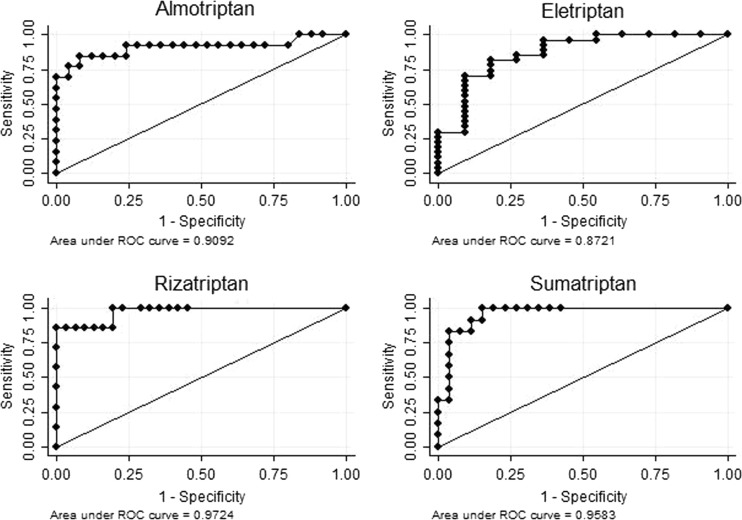
All the triptans could be detected in the hair of the patients. The agreement between type of self-reported triptan and type of triptan found in hair was from fair to good for frovatriptan and zolmitriptan and excellent for almotriptan, eletriptan, sumatriptan, and rizatriptan (P < 0.01, Cohen's kappa). The correlation between the reported quantities of triptan and hair concentrations was statistically significant for almotriptan, eletriptan, rizatriptan, and sumatriptan (P < 0.01, Spearman's rank correlation coefficient). The accuracy of hair analysis in distinguishing occasionally users from overusers was high for almotriptan (ROC AUC = 0.9092), eletriptan (ROC AUC = 0.8721), rizatriptan (ROC AUC = 0.9724), and sumatriptan (ROC AUC = 0.9583).
Hair analysis can be a valuable system to discriminate occasional use from triptan overuse.
本研究旨在评估服用阿莫曲坦、依立曲坦、夫罗曲坦、舒马曲坦、利扎曲坦和佐米曲坦的偏头痛患者头发中这些药物的检出率;自我报告的曲坦类药物类型与头发中发现的曲坦类药物之间的一致程度;头发中的浓度是否与报告的曲坦类药物累积剂量相关;以及头发分析是否能够区分这些药物的偶尔使用和过度使用。
在连续纳入的300例头痛患者中,我们纳入了147例偏头痛患者,这些患者报告在过去3个月内至少服用过一剂一种曲坦类药物;51%的患者过度使用曲坦类药物。为每位患者收集详细的用药史和头发样本。采用我们开发的方法,通过液相色谱-电喷雾串联质谱法(LC-MS/MS)对头发样本进行分析。
所有曲坦类药物均可在患者头发中检测到。自我报告的曲坦类药物类型与头发中发现的曲坦类药物类型之间的一致性,对于夫罗曲坦和佐米曲坦为中等至良好,对于阿莫曲坦、依立曲坦、舒马曲坦和利扎曲坦为优秀(P<0.01,Cohen's kappa)。对于阿莫曲坦、依立曲坦、利扎曲坦和舒马曲坦,报告的曲坦类药物数量与头发浓度之间的相关性具有统计学意义(P<0.01,Spearman等级相关系数)。对于阿莫曲坦(ROC AUC=0.9092)、依立曲坦(ROC AUC=0.8721)、利扎曲坦(ROC AUC=0.9724)和舒马曲坦(ROC AUC=0.9583),头发分析区分偶尔使用者和过度使用者的准确性较高。
头发分析可能是区分曲坦类药物偶尔使用和过度使用的有价值的系统。