Jagric Tomaz, Potrc Stojan, Mis Katarina, Plankl Mojca, Mars Tomaz
Department of Abdominal and General Surgery, University Medical Centre Maribor, Maribor, Sloveni.
Institute of Pathophysiology, Faculty of Medicine, University of Ljubljana, Ljubljana, Slovenia.
Radiol Oncol. 2016 Apr 23;50(2):204-11. doi: 10.1515/raon-2015-0025. eCollection 2016 Jun 1.
We explored the prognostic value of the up-regulated carbohydrate antigen (CA19-9) in node-negative patients with gastric cancer as a surrogate marker for micrometastases.
Micrometastases were determined using reverse transcription quantitative polymerase chain reaction (RT-qPCR) for a subgroup of 30 node-negative patients. This group was used to determine the cut-off for preoperative CA19-9 serum levels as a surrogate marker for micrometastases. Then 187 node-negative T1 to T4 patients were selected to validate the predictive value of this CA19-9 threshold.
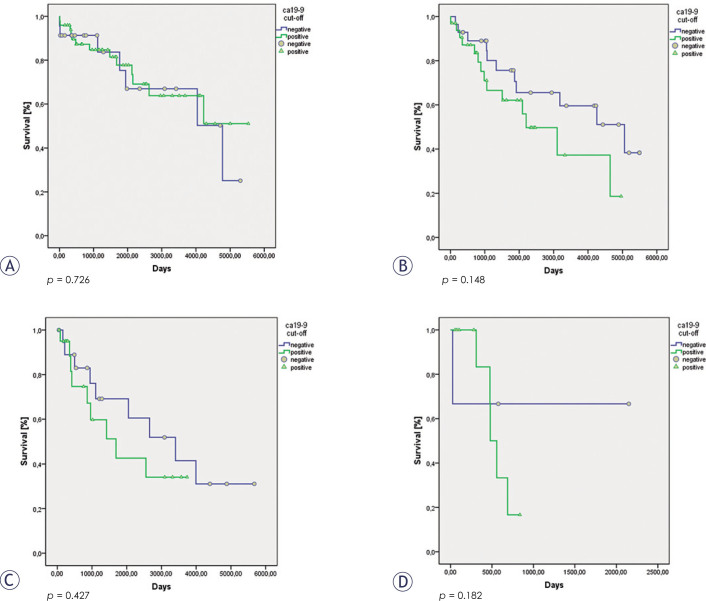
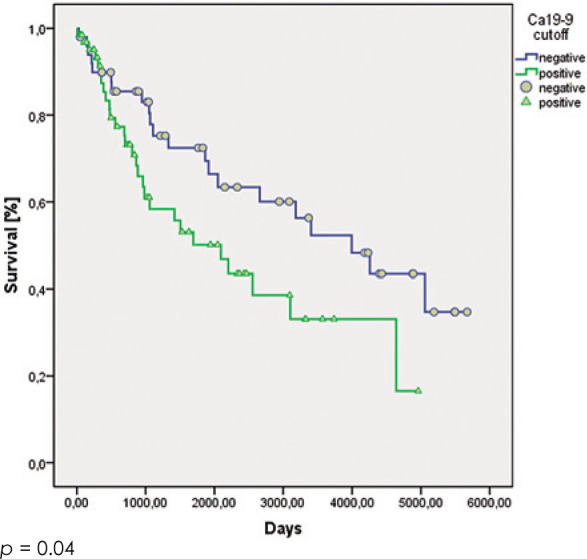
Patients with micrometastases had significantly higher preoperative CA19-9 serum levels compared to patients without micrometastases (p = 0.046). CA19-9 serum levels were significantly correlated with tumour site, tumour diameter, and perineural invasion. Although not reaching significance, subgroup analysis showed better five-year survival rates for patients with CA19-9 serum levels below the threshold, compared to patients with CA19-9 serum levels above the cut-off. The cumulative survival for T2 to T4 node-negative patients was significantly better with CA19-9 serum levels below the cut-off (p = 0.04).
Preoperative CA19-9 serum levels can be used to predict higher risk for haematogenous spread and micrometastases in node-negative patients. However, CA19-9 serum levels lack the necessary sensitivity and specificity to reliably predict micrometastases.
我们探讨了上调的糖类抗原(CA19-9)在无淋巴结转移的胃癌患者中作为微转移替代标志物的预后价值。
对30例无淋巴结转移患者的亚组采用逆转录定量聚合酶链反应(RT-qPCR)检测微转移情况。该组用于确定术前CA19-9血清水平作为微转移替代标志物的临界值。然后选取187例无淋巴结转移的T1至T4期患者,验证该CA19-9临界值的预测价值。
与无微转移的患者相比,有微转移的患者术前CA19-9血清水平显著更高(p = 0.046)。CA19-9血清水平与肿瘤部位、肿瘤直径及神经周围侵犯显著相关。尽管未达到显著差异,但亚组分析显示,CA19-9血清水平低于临界值的患者五年生存率高于CA19-9血清水平高于临界值的患者。CA19-9血清水平低于临界值时,T2至T4期无淋巴结转移患者的累积生存率显著更高(p = 0.04)。
术前CA19-9血清水平可用于预测无淋巴结转移患者发生血行播散和微转移的较高风险。然而,CA19-9血清水平缺乏可靠预测微转移所需的敏感性和特异性。