Ortiz Rina, Díaz Jorge, Díaz Natalia, Lobos-Gonzalez Lorena, Cárdenas Areli, Contreras Pamela, Díaz María Inés, Otte Ellen, Cooper-White Justin, Torres Vicente, Leyton Lisette, Quest Andrew F G
Center for Molecular Studies of the Cell (CEMC), Advanced Center for Chronic Diseases (ACCDiS), Faculty of Medicine, Universidad de Chile, Santiago, Chile.
Laboratory of Cellular Communication, Program of Cell and Molecular Biology, Institute of Biomedical Sciences (ICBM), Faculty of Medicine, Universidad de Chile, Santiago, Chile.
Oncotarget. 2016 Jun 28;7(26):40571-40593. doi: 10.18632/oncotarget.9738.
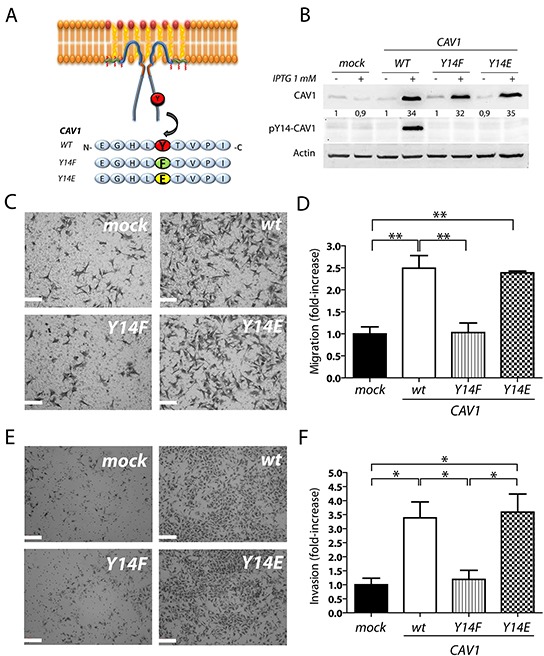
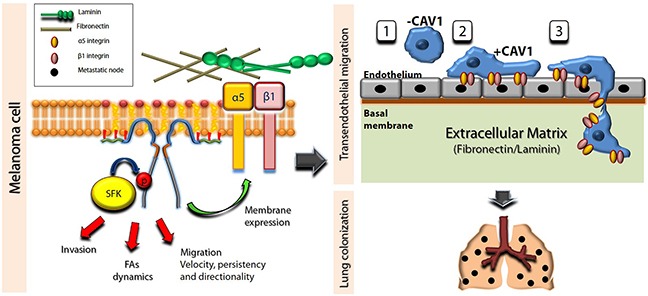
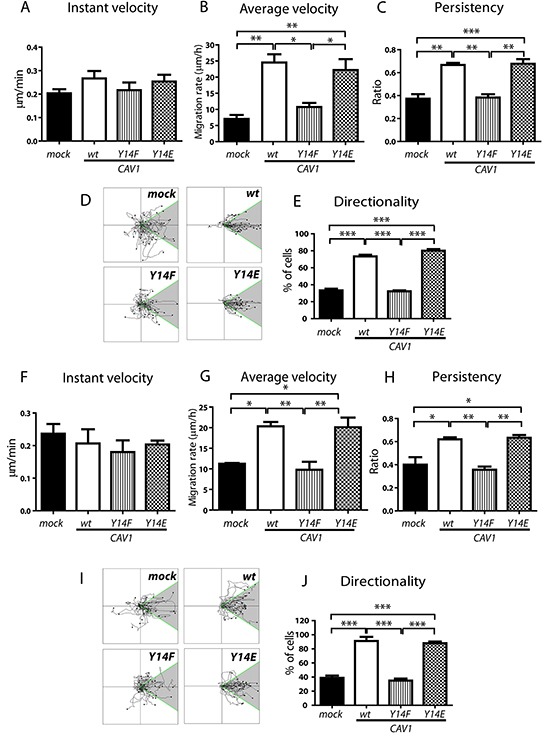
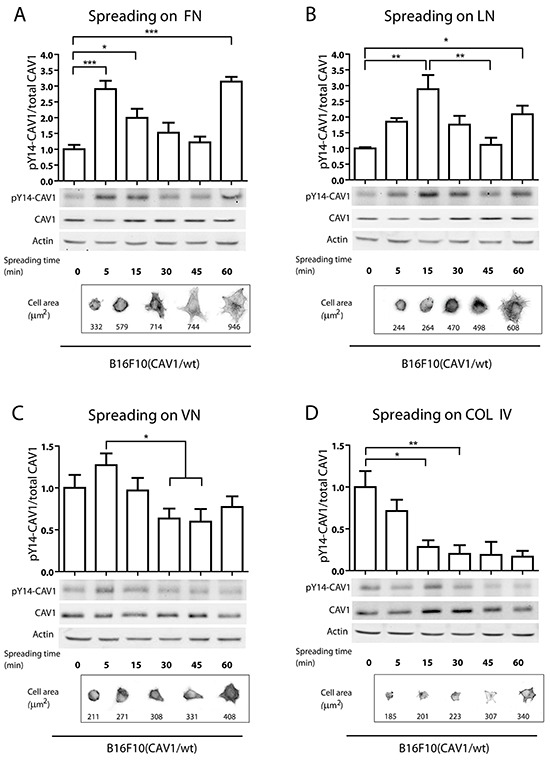
Caveolin-1 (CAV1) is a scaffolding protein that plays a dual role in cancer. In advanced stages of this disease, CAV1 expression in tumor cells is associated with enhanced metastatic potential, while, at earlier stages, CAV1 functions as a tumor suppressor. We recently implicated CAV1 phosphorylation on tyrosine 14 (Y14) in CAV1-enhanced cell migration. However, the contribution of this modification to the dual role of CAV1 in cancer remained unexplored. Here, we used in vitro [2D and transendothelial cell migration (TEM), invasion] and in vivo (metastasis) assays, as well as genetic and biochemical approaches to address this question in B16F10 murine melanoma cells. CAV1 promoted directional migration on fibronectin or laminin, two abundant lung extracellular matrix (ECM) components, which correlated with enhanced Y14 phosphorylation during spreading. Moreover, CAV1-driven migration, invasion, TEM and metastasis were ablated by expression of the phosphorylation null CAV1(Y14F), but not the phosphorylation mimicking CAV1(Y14E) mutation. Finally, CAV1-enhanced focal adhesion dynamics and surface expression of beta1 integrin were required for CAV1-driven TEM. Importantly, CAV1 function as a tumor suppressor in tumor formation assays was not altered by the Y14F mutation. In conclusion, our results provide critical insight to the mechanisms of CAV1 action during cancer development. Specific ECM-integrin interactions and Y14 phosphorylation are required for CAV1-enhanced melanoma cell migration, invasion and metastasis to the lung. Because Y14F mutation diminishes metastasis without inhibiting the tumor suppressor function of CAV1, Y14 phosphorylation emerges as an attractive therapeutic target to prevent metastasis without altering beneficial traits of CAV1.
小窝蛋白-1(CAV1)是一种支架蛋白,在癌症中发挥双重作用。在该疾病的晚期,肿瘤细胞中的CAV1表达与转移潜能增强相关,而在早期阶段,CAV1发挥肿瘤抑制作用。我们最近发现CAV1酪氨酸14(Y14)位点的磷酸化与CAV1增强的细胞迁移有关。然而,这种修饰对CAV1在癌症中的双重作用的贡献仍未得到探索。在这里,我们使用体外实验(二维和跨内皮细胞迁移(TEM)、侵袭)和体内实验(转移),以及基因和生化方法,在B16F10小鼠黑色素瘤细胞中解决这个问题。CAV1促进在纤连蛋白或层粘连蛋白上的定向迁移,这两种是肺细胞外基质(ECM)中的丰富成分,这与铺展过程中Y14磷酸化增强相关。此外,CAV1驱动的迁移、侵袭、TEM和转移被磷酸化缺失的CAV1(Y14F)的表达所消除,但磷酸化模拟的CAV1(Y14E)突变则没有。最后,CAV1驱动的TEM需要CAV1增强的粘着斑动力学和β1整合素的表面表达。重要的是,Y14F突变不会改变CAV1在肿瘤形成实验中作为肿瘤抑制因子的功能。总之,我们的结果为CAV1在癌症发展过程中的作用机制提供了关键见解。CAV1增强的黑色素瘤细胞向肺的迁移、侵袭和转移需要特定的ECM-整合素相互作用和Y14磷酸化。由于Y14F突变减少了转移而不抑制CAV1的肿瘤抑制功能,Y14磷酸化成为一个有吸引力的治疗靶点,可在不改变CAV1有益特性的情况下预防转移。