O'Donnell Sean, Baudier Kaitlin, Marenda Daniel R
Department of Biodiversity Earth and Environmental Science, Department of Biology, Drexel University, Philadelphia, PA, USA,
Department of Biodiversity Earth and Environmental Science.
J Insect Sci. 2016 Jun 7;16(1). doi: 10.1093/jisesa/iew031. Print 2016.
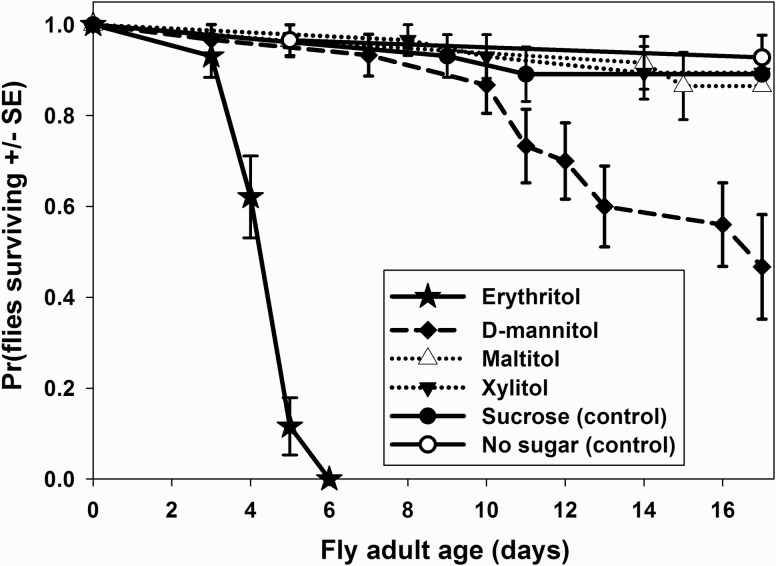
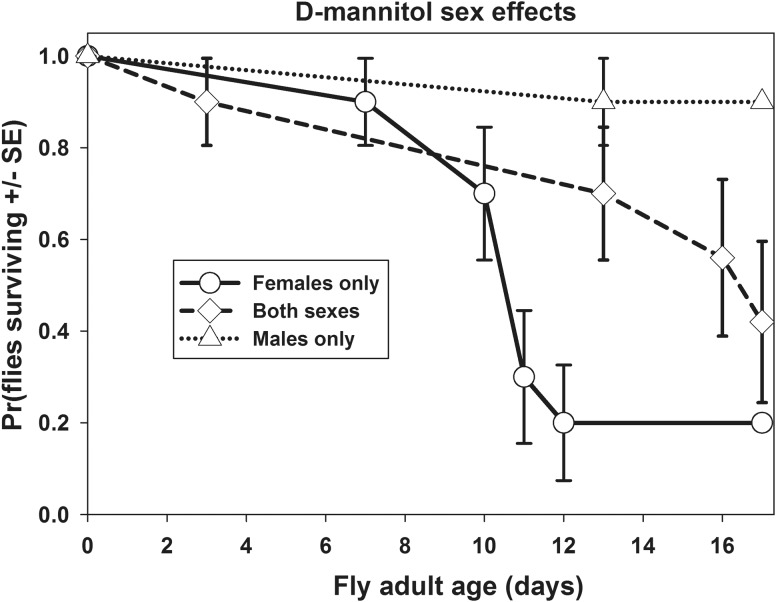
Previous work showed the non-nutritive polyol sweetener Erythritol was toxic when ingested by Drosophila melanogaster (Meigen, 1930). This study assessed whether insect toxicity is a general property of polyols. Among tested compounds, toxicity was highest for erythritol. Adult fruit flies (D. melanogaster) fed erythritol had reduced longevity relative to controls. Other polyols did not reduce longevity; the only exception was a weaker but significant reduction of female (but not male) longevity when flies were fed D-mannitol. We conclude at least some non-nutritive polyols are not toxic to adult D. melanogaster when ingested for 17 days. The longer time course (relative to erythritol) and female specificity of D-mannitol mortality suggests different mechanisms for D-mannitol and erythritol toxicity to D. melanogaster.
先前的研究表明,非营养性多元醇甜味剂赤藓糖醇被黑腹果蝇(Meigen,1930)摄入后具有毒性。本研究评估了昆虫毒性是否是多元醇的普遍特性。在所测试的化合物中,赤藓糖醇的毒性最高。与对照组相比,喂食赤藓糖醇的成年果蝇(黑腹果蝇)寿命缩短。其他多元醇并未缩短寿命;唯一的例外是,当果蝇喂食D-甘露醇时,雌性(而非雄性)果蝇的寿命有较弱但显著的缩短。我们得出结论,至少一些非营养性多元醇在被摄入17天时对成年黑腹果蝇无毒。D-甘露醇致死的时间进程较长(相对于赤藓糖醇)以及雌性特异性表明,D-甘露醇和赤藓糖醇对黑腹果蝇的毒性机制不同。