Alderson-Day Ben, Diederen Kelly, Fernyhough Charles, Ford Judith M, Horga Guillermo, Margulies Daniel S, McCarthy-Jones Simon, Northoff Georg, Shine James M, Turner Jessica, van de Ven Vincent, van Lutterveld Remko, Waters Flavie, Jardri Renaud
Psychology Department, Durham University, Durham, UK;
Department of Physiology, Development and Neuroscience, University of Cambridge, Cambridge, UK;
Schizophr Bull. 2016 Sep;42(5):1110-23. doi: 10.1093/schbul/sbw078. Epub 2016 Jun 8.
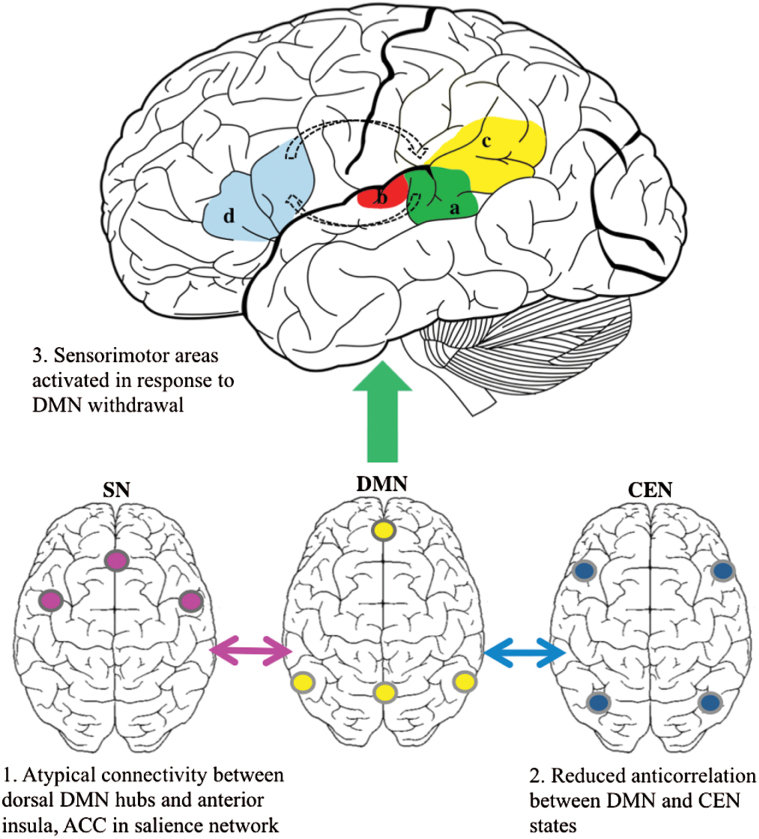
In recent years, there has been increasing interest in the potential for alterations to the brain's resting-state networks (RSNs) to explain various kinds of psychopathology. RSNs provide an intriguing new explanatory framework for hallucinations, which can occur in different modalities and population groups, but which remain poorly understood. This collaboration from the International Consortium on Hallucination Research (ICHR) reports on the evidence linking resting-state alterations to auditory hallucinations (AH) and provides a critical appraisal of the methodological approaches used in this area. In the report, we describe findings from resting connectivity fMRI in AH (in schizophrenia and nonclinical individuals) and compare them with findings from neurophysiological research, structural MRI, and research on visual hallucinations (VH). In AH, various studies show resting connectivity differences in left-hemisphere auditory and language regions, as well as atypical interaction of the default mode network and RSNs linked to cognitive control and salience. As the latter are also evident in studies of VH, this points to a domain-general mechanism for hallucinations alongside modality-specific changes to RSNs in different sensory regions. However, we also observed high methodological heterogeneity in the current literature, affecting the ability to make clear comparisons between studies. To address this, we provide some methodological recommendations and options for future research on the resting state and hallucinations.
近年来,人们越来越关注大脑静息态网络(RSNs)的改变对解释各种精神病理学现象的潜在作用。RSNs为幻觉提供了一个引人入胜的新解释框架,幻觉可发生于不同的感觉模态和人群中,但目前仍了解甚少。国际幻觉研究协会(ICHR)的这项合作报告了静息态改变与幻听(AH)之间联系的证据,并对该领域所采用的方法学进行了批判性评价。在本报告中,我们描述了在AH患者(精神分裂症患者和非临床个体)中静息态功能磁共振成像的研究结果,并将其与神经生理学研究、结构磁共振成像以及视幻觉(VH)研究的结果进行比较。在AH研究中,多项研究显示左半球听觉和语言区域存在静息态连接差异,以及默认模式网络与与认知控制和显著性相关的RSNs之间存在非典型相互作用。由于后者在VH研究中也很明显,这表明幻觉存在一种领域通用机制,同时不同感觉区域的RSNs存在特定感觉模态的变化。然而,我们也观察到当前文献中存在高度的方法学异质性,这影响了不同研究之间进行明确比较的能力。为解决这一问题,我们为未来关于静息态和幻觉的研究提供了一些方法学建议和选择。