Seixas Luiza, de Melo Cristiano Barros, Tanure Candice Bergmann, Peripolli Vanessa, McManus Concepta
Faculty of Agronomy and Veterinary Medicine, Graduate Program in Animal Sciences, University of Brasilia (UnB), Campus Darcy Ribeiro, Asa Norte, Brasília, 70910-900, Brazil.
Asian-Australas J Anim Sci. 2017 Apr;30(4):593-601. doi: 10.5713/ajas.16.0191. Epub 2016 Jun 6.
The aim of this study was to evaluate heat tolerance using heat tolerance indices, physiological, physical, thermographic, and hematological parameters in Santa Ines and Morada Nova sheep breeds in the Federal District, Brazil.
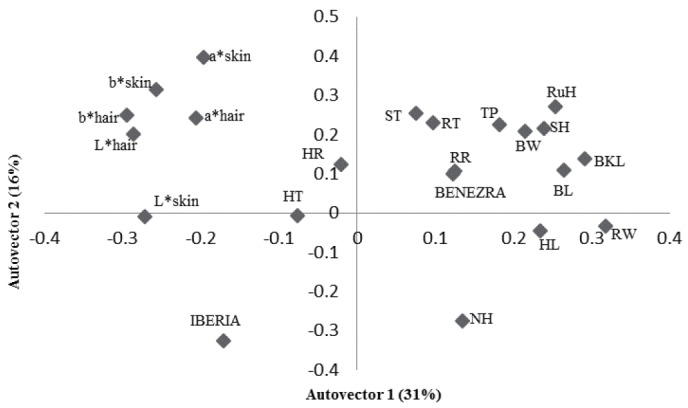
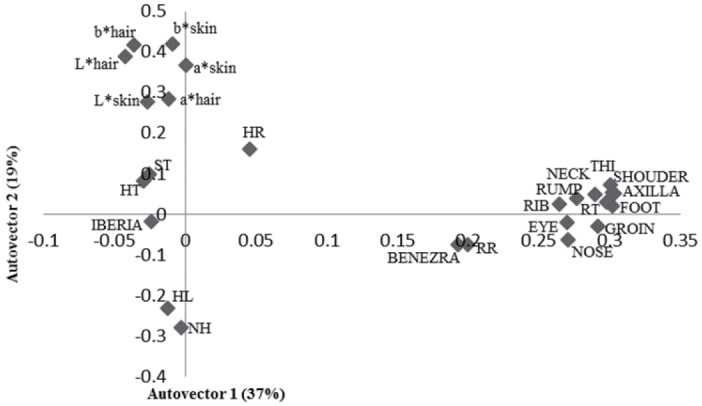
Twenty-six adult hair sheep, one and a half years old, from two genetic groups (Santa Ines: 12 males and 4 females; Morada Nova: 7 males and 3 females) were used and data (rectal temperature, respiratory rate, heart rate, skin temperatures; hematological parameters) were collected during three consecutive days, twice a day (morning and afternoon), with a total of six repetitions. Also physical parameters (biometric measurements, skin and hair traits) and heat tolerance indices (temperature-humidity index, Iberia and Benezra) were evaluated. The analyses included analyses of variance, correlation, and principal components with a significance level of 5%.
The environmental indices, in general, indicate a situation of thermal discomfort for the animals during the afternoon. Breed significantly influenced (p<0.001) physiological and physical characteristics of skin, hair, biometric measurements and Iberia and Benezra heat tolerance indices. Santa Ines animals were bigger and had longer, greater number and darker hair, thicker skin, greater respiratory rate and Benezra index and lower Iberia index compared with Morada Nova breed.
Although both breeds can be considered adapted to the environmental conditions of the region, Morada Nova breed is most suitable for farming in the Midwest region. The positive correlation found between the thermographic temperatures and physiological parameters indicates that this technique can be used to evaluate thermal comfort. Also, it has the advantage that animals do not have to be handled, which favors animal welfare.
本研究旨在利用耐热性指标、生理、物理、热成像和血液学参数,评估巴西联邦区圣伊内斯和莫拉达诺瓦绵羊品种的耐热性。
使用来自两个遗传群体的26只一岁半的成年毛用绵羊(圣伊内斯:12只雄性和4只雌性;莫拉达诺瓦:7只雄性和3只雌性),在连续三天内,每天两次(上午和下午)收集数据(直肠温度、呼吸频率、心率、皮肤温度;血液学参数),共进行六次重复。还评估了物理参数(生物测量、皮肤和毛发特征)和耐热性指标(温湿度指数、伊比利亚和贝内兹拉指数)。分析包括方差分析、相关性分析和主成分分析,显著性水平为5%。
总体而言,环境指标表明动物在下午处于热不适状态。品种对皮肤、毛发、生物测量以及伊比利亚和贝内兹拉耐热性指标的生理和物理特征有显著影响(p<0.001)。与莫拉达诺瓦品种相比,圣伊内斯品种的动物体型更大,毛发更长、数量更多且颜色更深,皮肤更厚,呼吸频率更高,贝内兹拉指数更高,伊比利亚指数更低。
虽然两个品种都可被认为适应该地区的环境条件,但莫拉达诺瓦品种最适合在中西部地区养殖。热成像温度与生理参数之间的正相关表明,该技术可用于评估热舒适度。此外,它具有无需处理动物的优点,有利于动物福利。