Hong Heeok, Lee Eunchae, Lee In Hyung, Lee Sang-Rak
Department of Medical Science, Konkuk University School of Medicine, Seoul 05029, Korea.
Department of Animal Bioscience and Technology, Konkuk University, Seoul 05029, Korea.
Asian-Australas J Anim Sci. 2019 Mar;32(3):442-451. doi: 10.5713/ajas.18.0108. Epub 2018 Aug 27.
This study was conducted to investigate the effect of transport stress on physiological and hematological responses and milk performance in lactating dairy cows.
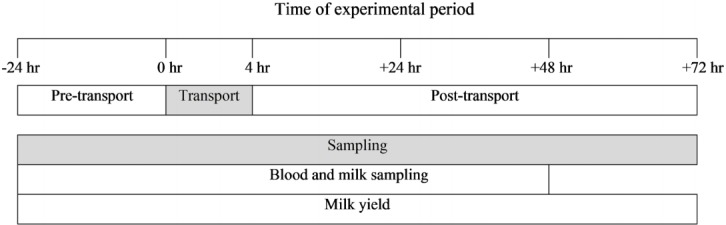
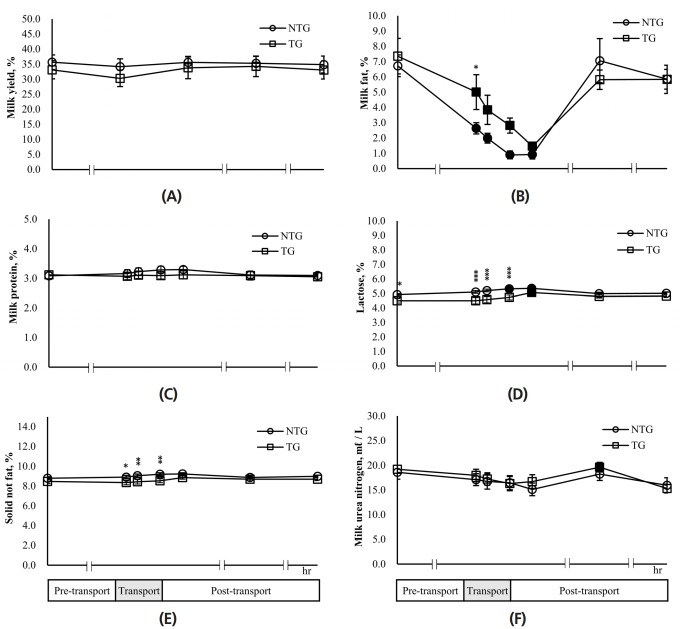
Ten lactating dairy cows were randomly divided into 2 groups. The treatment group (TG) was transported 200 km for 4 h by truck, and the control group (NTG) was restrained by stanchion for 4 h in Konkuk University farm. Blood and milk samples were collected at 24 h pre-transport; 1, 2, and 4 h during transport; and 2, 24, and 48 h post-transport. Milk yields were measured at 24 h pre-transport, 0 h during transport, and 24, 48, and 72 h post-transport.
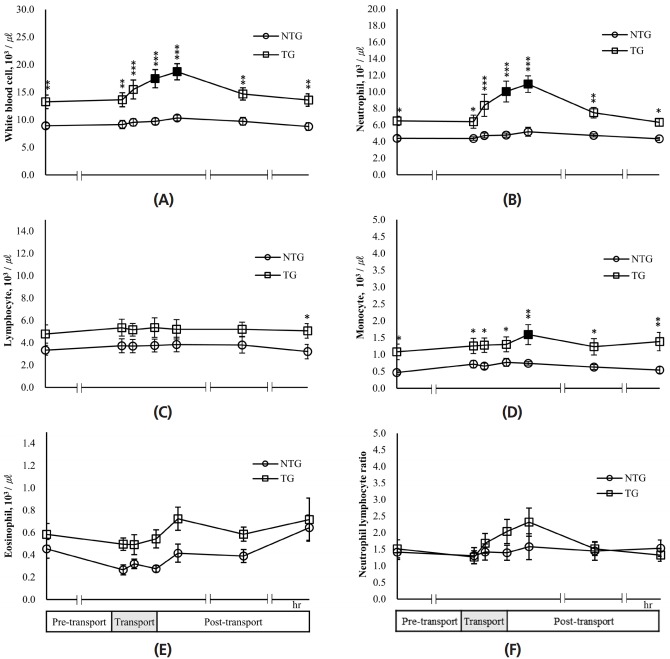
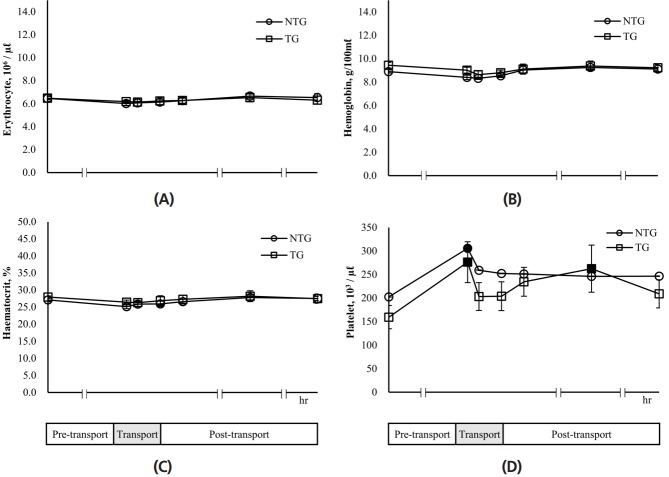
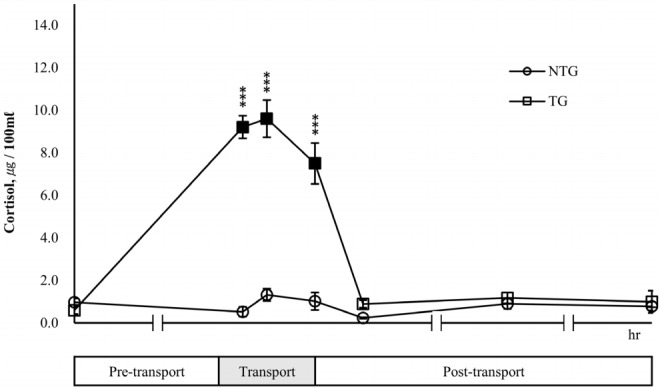
Leukocyte, neutrophil, and monocyte numbers in the TG were significantly higher than those of the NTG at each experimental time point. Lymphocyte numbers in the TG were significantly (p<0.05) higher than those of the NTG at 48 h post-transport. Additionally, the neutrophil:lymphocyte ratio of the TG was 45% and 46% higher than that of the NTG at 4 h during transport and 2 h post-transport, respectively. There were no significant differences in erythrocyte numbers, hemoglobin concentrations, platelet numbers, and hematocrit percentages between two groups. Cortisol levels in the TG were significantly (p<0.05) higher than those in the NTG. Milk yields in the TG were lower than those in the NTG. The somatic cell count (SCC) of the TG was significantly (p<0.05) higher than that of the NTG at 1 and 2 h during transport; that of the TG increased dramatically at 1 h during transport and gradually decreased subsequently.
Transport stress increased blood parameters including leucocyte, neutrophil, and monocyte numbers by increased cortisol levels, but did not affect erythrocytes, hemoglobin and hematocrit levels. Additionally, transport resulted in a decrease in milk yield and reduced milk quality owing to an increase in milk SCC.
本研究旨在调查运输应激对泌乳奶牛生理和血液学反应以及产奶性能的影响。
将10头泌乳奶牛随机分为2组。处理组(TG)用卡车运输200公里,时长4小时,对照组(NTG)在建国大学农场用牛栏限制4小时。在运输前24小时、运输期间的1、2和4小时以及运输后2、24和48小时采集血液和牛奶样本。在运输前24小时、运输期间0小时以及运输后24、48和72小时测量产奶量。
在每个实验时间点,TG组的白细胞、中性粒细胞和单核细胞数量均显著高于NTG组。运输后48小时,TG组的淋巴细胞数量显著高于NTG组(p<0.05)。此外,运输期间4小时和运输后2小时,TG组的中性粒细胞与淋巴细胞比率分别比NTG组高45%和46%。两组之间的红细胞数量、血红蛋白浓度、血小板数量和血细胞比容百分比无显著差异。TG组的皮质醇水平显著高于NTG组(p<0.05)。TG组的产奶量低于NTG组。运输期间1小时和2小时,TG组的体细胞计数(SCC)显著高于NTG组;运输期间1小时,TG组的体细胞计数急剧增加,随后逐渐下降。
运输应激通过增加皮质醇水平,增加了包括白细胞、中性粒细胞和单核细胞数量在内的血液参数,但未影响红细胞、血红蛋白和血细胞比容水平。此外,运输导致产奶量下降,且由于牛奶体细胞数增加,导致牛奶质量下降。