Yang S I, Yuan Yongjie, Jiao Shan, Luo Q I, Yu Jinlu
Department of Neurosurgery, The First Hospital of Jilin University, Changchun, Jilin 130021, P.R. China; Department of Pediatric Neurology, The First Hospital of Jilin University, Changchun, Jilin 130021, P.R. China.
Department of Neurosurgery, The First Hospital of Jilin University, Changchun, Jilin 130021, P.R. China.
Biomed Rep. 2016 Jun;4(6):699-703. doi: 10.3892/br.2016.658. Epub 2016 Apr 18.
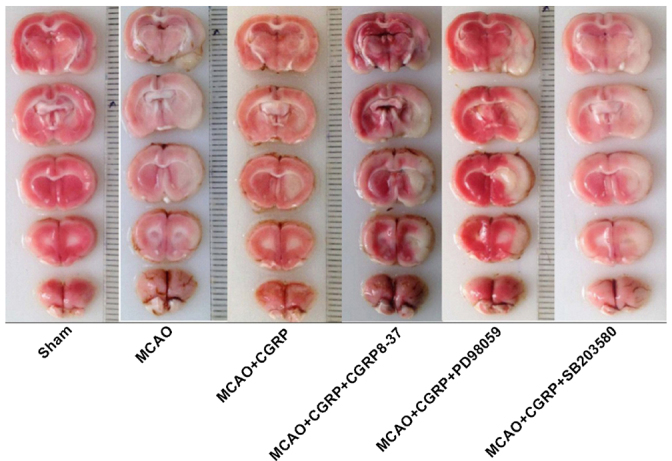
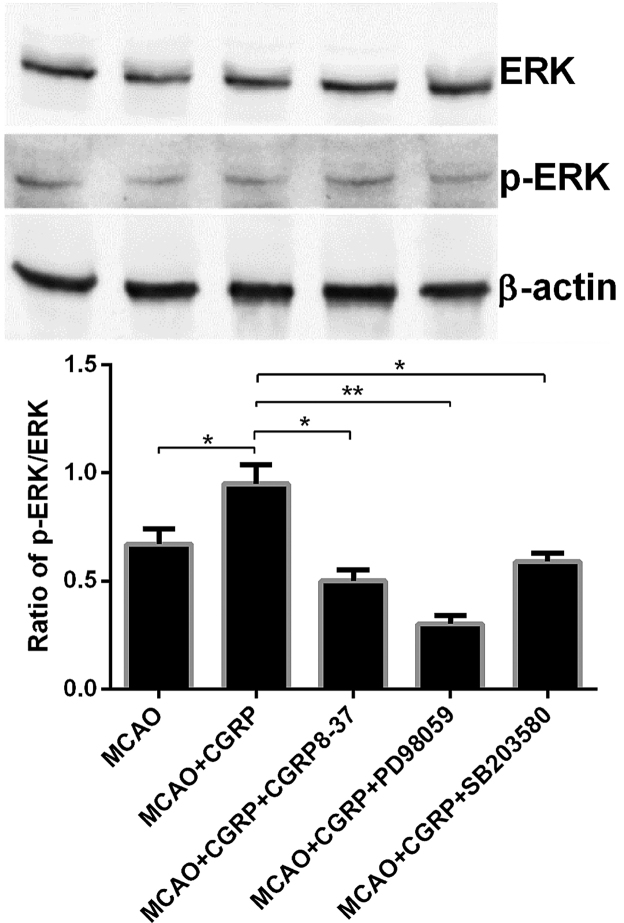
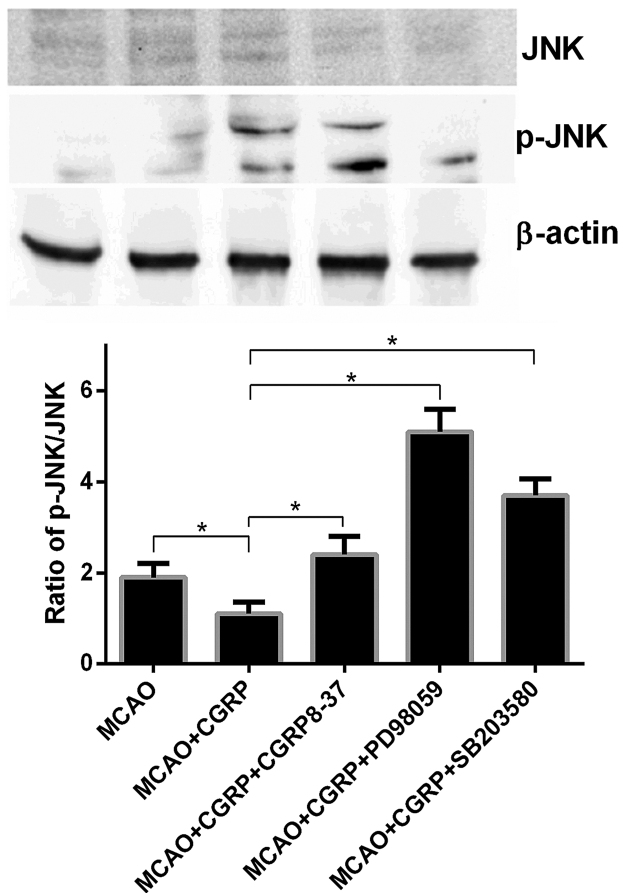
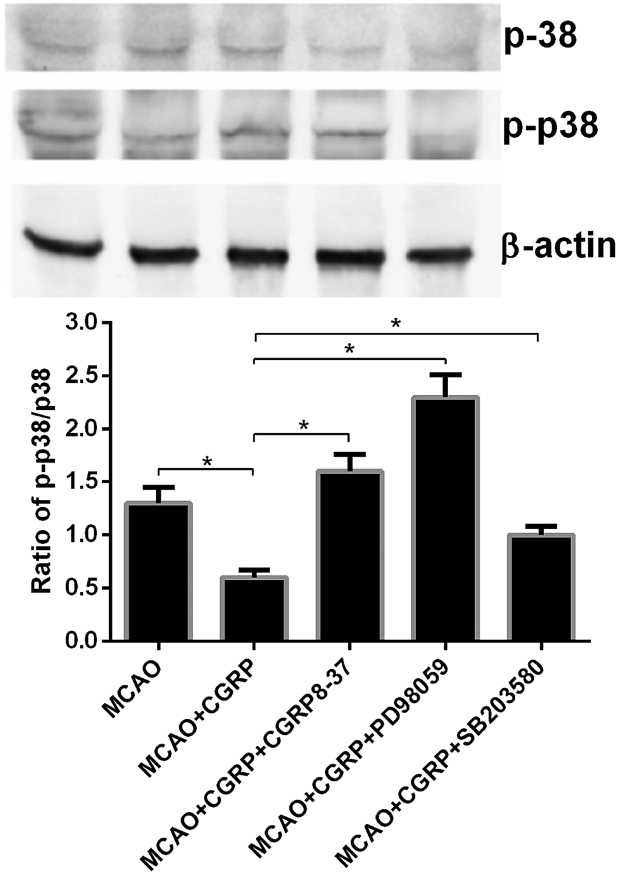
The aim of the present study was to investigate the protective function and underlying mechanism of calcitonin gene-related peptide (CGRP) on cerebral ischemia/reperfusion damage in rats. Adult male Wistar rats were selected for the establishment of an ischemia/reperfusion injury model through the application of a middle cerebral artery occlusion. Animals were randomly divided into 6 groups of 24 animals. Drugs were administered according to the design of each group; animals were administered CGRP, CGRP8-37, PD98059 and SB20358. The neurobehavioral scores of the rat cerebral ischemia model in each group were calculated. The infarction range of the rat brain tissues was observed by 2,3,5-triphenyltetrazolium chloride staining. The expression levels of three proteins, phosphorylated c-Jun N-terminal kinase (JNK)/JNK, phosphorylated extracellular signal-regulated protein kinase (ERK)/ERK and p-p38/p38, in the mitogen-activated protein kinase (MAPK) pathway in the brain tissues was detected by western blotting. The results showed that CGRP could improve the neurobehavioral function of the ischemic rats and reduce the infarction range. Western blotting results confirmed that the function of the CGRP was mediated mainly through the reduction of the JNK and p38 phosphorylation and the promotion of ERK phosphorylation. Therefore, the present study confirmed that an increase in the exogenous CRGP could effectively improve ischemia/reperfusion injury of the brain tissue. The mechanisms of action were achieved through a reduction in JNK and p38 phosphorylation and an increase in ERL phosphorylation in the MAPK pathway. These mechanisms were interdependent.
本研究的目的是探讨降钙素基因相关肽(CGRP)对大鼠脑缺血/再灌注损伤的保护作用及其潜在机制。选用成年雄性Wistar大鼠,通过大脑中动脉闭塞法建立缺血/再灌注损伤模型。将动物随机分为6组,每组24只。根据每组设计给药;给动物注射CGRP、CGRP8 - 37、PD98059和SB20358。计算每组大鼠脑缺血模型的神经行为学评分。通过2,3,5 - 氯化三苯基四氮唑染色观察大鼠脑组织的梗死范围。采用蛋白质免疫印迹法检测脑组织丝裂原活化蛋白激酶(MAPK)途径中三种蛋白,即磷酸化c - Jun氨基末端激酶(JNK)/JNK、磷酸化细胞外信号调节蛋白激酶(ERK)/ERK和p - p38/p38的表达水平。结果表明,CGRP可改善缺血大鼠的神经行为功能,缩小梗死范围。蛋白质免疫印迹结果证实,CGRP的作用主要是通过降低JNK和p38的磷酸化水平以及促进ERK的磷酸化来介导的。因此,本研究证实,外源性CGRP增加可有效改善脑组织的缺血/再灌注损伤。其作用机制是通过降低MAPK途径中JNK和p38的磷酸化水平以及增加ERK的磷酸化水平来实现的。这些机制相互依存。