Lan Xiao, Zhang Xin, Zhou Guo-Ping, Wu Chun-Xiao, Li Chun, Xu Xiu-Hong
School of Traditional Chinese Medicine, Southern Medical University, Guangzhou, Guangdong Province, China.
College of Acupuncture, Moxibustion and Tuina, Hunan University of Chinese Medicine, Changsha, Hunan Province, China.
Neural Regen Res. 2017 Mar;12(3):409-416. doi: 10.4103/1673-5374.202944.
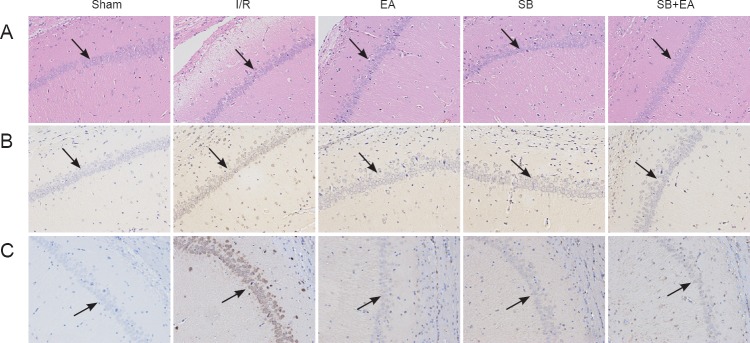
Electroacupuncture attenuates cerebral hypoxia and neuronal apoptosis induced by cerebral ischemia/reperfusion injury. To further identify the involved mechanisms, we assumed that electroacupuncture used to treat cerebral ischemia/reperfusion injury was associated with the p38 mitogen-activated protein kinase (MAPK) signaling pathway. We established rat models of cerebral ischemia/reperfusion injury using the modified Zea-Longa's method. At 30 minutes before model establishment, p38 MAPK blocker SB20358 was injected into the left lateral ventricles. At 1.5 hours after model establishment, electroacupuncture was administered at acupoints of (LU5), (LI4), (ST36), and (SP6) for 20 minutes in the affected side. Results showed that the combination of EA and SB20358 injection significantly decreased neurologic impairment scores, but no significant differences were determined among different interventional groups. Hematoxylin-eosin staining also showed reduced brain tissue injuries. Compared with the SB20358 group, the cells were regularly arranged, the structures were complete, and the number of viable neurons was higher in the SB20358 + electroacupuncture group. Terminal deoxynucleotidyl transferase (TdT)-mediated dUTP nick-end labeling assay showed a decreased apoptotic index in each group, with a significant decrease in the SB20358 + electroacupuncture group. Immunohistochemistry revealed reduced phosphorylated p38 expression at 3 days in the electroacupuncture group and SB20358 + electroacupuncture group compared with the ischemia/reperfusion group. There was no significant difference in phosphorylated p38 expression between the ischemia/reperfusion group and SB20358 group. These findings confirmed that the electroacupuncture effects on mitigating cerebral ischemia/reperfusion injury are possibly associated with the p38 MAPK signaling pathway. A time period of 3 days could promote the repair of ischemic cerebral nerves.
电针可减轻脑缺血/再灌注损伤诱导的脑缺氧和神经元凋亡。为进一步确定其中涉及的机制,我们推测用于治疗脑缺血/再灌注损伤的电针与p38丝裂原活化蛋白激酶(MAPK)信号通路有关。我们采用改良的Zea-Longa法建立大鼠脑缺血/再灌注损伤模型。在模型建立前30分钟,将p38 MAPK阻断剂SB20358注入左侧脑室。在模型建立后1.5小时,在患侧的 (肺经5穴)、 (大肠经4穴)、 (胃经36穴)和 (脾经6穴)穴位进行电针治疗20分钟。结果显示,电针与注射SB20358联合应用显著降低了神经功能缺损评分,但不同干预组之间未发现显著差异。苏木精-伊红染色也显示脑组织损伤减轻。与SB20358组相比,SB20358 + 电针组细胞排列规则,结构完整,存活神经元数量更多。末端脱氧核苷酸转移酶(TdT)介导的dUTP缺口末端标记法显示每组凋亡指数均降低,SB20358 + 电针组显著降低。免疫组织化学显示,与缺血/再灌注组相比,电针组和SB20358 + 电针组在第3天时磷酸化p38表达降低。缺血/再灌注组和SB20358组之间磷酸化p38表达无显著差异。这些结果证实,电针减轻脑缺血/再灌注损伤的作用可能与p38 MAPK信号通路有关。3天的时间段可促进缺血性脑神经的修复。