Amsbaugh Mark, Pan Jianmin, Yusuf Mehran B, Dragun Anthony, Dunlap Neal, Guan Timothy, Boling Warren, Rai Shesh, Woo Shiao
Radiation Oncology, University of Louisville.
JG Brown Cancer Center, University of Louisville.
Cureus. 2016 Apr 27;8(4):e587. doi: 10.7759/cureus.587.
Our aim was to identify a dose-volume response relationship for brain metastases treated with frameless stereotactic radiosurgery (SRS).
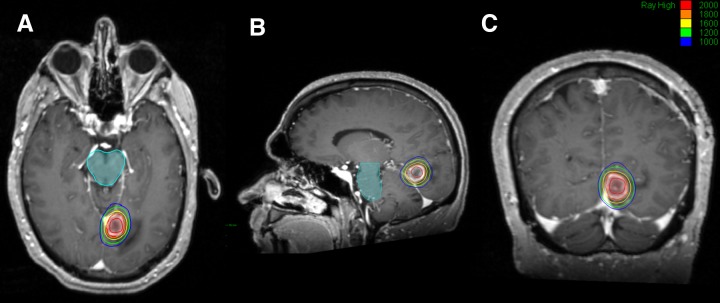
We reviewed patients who underwent frameless single-fraction linear accelerator SRS for brain metastases between 2007 and 2013 from an institutional database. Proportional hazards modeling was used to identify predictors of outcome. A ratio of maximum lesion dose per mm-diameter (Gy/mm) was constructed to establish a dose-volume relationship.
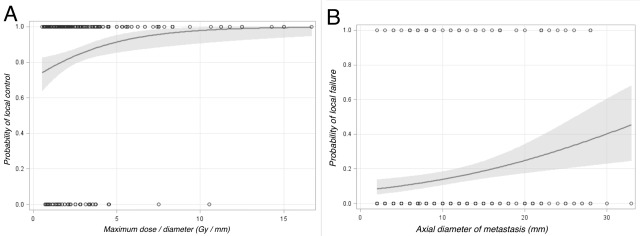
There were 316 metastases evaluated in 121 patients (2 - 33 mm in the largest diameter). The median peripheral dose was 18.0 Gy (range: 10.0 - 24.0 Gy). Local control was 84.8% for all lesions and was affected by location, peripheral dose, maximum dose, and lesion size (p values < 0.050). A dose-volume response relationship was constructed using the maximum dose and lesion size. A unit increase in Gy/mm was associated with decreased local failure (p = 0.005). Local control of 80%, 85%, and 90% corresponded to maximum doses per millimeter of 1.67 Gy/mm, 2.86 Gy/mm, and 4.4 Gy/mm, respectively. Toxicity was uncommon and only 1.0% of lesions developed radionecrosis requiring surgery.
For brain metastases less than 3 cm, a dose-volume response relationship exists between maximum radiosurgical dose and lesion size, which is predictive of local control.
我们的目的是确定无框架立体定向放射外科(SRS)治疗脑转移瘤的剂量-体积反应关系。
我们从机构数据库中回顾了2007年至2013年间接受无框架单分割直线加速器SRS治疗脑转移瘤的患者。采用比例风险模型确定预后的预测因素。构建每毫米直径最大病变剂量(Gy/mm)的比值以建立剂量-体积关系。
121例患者共评估了316个转移瘤(最大直径2 - 33mm)。中位周边剂量为18.0Gy(范围:10.0 - 24.0Gy)。所有病变的局部控制率为84.8%,受位置、周边剂量、最大剂量和病变大小影响(p值<0.050)。使用最大剂量和病变大小构建剂量-体积反应关系。Gy/mm每增加一个单位,局部失败率降低(p = 0.005)。局部控制率达到80%、85%和90%时,每毫米的最大剂量分别对应1.67Gy/mm、2.86Gy/mm和4.4Gy/mm。毒性不常见,仅1.0%的病变发生放射性坏死需要手术治疗。
对于直径小于3cm的脑转移瘤,最大放射外科剂量与病变大小之间存在剂量-体积反应关系,可预测局部控制情况。