Chiu Hui-Wen, Yeh Ya-Ling, Wang Yi-Ching, Huang Wei-Jan, Ho Sheng-Yow, Lin Pinpin, Wang Ying-Jan
Division of Nephrology, Department of Internal Medicine, Shuang Ho Hospital, Taipei Medical University, Taipei, Taiwan.
Graduate Institute of Clinical Medicine, College of Medicine, Taipei Medical University, Taipei, Taiwan.
Mol Cancer. 2016 Jun 10;15(1):46. doi: 10.1186/s12943-016-0531-5.
Triple-negative breast cancer (TNBC) is the most aggressive and invasive of the breast cancer subtypes. TNBC is a challenging disease that lacks targets for treatment. Histone deacetylase inhibitors (HDACi) are a group of targeted anticancer agents that enhance radiosensitivity. Bcl-2/adenovirus E1B 19 kDa protein-interacting protein 3 (BNIP3) is a member of the Bcl-2 subfamily. BNIP3 is not found in normal breast tissue but is up-regulated in breast cancer. In the present study, we investigated the anti-cancer effects of a newly developed HDACi, YCW1, combined with ionizing radiation (IR) in TNBC in vitro and in an orthotopic mouse model. Furthermore, we examined the relationship between autophagy and BNIP3.
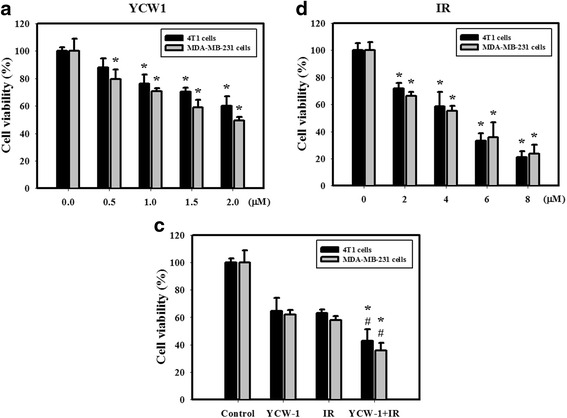
Trypan blue exclusion was used to investigate the viability of 4 T1 (a mouse TNBC cell line) and MDA-MB-231 cells (a human TNBC cell line) following combined YCW1 and IR treatment. Flow cytometry was used to determine apoptosis and autophagy. The expression levels of BNIP3, endoplasmic reticulum (ER) stress- and autophagic-related proteins were measured using western blot analysis. An orthotopic mouse model was used to investigate the in vivo effects of YCW1 and IR alone and in combination. Tumor volumes were monitored using a bioluminescence-based IVIS Imaging System 200.
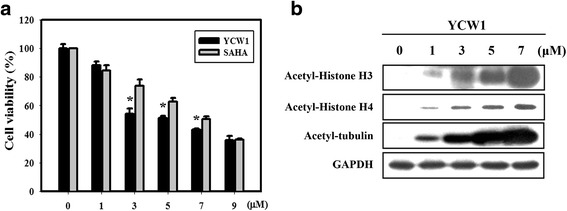
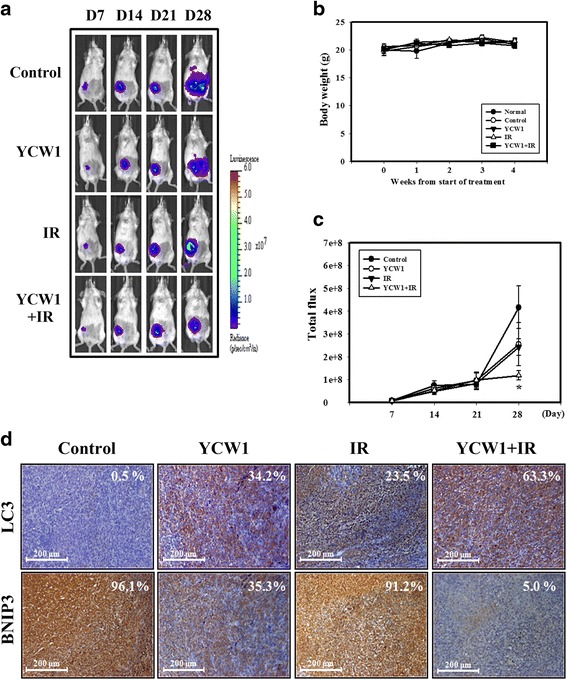
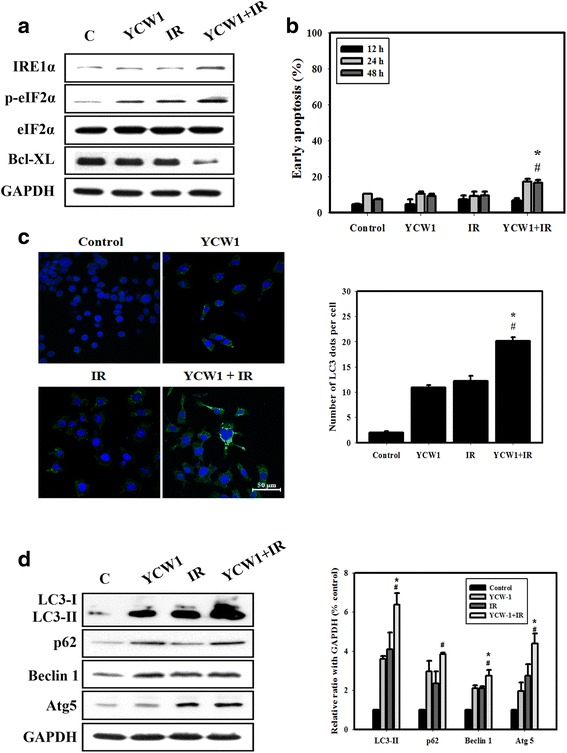
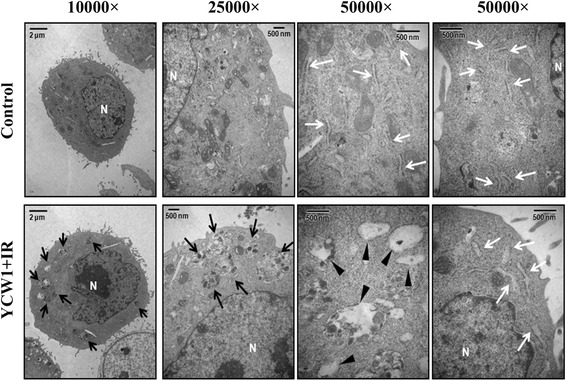
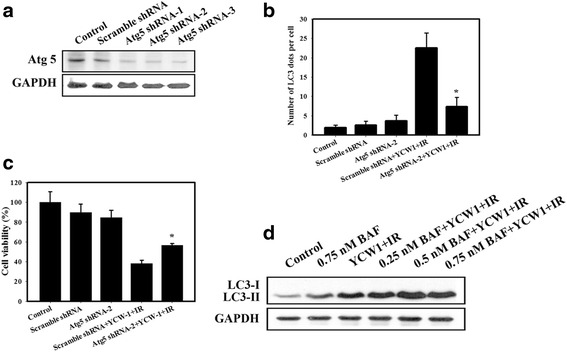
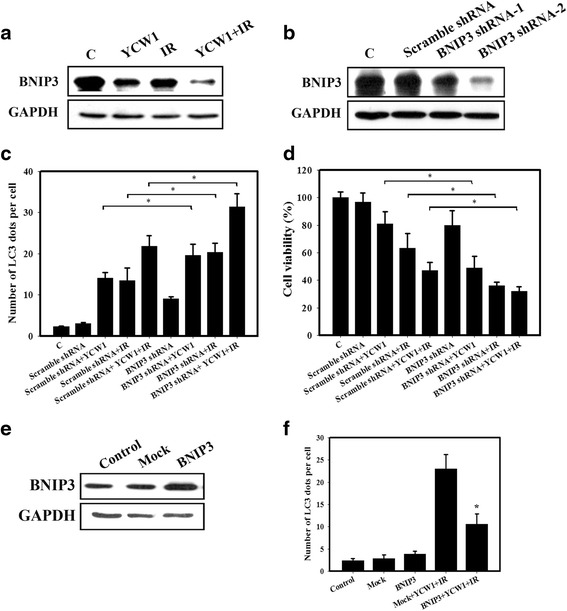
We found that YCW1 significantly enhanced toxicity in 4 T1 cells compared with suberoylanilide hydroxamic acid (SAHA), which was the first HDACi approved by the Food and Drug Administration for clinical use in cancer patients. The combined treatment of YCW1 and IR enhanced cytotoxicity by inducing ER stress and increasing autophagy induction. Additionally, the combined treatment caused autophagic flux and autophagic cell death. Furthermore, the expression level of BNIP3 was significantly decreased in cells following combined treatment. The downregulation of BNIP3 led to a significant increase in autophagy and cytotoxicity. The combined anti-tumor effects of YCW1 and IR were also observed in an orthotopic mouse model; combination therapy resulted in a significant increase in autophagy and decreased tumor tissue expression of BNIP3 in the tumor tissue.
These data support the possibility of using a combination of HDACi and IR in the treatment of TNBC. Moreover, BNIP3 may be a potential target protein for TNBC treatment.
三阴性乳腺癌(TNBC)是乳腺癌亚型中最具侵袭性的。TNBC是一种缺乏治疗靶点的挑战性疾病。组蛋白去乙酰化酶抑制剂(HDACi)是一类可增强放射敏感性的靶向抗癌药物。Bcl-2/腺病毒E1B 19 kDa蛋白相互作用蛋白3(BNIP3)是Bcl-2亚家族的成员。在正常乳腺组织中未发现BNIP3,但在乳腺癌中其表达上调。在本研究中,我们研究了新开发的HDACi YCW1与电离辐射(IR)联合应用于体外TNBC及原位小鼠模型中的抗癌作用。此外,我们还研究了自噬与BNIP3之间的关系。
采用台盼蓝排斥法研究联合YCW1和IR处理后4T1(一种小鼠TNBC细胞系)和MDA-MB-231细胞(一种人TNBC细胞系)的活力。采用流式细胞术检测细胞凋亡和自噬。使用蛋白质免疫印迹分析检测BNIP3、内质网(ER)应激和自噬相关蛋白的表达水平。采用原位小鼠模型研究YCW1和IR单独及联合应用的体内效应。使用基于生物发光的IVIS Imaging System 200监测肿瘤体积。
我们发现,与伏立诺他(SAHA)相比,YCW1显著增强了对4T1细胞的毒性,SAHA是美国食品药品监督管理局批准用于癌症患者临床治疗的首个HDACi。YCW1与IR联合治疗通过诱导ER应激和增加自噬诱导来增强细胞毒性。此外,联合治疗导致自噬通量和自噬性细胞死亡。此外,联合治疗后细胞中BNIP3的表达水平显著降低。BNIP3的下调导致自噬和细胞毒性显著增加。在原位小鼠模型中也观察到了YCW1与IR联合的抗肿瘤作用;联合治疗导致自噬显著增加,肿瘤组织中BNIP3的表达降低。
这些数据支持HDACi与IR联合用于TNBC治疗的可能性。此外,BNIP3可能是TNBC治疗的潜在靶点蛋白。