Roux Perrine, Rojas Castro Daniela, Ndiaye Khadim, Debrus Marie, Protopopescu Camélia, Le Gall Jean-Marie, Haas Aurélie, Mora Marion, Spire Bruno, Suzan-Monti Marie, Carrieri Patrizia
INSERM U912 (SESSTIM), Marseille, France.
Aix Marseille Université, IRD, UMR-S912, Marseille, France.
PLoS One. 2016 Jun 13;11(6):e0157062. doi: 10.1371/journal.pone.0157062. eCollection 2016.
The community-based AERLI intervention provided training and education to people who inject drugs (PWID) about HIV and HCV transmission risk reduction, with a focus on drug injecting practices, other injection-related complications, and access to HIV and HCV testing and care. We hypothesized that in such a population where HCV prevalence is very high and where few know their HCV serostatus, AERLI would lead to increased HCV testing.
The national multisite intervention study ANRS-AERLI consisted in assessing the impact of an injection-centered face-to-face educational session offered in volunteer harm reduction (HR) centers ("with intervention") compared with standard HR centers ("without intervention"). The study included 271 PWID interviewed on three occasions: enrolment, 6 and 12 months. Participants in the intervention group received at least one face-to-face educational session during the first 6 months.
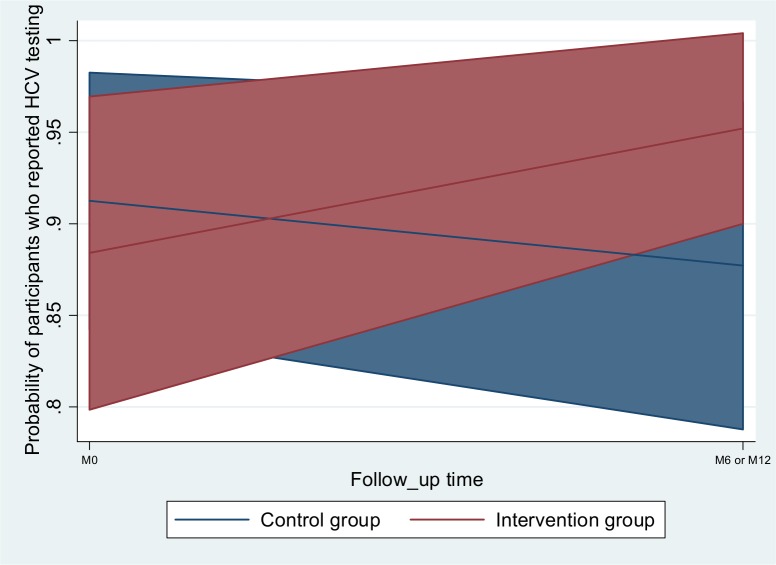
The primary outcome of this analysis was reporting to have been tested for HCV during the previous 6 months. Statistical analyses used a two-step Heckman approach to account for bias arising from the non-randomized clustering design. This approach identified factors associated with HCV testing during the previous 6 months.
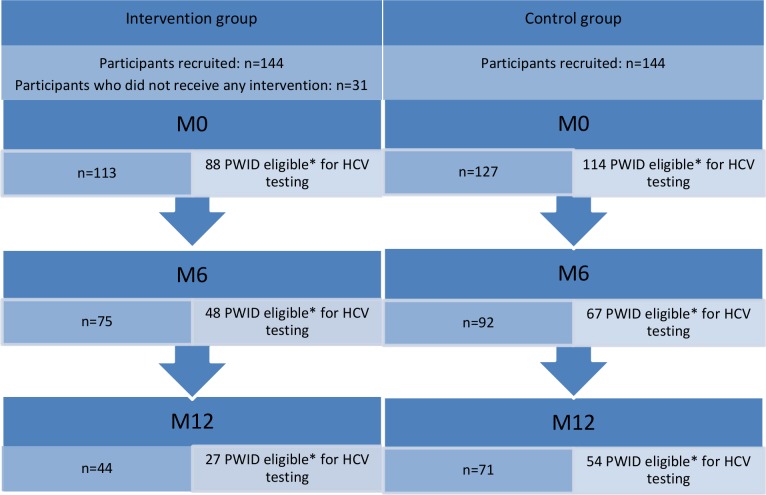
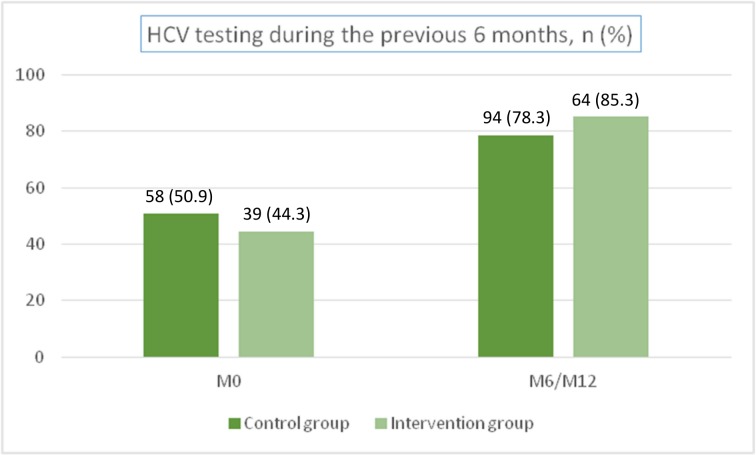
Of the 271 participants, 127 and 144 were enrolled in the control and intervention groups, respectively. Of the latter, 113 received at least one educational session. For the present analysis, we selected 114 and 88 participants eligible for HCV testing in the control and intervention groups, respectively. In the intervention group, 44% of participants reported having being tested for HCV during the previous 6 months at enrolment and 85% at 6 months or 12 months. In the control group, these percentages were 51% at enrolment and 78% at 12 months. Multivariable analyses showed that participants who received at least one educational session during follow-up were more likely to report HCV testing, compared with those who did not receive any intervention (95%[CI] = 4.13[1.03;16.60]).
The educational intervention AERLI had already shown efficiency in reducing HCV at-risk practices and associated cutaneous complications and also seems to have a positive impact in increasing HCV testing in PWID.
基于社区的AERLI干预项目为注射吸毒者(PWID)提供了关于降低艾滋病毒和丙型肝炎病毒传播风险的培训和教育,重点关注吸毒注射行为、其他与注射相关的并发症,以及艾滋病毒和丙型肝炎病毒检测与护理服务的获取。我们推测,在这样一个丙型肝炎病毒感染率非常高且很少有人知道自己丙型肝炎病毒血清学状态的人群中,AERLI干预将导致丙型肝炎病毒检测率增加。
全国多中心干预研究ANRS - AERLI包括评估在志愿者减害(HR)中心提供的以注射为中心的面对面教育课程(“有干预”)与标准HR中心(“无干预”)相比的影响。该研究纳入了271名注射吸毒者,分三次进行访谈:入组时、6个月和12个月时。干预组的参与者在最初6个月内至少接受了一次面对面教育课程。
该分析的主要结果是报告在过去6个月内进行了丙型肝炎病毒检测。统计分析采用两步Heckman方法来处理非随机聚类设计产生的偏差。该方法确定了与过去6个月内丙型肝炎病毒检测相关的因素。
在271名参与者中,分别有127名和144名被纳入对照组和干预组。在干预组中,113人至少接受了一次教育课程。在本次分析中,我们分别从对照组和干预组中选择了114名和88名符合丙型肝炎病毒检测条件的参与者。在干预组中,44%的参与者报告在入组时的过去6个月内进行了丙型肝炎病毒检测,在6个月或12个月时这一比例为85%。在对照组中,这些比例在入组时为51%,在12个月时为78%。多变量分析显示,与未接受任何干预的参与者相比,在随访期间至少接受了一次教育课程的参与者更有可能报告进行了丙型肝炎病毒检测(95%[CI]=4.13[1.03;16.60])。
教育干预AERLI已显示出在减少丙型肝炎病毒高危行为及相关皮肤并发症方面的效果,并且似乎对增加注射吸毒者的丙型肝炎病毒检测也有积极影响。