Castro Rodolfo, Ribeiro-Alves Marcelo, Corrêa Renato Girade, Derrico Monica, Lemos Katia, Grangeiro Jose Roberto, Jesus Beto de, Pires Denise, Veloso Valdilea G, Grinsztejn Beatriz
Instituto Nacional de Infectologia Evandro Chagas, Fundação Oswaldo Cruz, Rio de Janeiro, RJ, Brazil.
Instituto de Saúde Coletiva, Universidade Federal do Estado do Rio de Janeiro, Rio de Janeiro, RJ, Brazil.
PLoS One. 2016 Jun 14;11(6):e0157309. doi: 10.1371/journal.pone.0157309. eCollection 2016.
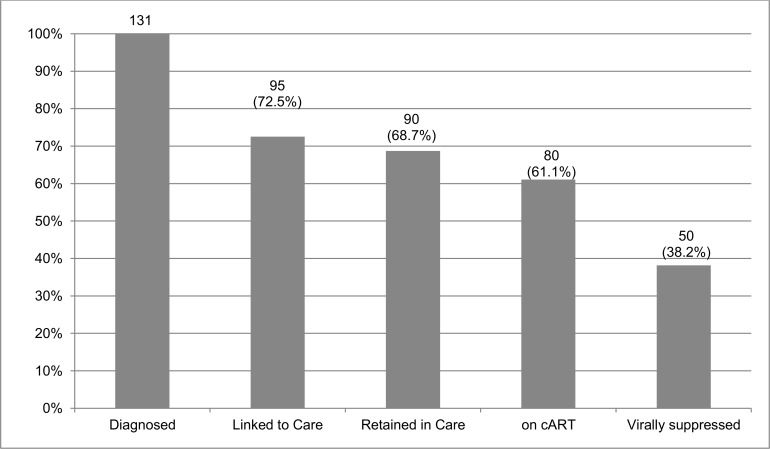
Brazil has a concentrated HIV epidemic and men who have sex with men (MSM) are disproportionately affected. Yet, no data is available on the HIV care cascade for this population. This study aimed to assess the HIV care cascade among MSM newly diagnosed through innovative testing strategies in Rio de Janeiro. Data from 793 MSM and travestites/transgender women (transwomen) tested for HIV at a non-governmental LGBT organization and a mobile testing unit located at a gay friendly venue were analyzed. A 12-month-after-HIV-diagnosis-censored cohort was established using CD4, viral load and combination antiretroviral therapy (cART) longitudinal data from those diagnosed with HIV. A cross-sectional HIV care cascade was built using this data. The relative risks of achieving each cascade-stage were estimated using generalized linear models according to age, self-declared skin-color, education, history of sexually transmitted diseases (STD), drug use and prior HIV testing. From Jan-2013 to Jan-2014, 793 MSM and transwomen were tested, 131 (16.5%) were HIV-infected. As of January 2015, 95 (72.5%) were linked to HIV care, 90 (68.7%) were retained in HIV care, 80 (61.1%) were on cART, and 50 (38.2%) were virally suppressed one year after HIV diagnosis. Being non-white (Relative risk [lower bound; upper bound of 95% confidence interval] = 1.709 [1.145; 2.549]) and having a prior HIV-test (1.954 [1.278; 2.986]) were associated with an HIV-positive diagnosis. A higher linkage (2.603 [1.091; 6.211]) and retention in care (4.510 [1.880; 10.822]) were observed among those who were older than 30 years of age. Using community-based testing strategies, we were able to access a high-risk MSM population and a small sample of transwomen. Despite universal care coverage and the test-and-treat policy adopted in Brazil, the MSM cascade of care indicates that strategies to increase linkage to care and prompt cART initiation targeted to these populations are critically needed. Interventions targeting non-white and young MSM should be prioritized.
巴西的艾滋病疫情呈集中态势,男男性行为者(MSM)受影响的比例过高。然而,目前尚无该人群艾滋病治疗连续过程的数据。本研究旨在评估通过里约热内卢创新检测策略新诊断出的男男性行为者中的艾滋病治疗连续过程。对在一个非政府性的 LGBT 组织以及一个位于同性恋友好场所的移动检测单位接受艾滋病检测的 793 名男男性行为者、易装癖者/变性女性(跨性别女性)的数据进行了分析。利用那些被诊断为艾滋病病毒感染者的 CD4、病毒载量和联合抗逆转录病毒疗法(cART)纵向数据,建立了一个艾滋病诊断后 12 个月截尾队列。利用这些数据构建了一个横断面艾滋病治疗连续过程。根据年龄、自我宣称的肤色、教育程度、性传播疾病(STD)史、药物使用情况和先前的艾滋病检测情况,使用广义线性模型估计达到每个连续阶段的相对风险。从 2013 年 1 月至 2014 年 1 月,对 793 名男男性行为者和跨性别女性进行了检测,其中 131 人(16.5%)感染了艾滋病病毒。截至 2015 年 1 月,95 人(72.5%)与艾滋病治疗机构建立了联系,90 人(68.7%)继续接受艾滋病治疗,80 人(61.1%)接受了联合抗逆转录病毒疗法,50 人(38.2%)在艾滋病诊断后一年病毒得到抑制。非白人(相对风险[95%置信区间的下限;上限]=1.709[1.145;2.549])和先前接受过艾滋病检测(1.954[1.278;2.986])与艾滋病病毒阳性诊断相关。在 30 岁以上的人群中,观察到更高的联系率(2.603[1.091;6.211])和治疗保留率(4.510[1.880;10.822])。通过基于社区的检测策略,我们能够接触到高危男男性行为者人群和一小部分跨性别女性样本。尽管巴西实行了全民医疗覆盖和检测即治疗政策,但男男性行为者的治疗连续过程表明,迫切需要针对这些人群增加与治疗机构联系并促使其及时开始接受联合抗逆转录病毒疗法的策略。应优先针对非白人和年轻男男性行为者进行干预。