MacCarthy Sarah, Brignol Sandra, Reddy Manasa, Nunn Amy, Dourado Ines
Rand Corporation, 1776 Main Street, Santa Monica, CA 90407, USA.
BMC Public Health. 2014 Dec 22;14:1313. doi: 10.1186/1471-2458-14-1313.
Late presentation to testing, treatment and continued care has detrimental impacts on the health of HIV-positive individuals as well as their sexual partners' health. Men who have sex with men (MSM) experience disproportionately high rates of HIV both globally and in Brazil. However, the factors that inhibit linkage to care among MSM remain unclear.
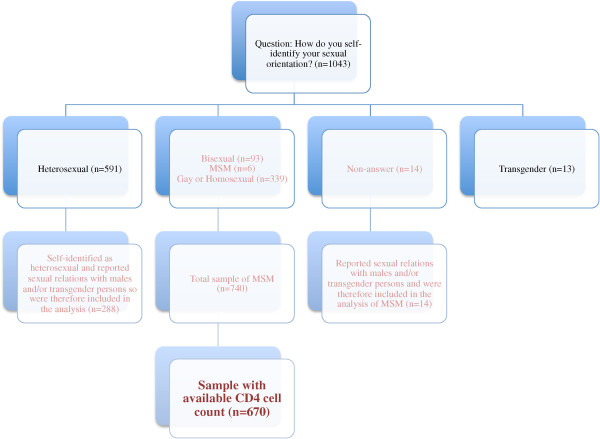
We conducted a cross-sectional study of HIV-positive MSM (n = 740) enrolled in HIV/AIDS services in a large urban center of Brazil from August 2010 to June 2011. Descriptive, bivariate and multivariate statistics were conducted using STATA 12 to examine the relationship between a range of variables and late presentation, defined as having a first CD4 count <350 cells/mm3.
Within the sample, the prevalence of LP was 63.1%. Men who self-identified as heterosexual (AOR 1.54 and 95% CI 1.08 - 2.20) compared to men who self-identified as homosexual and bisexual were at increased odds of late presentation. Additionally, men age 30 and older (AOR 1.56, 95% CI 1.01 - 2.43) compared to individuals age 18-29 experienced increased odds of late presentation among MSM.
The prevalence of LP in this population was higher than noted in the global literature on LP among MSM. Heterosexual men and older age individuals experienced substantial barriers to HIV care. The stigma around same-sex behaviors and the current focus of HIV prevention and treatment campaigns on younger age individuals may limit patients' and providers' awareness of the risk for HIV and access to available services. In addition to addressing HIV-specific barriers to care, developing effective strategies to reduce late presentation in Brazil will require addressing social factors - such as stigma against diverse sexualities - to concretely identify and eliminate barriers to available services. Only in so doing can we make currently invisible people, visible.
检测、治疗和持续护理的延迟对艾滋病毒阳性个体的健康及其性伴侣的健康产生不利影响。在全球和巴西,男男性行为者(MSM)感染艾滋病毒的比例都过高。然而,抑制男男性行为者获得护理的因素仍不清楚。
我们对2010年8月至2011年6月在巴西一个大型城市中心参加艾滋病毒/艾滋病服务的740名艾滋病毒阳性男男性行为者进行了横断面研究。使用STATA 12进行描述性、双变量和多变量统计,以检查一系列变量与延迟就诊之间的关系,延迟就诊定义为首次CD4细胞计数<350个细胞/mm³。
在样本中,延迟就诊的患病率为63.1%。与自我认同为同性恋和双性恋的男性相比,自我认同为异性恋的男性延迟就诊的几率更高(调整后比值比[AOR]为1.54,95%置信区间[CI]为1.08 - 2.20)。此外,与18 - 29岁的个体相比,30岁及以上的男性在男男性行为者中延迟就诊的几率更高(AOR为1.56,95%CI为1.01 - 2.43)。
该人群中延迟就诊的患病率高于全球男男性行为者延迟就诊文献中所记载的患病率。异性恋男性和年龄较大的个体在获得艾滋病毒护理方面面临重大障碍。围绕同性行为的污名以及当前艾滋病毒预防和治疗运动对年轻个体的关注,可能会限制患者和提供者对艾滋病毒风险的认识以及获得现有服务的机会。除了解决特定于艾滋病毒的护理障碍外,在巴西制定有效的策略以减少延迟就诊将需要解决社会因素,例如对不同性取向的污名,以具体识别和消除获得现有服务的障碍。只有这样做,我们才能让目前不被关注的人群得到关注。